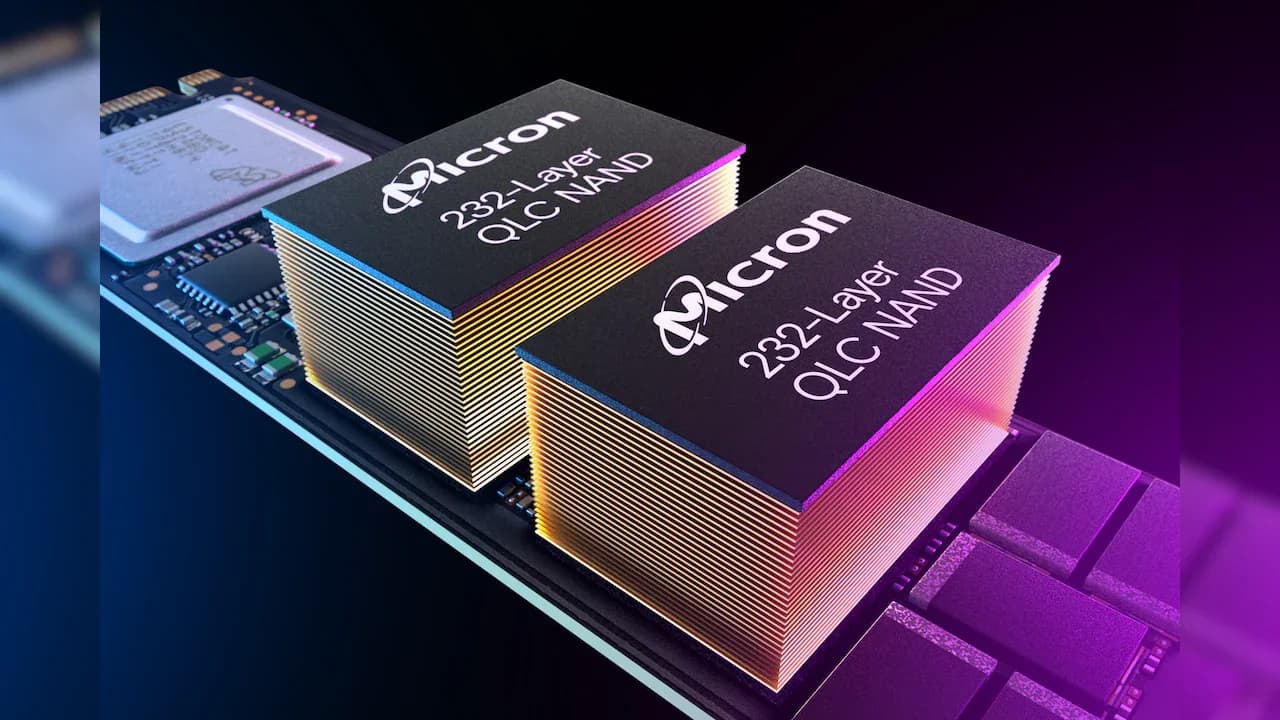
US futures advanced significantly on Thursday, with Dow Jones futures rising 0.25% to trade near 52,350, S&P 500 futures up 0.70% near 7,490, and Nasdaq 100 futures surging 2.25% to trade near 30,180. The rally was driven by strong semiconductor outlooks that have revived interest in the artificial intelligence sector, marking a turnaround from Wednesday's mixed session where heavyweight tech losses weighed on indices. Micron Technology soared 19% after its fiscal Q3 results comfortably beat expectations, with EPS coming in at $25.11 versus forecasts of $20.78 and revenue surging to $41.46 billion from $9.3 billion a year ago, well above expectations of $35.85 billion. Qualcomm also rallied 10% after doubling its fiscal 2029 non-handset revenue forecast to $40 billion from $22 billion previously, with the company also forecasting $15 billion in data-center revenue, reinforcing confidence that AI demand is broadening beyond GPUs. The momentum rippled across the chip industry, with memory stocks rebounding strongly, with SanDisk rising 18% and Western Digital gaining 13%, while IBM traded 3% higher after unveiling chip technology capable of producing processors smaller than one nanometre.

Asian markets delivered a strong performance on Thursday, with South Korea's KOSPI surging 5.7% and Japan's Nikkei 225 rallying 5% as upbeat forecasts from Micron Technology Inc revived optimism over artificial intelligence spending. According to Investing.com, the regional rebound tracked gains in U.S. stock futures after Micron delivered stronger-than-expected earnings and forecast robust demand for AI memory chips. Samsung Electronics rose 5.3% and SK Hynix surged more than 13%, helping propel the benchmark KOSPI index more than 5% higher as the world's best-performing major stock market this year continued its volatile, retail-driven AI rally. Japanese equities also benefited, with the Nikkei 225 climbing 4.6% to a record closing high of 72,366.34, as the rally spread rapidly through global markets. The strength came despite U.S. Core PCE data showing inflation rising to 3.4% year-on-year in May from 3.3%, while the monthly reading remained at 0.3%, which typically weighs on tech stocks but was overshadowed by the AI rally.
The rally was led by regional memory-chip makers, with Samsung Electronics ending 5.3% higher and SK Hynix closing up 13.9%, helping reverse part of the roughly $1.3 trillion rout in global technology stocks earlier this week. As reported by Investing.com, Japan's semiconductor equipment suppliers showed strong performance with Advantest Corp. climbing 14.9%, Tokyo Electron Ltd rising 8.1%, and Kioxia Holdings Corp gaining 13.1%. The rebound followed a steep selloff earlier this week on concerns over elevated technology valuations, with the gains driven by Micron's upbeat outlook underscoring resilient AI-related memory demand. European semiconductor companies joined the advance after Micron indicated that tight chip supplies could extend beyond 2027, with Dutch semiconductor equipment maker ASML Holding rising 5.1%, ASM International gaining 6.6%, BE Semiconductor Industries advancing 5.5%, Germany's Infineon Technologies adding 5.6%, and STMicroelectronics climbing 4%. The latest surge added more than $400 billion in market capitalization across semiconductor stocks, with Micron alone rising 19% in aftermarket trading after reporting quarterly earnings that beat analysts' expectations.
European markets opened on a positive note and extended gains throughout the trading session, with the pan-European STOXX 600 index rising 0.46% to 638.11 points by midday. According to The Economic Times, the gains were primarily driven by a surge in technology stocks following strong forecasts from US chipmakers. Technology stocks across Europe rose 2.4% this quarter—driven by chipmakers Infineon and STMicroelectronics with gains of 5.6% and 4.2%, respectively—while Siemens Energy added 1.5%. The rally was further supported by continued declines in oil prices and positive developments for European airlines. Europe's tech index was the biggest sectoral gainer, up more than 2%, bringing year-to-date gains to 21.4%, with ASML, Infineon, STMicroelectronics, and ASM International rising between 3% and 6% to provide main support for benchmark indices. The positive momentum in European markets mirrored the Asian rally, with investors responding to the renewed confidence in AI-related technology demand.
The AI rally was back in focus as US chipmakers Micron and Qualcomm unveiled strong forecasts, temporarily placating investor concerns that a rally in global AI-linked stocks had run too far. As reported by The Economic Times, these strong forecasts from major semiconductor companies helped ease worries about inflated valuations in the technology sector. Micron shares rose 19% in premarket trading after the company reported record quarterly revenue, record gross margins and record earnings, while also unveiling long-term agreements designed to lock in supplies of its high-bandwidth memory chips. The company announced it had secured $22 billion in customer commitments and signed 16 strategic customer agreements aimed at securing supply relationships over several years. Qualcomm shares climbed about 11% in premarket trading after the company forecast that its data-centre business could generate $15 billion in revenue by 2029, with Chief Financial Officer and Chief Operating Officer Akash Palkhiwala raising Qualcomm's fiscal 2029 revenue target for its non-handset businesses to $40 billion from $22 billion. Western Digital, SanDisk and Seagate Technology, which compete with Micron, also rose more than 8%, while Arm Holdings rose about 6%, Marvell added nearly 4%, and Broadcom climbed about 2%. Nvidia, the world's most valuable company, rose 1.2%, with the company's strong performance as a key AI processor manufacturer supporting the broader semiconductor rally.
Other Asian markets also participated in the rally, with Indonesia's Jakarta Stock Exchange Composite Index rallying 2.7%, Thailand's SET Index gaining 0.8%, the Philippines' PSEi Composite advancing 1.6%, and India's Nifty 50 rising 0.9%. However, Hong Kong's Hang Seng fell 1.8% as heavyweight banking stocks came under pressure amid ongoing regulatory audit scrutiny. According to Investing.com, investors also looked ahead to U.S. Personal Consumption Expenditures (PCE) inflation data, which is the Federal Reserve's preferred inflation gauge and expected to offer more cues on interest rates. Despite Thursday's rebound, the Nasdaq remained on track for its largest monthly decline since March 2025, while the Philadelphia Semiconductor Index was headed for its worst week since the Middle East conflict escalated earlier this year. Oil prices extended their declines as more tankers left the Strait of Hormuz, providing additional momentum to European markets. The PHLX Semiconductor Index remained high, up about 90% since the start of 2026, with Micron having risen more than 260% this year if excluding the late rally on Wednesday. South Korea's SK Hynix also said on Wednesday it plans to raise up to $29.4 billion through a U.S. stock market listing, boosting investor expectations of a reduced valuation gap between the chipmaker and its smaller U.S. rival Micron.