US Treasury yields ended a three-day decline on Wednesday as markets awaited the Federal Reserve's interest rate decision. The yield on the benchmark 10-year note inched 1.2 basis points higher to 4.616%, while the 2-year note, which most closely tracks interest rate expectations, rose 2.4 basis points to 4.301%. Both yields were on pace to snap their three-day streak of declines, with the longer-dated 30-year Treasury bond yield remaining broadly flat at 5.1%. Treasury yields have fallen from their July highs but are still set for a sharp monthly rise, with the 10-year and 30-year notes headed for their biggest monthly jump since March, while the 2-year yield is headed for a fifth straight monthly rise. Investors are increasingly betting on interest-rate hikes amid higher oil prices, which are raising concerns about inflation. On Wednesday, crude oil prices rose more than 3% after sliding for the previous three sessions, after the U.S. and Saudi Arabia launched strikes on Iran-backed groups in Iraq, raising concern about the conflict widening and further restricting energy flows from the region. Treasury yields are below this month's highs, but are still on course for a strong rise in July, as investors have ramped up their bets on interest-rate hikes, given the spike in oil prices and the possible impact on inflation.
US stock futures traded higher on Wednesday as investors looked past concerns over a potential Federal Reserve rate hike and awaited the central bank's policy decision. As of 4:44 p.m., S&P 500 futures were up 0.21% at 7,480, while Nasdaq futures gained 0.15% to 27,966.25, signalling a positive start for Wall Street despite lingering macroeconomic uncertainties. Treasury prices paused after a three-day rally, with investors reassessing the outlook for US monetary policy. Markets are currently pricing in around a 30% probability of a Federal Reserve interest rate hike, while the US dollar remained largely unchanged. The spotlight is firmly on the Federal Reserve's policy announcement, with traders watching for any changes in the central bank's outlook on inflation, growth and interest rates. While higher borrowing costs typically weigh on equities, persistent inflation has kept policymakers wary of easing monetary policy too soon, with rising energy prices also increasing the likelihood of another rate hike.
Crude oil prices surged more than 3% after sliding for the previous three sessions, after the U.S. and Saudi Arabia launched strikes on Iran-backed groups in Iraq, raising concerns about the conflict widening and further restricting energy flows from the region. A days-long lull in hostilities ended abruptly after Iran launched attacks on US forces stationed across the Middle East overnight, while the United States and Saudi Arabia targeted Tehran-backed militias in Iraq. The recent optimism over a possible diplomatic breakthrough between the United States and Iran, which had pushed crude prices nearly 14% lower from last week's peak, has faded following the latest escalation. Iran rejected Oman's proposal for a 50-50 joint management arrangement for the Strait of Hormuz, insisting that Tehran retain full control over the inbound shipping lane and part of the outbound route. Oil prices have surged over 20% in the last two weeks, with the latest surge following a three-day decline that saw global benchmark Brent settle at $84.09 on Tuesday, marking its biggest three-day decline since April 2020. A sustainable drop in oil prices may reduce inflationary risks associated with the Iran conflict, giving the US Federal Reserve room to raise rates initially before considering cuts in the future.
The Federal Reserve faces significant internal debate ahead of their rate decision, with money markets showing traders still see a near 32% chance of a 25-basis-point rate hike, according to the CME FedWatch Tool. Fed likely to keep interest rates unchanged as markets largely expect this outcome, though some investors remain cautious about that outcome. Traders are fully pricing in the chance of a September rate hike, along with a 71.2% chance of an additional hike by year-end, according to LSEG-compiled data. At its June policy meeting, the Federal Reserve left the federal funds rate unchanged at 3.50%-3.75% for a fourth consecutive meeting. BCA Research analysts noted that "The labour market is not contributing to inflation, leading inflation indicators point to further cooling, and inflation expectations are broadly anchored". "If the data continues to cool, peak hawkishness is behind us," BCA Research analysts said in a note. Data earlier this month showed US job growth slowed sharply in June and payroll gains for the prior two months were revised lower, pointing to a cooling labour market, while consumer inflation slowed more than expected in June as crude oil prices retreated. On Wednesday, Indian government bonds took a hit due to renewed U.S. airstrikes in the Middle East, escalating tensions in the Gulf region, with the rising crude prices posing challenges for India's inflation, fiscal health, and current account.
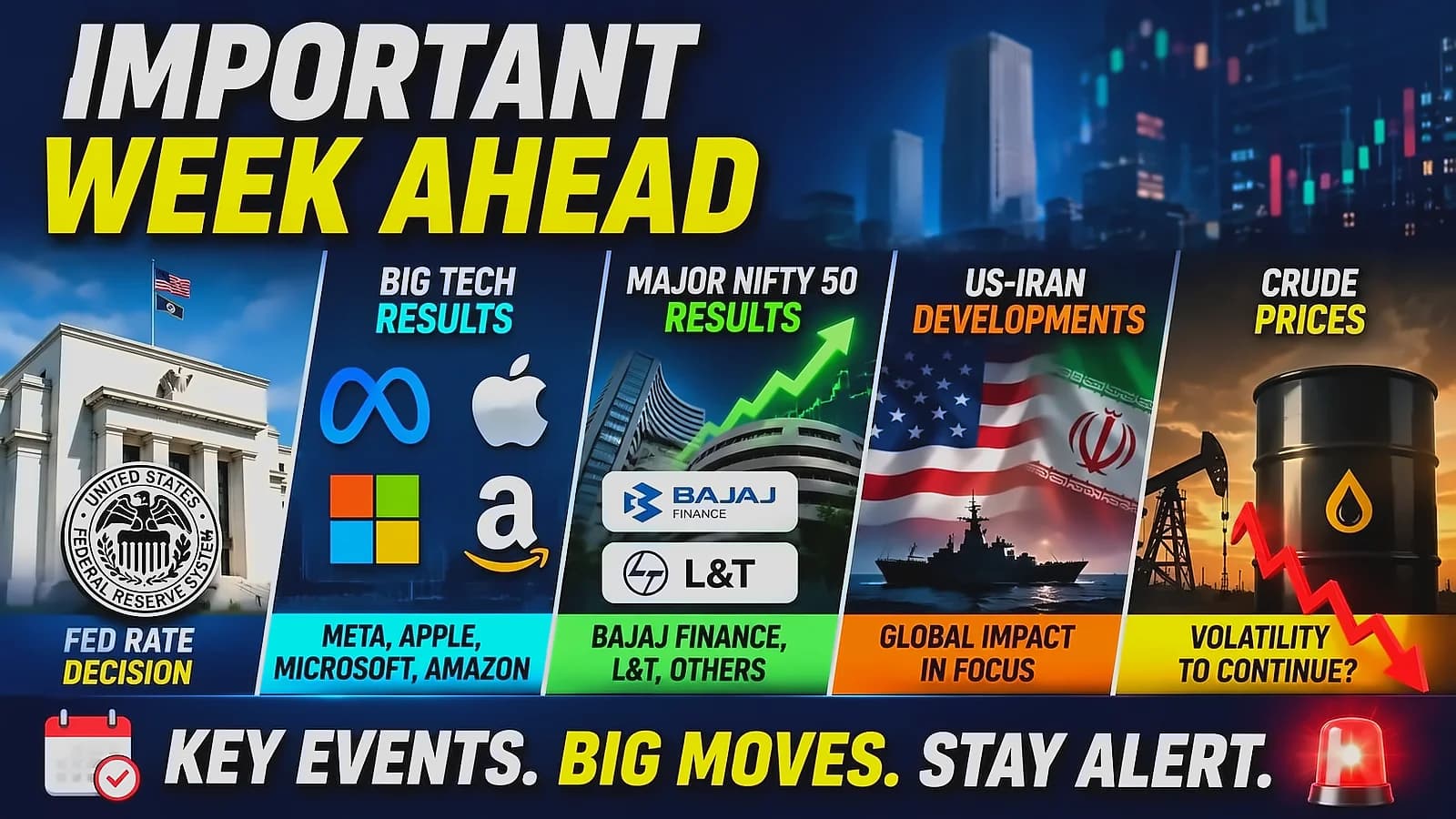
The Magnificent Seven technology companies face continued scrutiny over heavy AI spending, with both Alphabet and Tesla reporting increased capital expenditure in recent results. As reported by CNBC TV18, while Alphabet raised its full-year capex guidance to $195-205 million, Tesla indicated operating expenses will remain elevated. The market punishment was severe, wiping out $767 million in overall market capitalisation for these companies last week. This week will test investor confidence further as peers Apple, Amazon, Microsoft, and Meta report their results, with Microsoft and Meta reporting Wednesday and Apple and Amazon on Thursday. However, the Q2 2026 earnings season has revealed a divergence between the broader market and mega-cap technology space, with sharp post-earnings stock declines for mega-caps like GOOG and TSLA caused by "AI cash burn anxiety" rather than poor revenue growth. Both Alphabet and Tesla handily beat top-line expectations, but massive infrastructure spending pushed Alphabet's quarterly free cash flow into negative deficit while Tesla's core automotive margins narrowed due to EV price wars and heavy AI investments.
Technology shares remained under pressure as investors questioned whether massive spending on AI will generate returns sufficient to justify elevated valuations. US-listed shares of SK Hynix fell another 2.1% in premarket trading, extending losses after the stock dropped below its IPO price, with the sharp decline in Seoul driven by SK Hynix after the chipmaker reported quarterly operating profit that, despite surging nearly sixfold year on year, fell short of analysts' expectations. The disappointing results extended the stock's rout, with more than $700 billion erased from its market value in just over a month. In Asia, major benchmark indices ended lower with South Korea's Kospi plunging 6%, while Japan's Nikkei 225 declined 1.49%. The Philadelphia Semiconductor Index fell 4.5%, putting the gauge on course for its worst month since 2002 after its strongest quarter on record. The divergence in S&P 500 and Nasdaq 100 moves reflects rotation away from chipmakers, with Micron Technology and Sandisk Corp. were among the biggest drags on the S&P 500. US stocks are already under pressure after chip stocks came under heavy selling across other global markets, with much depending on the earnings and guidance from Microsoft and Meta, which will be reported today after market hours.