US semiconductor stocks experienced significant declines on Monday, with chip company stock futures falling as much as 5% after China's memory chipmaker CXMT announced significant progress on a new, high-density chip structure, ramping up competitive pressure. According to latest market data, Nvidia Corp.'s share price was trading at a downturn of 2% to $224.90, while Broadcom, Advanced Micro Devices (AMD), and Intel declined 1.2%, 3.3%, and 3.6%, respectively. Marvell Technology, Micron, and SK Hynix shed 4.2%, 5%, and 4.3%, respectively, with other major technology stocks, including Amazon and Tesla, also falling by up to 1%. The selloff reflects rising concern regarding the return on investment from AI after massive infrastructure spending by companies in the sector, with prominent investors such as Ray Dalio predicting the AI industry is nearing a "classic bubble" close to bursting. South Korean chip stocks like Samsung and SK Hynix fell over 5%, extending a five-day losing streak amid rising Chinese competition fears, valuation concerns in the AI rally, and cautious remarks from Broadcom's CEO.
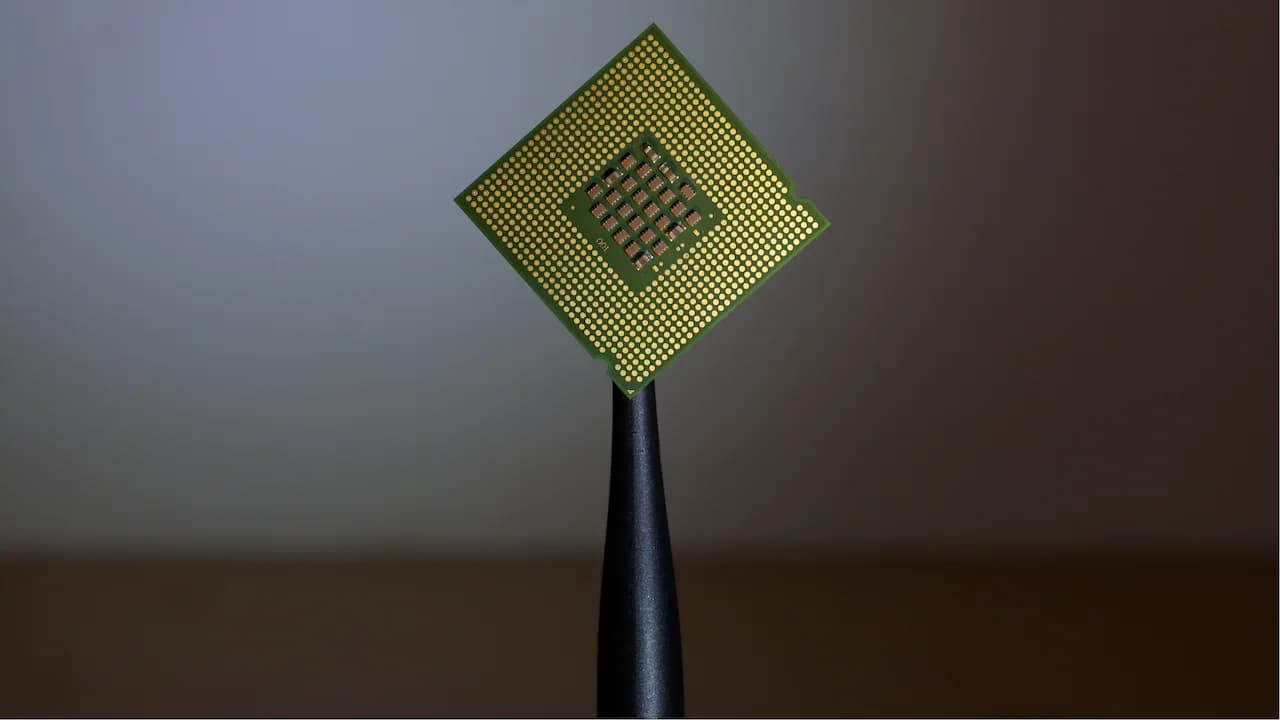
ChangXin Memory Technologies (CXMT) has reportedly announced significant progress in a new memory-cell design aimed at increasing storage density, an area of innovation also being pursued by the world's largest memory makers, including Samsung Electronics, SK Hynix, and Micron. CXMT aims to introduce a new server memory product based on the architecture by the end of 2026, with company president Cao Kanyu announcing the development at an industry event in Shanghai over the weekend. At the center of the development is the "4F²" design, in which each memory cell occupies an area equivalent to four times the square of F, with F representing the minimum line width of a semiconductor. The structure enables higher storage density by allowing more cells to fit onto a single chip, with CXMT saying the core of its 4F² design was its proprietary Vertical Surrounding Gate (VSG) transistor that uses vertical gate architecture to address current leakage while significantly reducing memory cell area. Since its listing on the Shanghai Stock Exchange's STAR Market in July, CXMT has made several moves to showcase its technological capabilities, including announcing that its fifth-generation DRAM manufacturing platform, known as G5, had entered mass production last month. TrendForce estimates the design could lift memory density by 30% to 50%, making it a higher-value market where Samsung and SK Hynix compete.
South Korea's KOSPI fell nearly 6.5% to 6,001.81 on Tuesday morning as Chinese chip progress hit Samsung and SK Hynix, which hold more than half the index by market value. The Korea Composite Stock Price Index (KOSPI) extends a 3.7% slide on Monday and sits 10.1% lower over five days, though it remains up 44.89% for 2026. Samsung Electronics and SK Hynix each fell roughly 9% and 8% respectively, with foreign investors selling a net 341.4 billion won of shares, while individuals and institutions bought. Micron fell 3.9% and Sandisk 6% in US trading overnight, according to Bloomberg data. Monday's slide also reflected foreign selling and the near-completion of chipmaker share buybacks, as reported by SBS News. Kiwoom Securities researcher Han Ji-young expected dip buying to spark a rebound during the session, though the index remained down 4.06% at 9:49 a.m. in Seoul. Samsung and SK Hynix pushed the KOSPI past 9,000 in June, but the index now trades more than 30% below that mark.
The semiconductor selloff extended across global markets, with Japan's Nikkei slumping nearly 3% to 5,988.22 after returning from holiday, while Australia's S&P/ASX 200 was down 0.38% to 8,749.40 and Hong Kong's Hang Seng Exchange opened 0.8% lower at 24,072.28. On Monday, Wall Street witnessed tech rout, with the tech-heavy Nasdaq Composite closing 0.44% lower, as reported by NDTV Profit. In pre-market trading on Tuesday, October 13, SK Hynix declined the most at 5.15% to $153.88, followed by Sandisk down 3.81% at $1,430.65, Micron trading 3.14% lower at 957.98, AMD dropping 1.18% to $587.25, and Nvidia shares slipping 0.90% to $224.29. Bank J Safra Sarasin's von Rotberg told Bloomberg that "memory names are under pressure from a rise in Chinese competition and an increasing number of voices in the industry warning of a bubble." The pressure reflects wider selloff of South Korean AI stocks such as SK Hynix and Samsung Electronics, with investors reassessing whether the pace of AI investment can be sustained against mounting safety concerns and signs of funding strain.
Crude oil prices rose sharply following a deadly attack on Saudi Arabia's airport in Riyadh, with Brent crude futures rising 2% to $106.81 a barrel, adding to market jitters and weighing on broader market sentiment. Iran-backed Houthi militants in Yemen reportedly attacked King Khalid International Airport in Saudi Arabia's capital, Riyadh, on Saturday, leaving 12 people dead and more than 300 injured in a major escalation. US President Donald Trump told reporters that he was considering joining Saudi Arabia in its fight against the Tehran-backed Houthis in Yemen following another deadly attack on Riyadh's international airport, raising concerns about a further escalation of tensions in the region. Ukraine also said Russia continued to target its energy facilities, with the combination of Middle East and Ukraine tensions providing additional pressure on risk-sensitive assets.