Chinese stocks traded mixed on Tuesday as investors weighed fading hopes of a US-Iran peace deal and its impact on oil prices. At the midday break, the Shanghai Composite was down 0.1%, while the blue-chip CSI300 gained 0.2%. The Shenzhen index rose 0.4%, the ChiNext Composite advanced 1.4%, and Shanghai's technology-focused STAR50 index added 0.2%. This mixed performance reflects investor uncertainty over the ongoing US-Iran conflict and its potential implications for global markets.
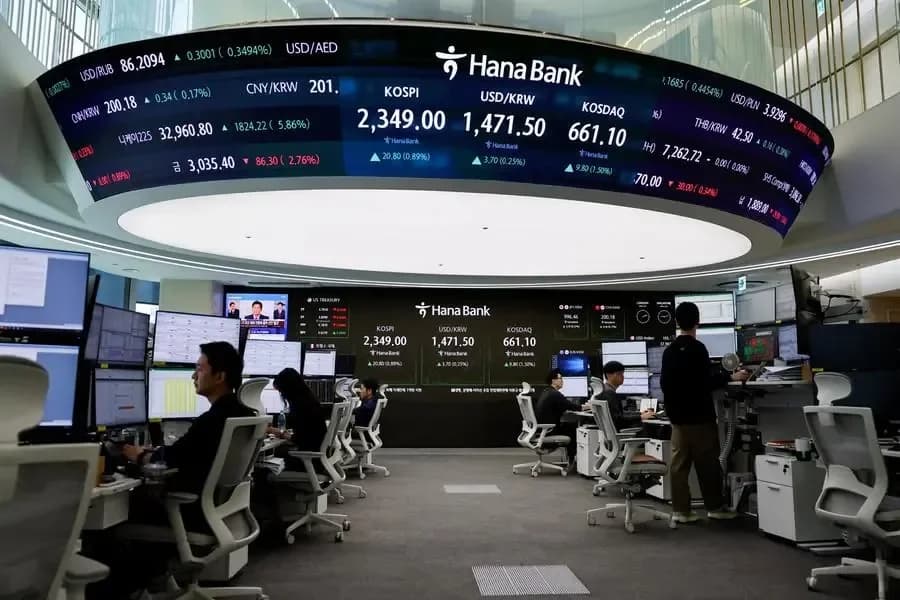
Asian markets fell sharply on Tuesday led by chipmakers amid growing concerns about the massive funding demands of the AI boom. South Korea's KOSPI dived more than 8% to a three-month low, triggering a circuit breaker, while Japan's Nikkei slid 4%. The decline followed a 2.2% drop for the Philadelphia Semiconductor index, with Nvidia shares shedding 5% after the Wall Street Journal reported the company is in talks to provide roughly $250 billion in financing guarantees for OpenAI as part of a massive data centre project. This funding anxiety has created significant uncertainty in the semiconductor sector, with South Korea's SK Hynix falling nearly 11% and Samsung Electronics shares shedding more than 9%.
In mainland China, non-ferrous metal stocks were among the biggest decliners, with an index tracking the sector falling 1.5% in morning trading. This decline highlights continued challenges in the commodities sector amid broader market uncertainty. The strong demand for technology-related stocks and new listings, particularly in areas linked to robotics and advanced manufacturing, continues to provide some support to certain segments of the Chinese market.
Oil prices remained at more than one-week highs on Tuesday as hopes for an agreement between Washington and Tehran faded. Oil prices stayed near one-week highs as ongoing disruption around the Strait of Hormuz has raised concerns about oil supplies and added to inflationary pressures globally. Brent crude futures fell 21 cents, or 0.24%, to $87.51 a barrel by 1138 GMT as optimism over a potential US-Iran agreement faded. The latest weak U.S. employment data had reduced expectations for further rate increases, making the upcoming inflation figures particularly important for investors assessing the path of monetary policy.
Despite broader tech sector concerns, China's semiconductor sector showed growing investor enthusiasm with CXMT Corp shares surging 466% on debut day in Shanghai, highlighting rising competitive threat from Chinese rivals. As reported by The Information, China has begun manufacturing domestically developed immersion deep ultraviolet lithography machines, a chipmaking tool long dominated by Dutch supplier ASML, with ASML shares down 8.5% following the news. "There is clearly a growing sense of optimism within mainland markets about China's ability to build a globally competitive AI ecosystem," said Chris Weston, head of research at Pepperstone. The stellar debut performance reflects growing investor confidence in China's domestic AI capabilities.