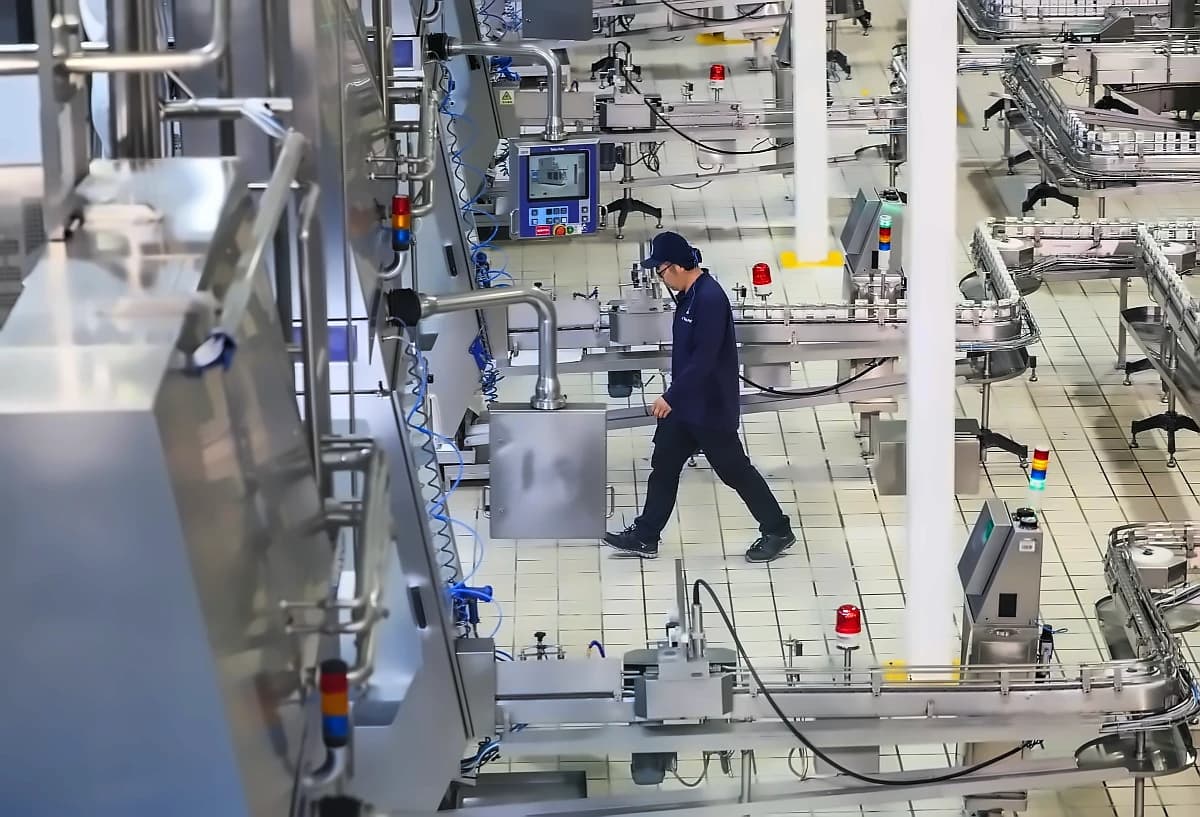
China's industrial output growth decelerated significantly in April, with factory output rising 4.1% year-on-year compared to 5.7% in March, according to data from the National Bureau of Statistics (NBS). This marked the slowest growth since July 2023 and fell short of the Reuters poll forecast of 5.9% growth. As per Reuters, the decline reflects the Asian powerhouse's struggle with higher energy costs from the Iran war and sluggish domestic demand. Despite these headwinds, stronger exports and China's fuel-pricing controls have helped cushion the impact of the Middle East conflict so far. Exports expanded 14.1% in April, sharply beating estimates of a 7.9% growth, as factories scrambled to meet surging overseas demand from foreign buyers stockpiling goods amid Iran war fears. Crude oil refining volumes fell 5.8% from a year earlier — the steepest decline since August 2024 — while crude output climbed 1.2% from a year earlier.
Retail sales showed particularly concerning trends with growth cooling to just 0.2% in April from 1.7% in March, marking the weakest growth since December 2022 and significantly missing forecasts centered on a 2.0% increase. These figures underscore China's struggle with fragile household consumption, with the weakest growth since December 2022 according to Wind data. The fragility of household consumption was underscored in April domestic car sales, which dropped 21.6% in April year-on-year for their seventh consecutive month of decline, even as automakers ramped up efforts to expand in overseas markets to offset weakness at home. However, service retail sales expanded 5.6% in the first four months, outpacing overall retail sales growth of 1.9%, with spending on cultural, tourism, sports and entertainment activities emerging as a bright spot. Urban unemployment rate edged lower to 5.2% from 5.4% in March, providing some relief to employment concerns. As per ING analysts, "Industrial activity has been supported by strong external demand, but the rest of China's domestic demand indicators have been quite lacklustre."

Fixed-asset investment contracted 1.6% in the first four months of 2026, compared with expectations for 1.7% growth, according to Bloomberg. The investment decline was primarily driven by the property sector, with property investment flows plunging 13.7% this year as of April, deepening from the 11.2% drop in the first three months. Urban investment, including real estate and infrastructure, contracted 1.6% year-on-year, compared with expectations for 1.7% growth in the January-March period. However, infrastructure investment grew 4.3% and manufacturing investment expanded 1.2% in the first four months. Property investment in the country has nearly halved since its peak in 2021, with further declines in home prices expected to deepen the impact on household balance sheets. Separate data showed China's new home prices extended their decline in April, albeit at a slower pace, as the multi-year property downturn continues to weigh on the economy.
Top Chinese leaders have pledged to strengthen the country's energy security, accelerate technological self-sufficiency and seek greater control of supply chains in response to external shocks, according to The Economic Times. The Politburo reiterated China's 'proactive' fiscal stance and 'appropriately loose' monetary policy, language broadly in line with previous meetings and suggesting no imminent additional stimulus plans. During a press briefing Monday, Fu Linghui, spokesman for China's statistics bureau, warned that volatility in energy markets and supply chain disruption stemming from the Middle East conflict continue to cloud the global economic recovery. The figures were released shortly after U.S. President Donald Trump concluded his state visit to China last week, which helped ease tensions between the world's two largest economies, though substantive progress on trade and investment issues remained limited. Beijing will likely remain in a wait-and-see mode and reassess its policy stance in July after the second quarter GDP data, according to analysts, with the strong exports helping to mitigate domestic demand weakness but not fully offsetting it. Chinese officials have recently pledged additional support measures to boost domestic demand and stabilize the property sector as policymakers try to sustain growth momentum.