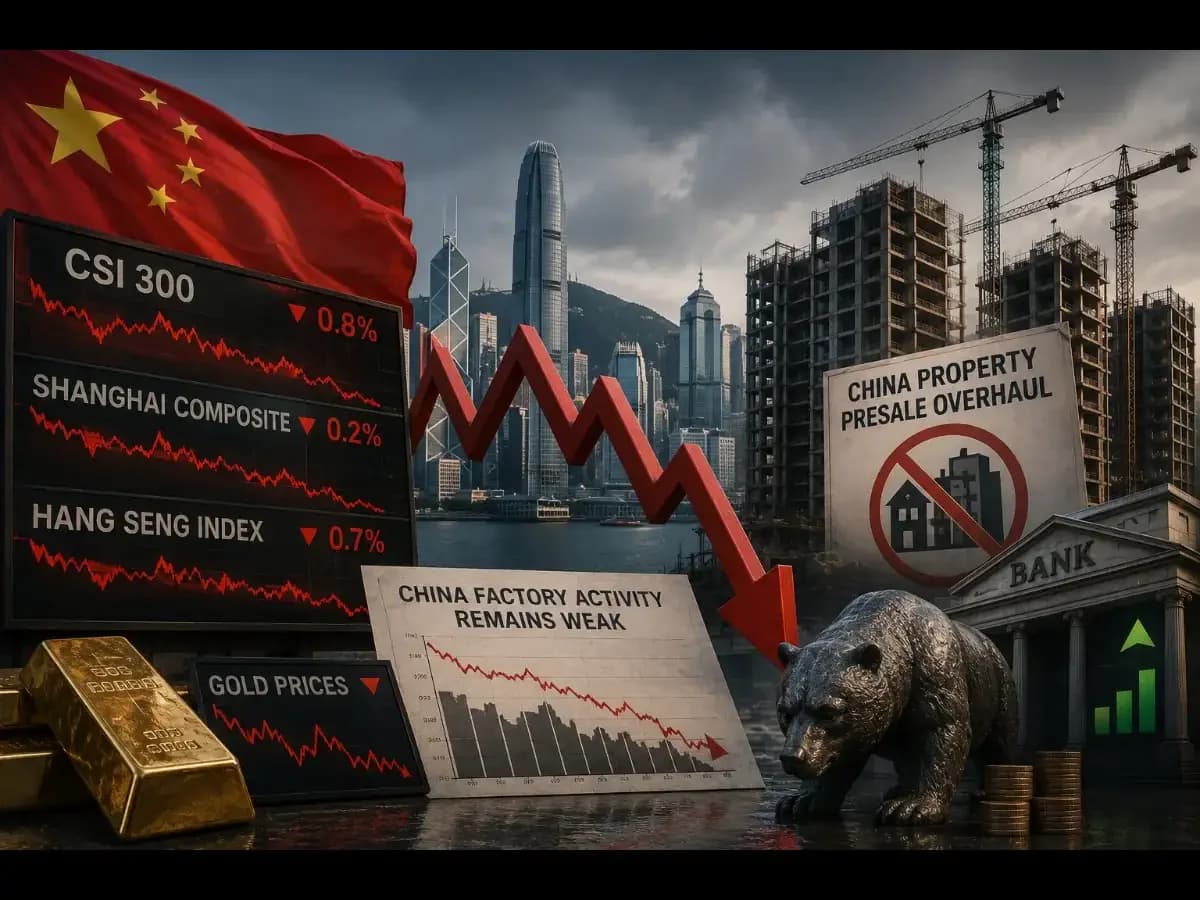
Chinese stocks experienced significant declines as investors reacted to disappointing economic indicators released on April 2026. According to reports from Business Standard, the market reaction came after softer readings across multiple key sectors, with new home prices in 70 major cities dropping 3.5% from a year earlier in April. The economic data revealed concerning trends across multiple indicators, with fixed-asset investment falling 1.6% in the first four months of 2026, marking a sharp reversal from the previous period. As reported by Bloomberg, the data showed investment plunged by around 8% in April from a year earlier, returning to a similar pace of decline seen in the second half of 2025. The weaker growth and rising inflation are expected to complicate policymaking, as authorities face mounting economic pressures from the ongoing Middle East conflict that is straining supply chains and pushing energy prices higher. The National Bureau of Statistics reported that industrial production rose 4.1% year-on-year in April, falling short of the expected rise of 6.0% and remaining below March's increase of 5.7%. This weaker-than-expected growth signals an economic slowdown in the second quarter.
The economic data showed broader weakness beyond real estate, as retail sales grew just 0.2%, marking the weakest pace since December 2022 and missing all economist forecasts. According to Bloomberg, car sales plunged 15.3% in April from a year earlier, the worst contraction since mid-2022, while purchases of home appliances and furniture declined at a double-digit pace. Gold, silver and jewelry sales plummeted 21.3%, representing a huge reversal from earlier this year and 2025 when soaring prices led to speculative investment frenzy. Industrial production grew 4.1% last month, the weakest in almost three years, with electronics production expanding 15.6% - the fastest pace in two years - while auto industry expanded 9.2% as overseas EV sales took off. Despite these concerning indicators, there was some positive news with the urban unemployment rate easing to 5.2%, the lowest level in three months, though this was not enough to offset the overall negative sentiment from the broader economic slowdown.
The disappointing April data has highlighted a critical dilemma between growth and inflation that policymakers must navigate. According to ING, PPI inflation and non-food inflation just hit 45-month highs, with further price pressures likely still ahead. However, this rising inflation backdrop stems from a near-deflationary environment over the past few years, meaning the People's Bank of China doesn't face the rate hike pressure that many global central banks are now facing. The combination of downside growth risks and upside inflation risks creates a challenging policy environment, with authorities having to balance support measures for economic growth against concerns about price stability. ING economists note that this limited urgency for stimulus so far this year could change soon if data continue to deteriorate. The ongoing Middle East conflict is contributing to higher energy prices and supply chain disruptions, adding another layer of complexity to China's economic challenges.
The disappointing April data has put more aggressive stimulus measures back on the agenda after China had previously stood out in its resilience to the fallout from the Iran war. According to Bloomberg, Nomura economists led by Ting Lu said authorities "might need to step up policy support for stabilizing growth," with Beijing having no room for complacency. Societe Generale economists noted that the data "should keep PBOC easing – RRR and even rate cuts – firmly on the table, while fiscal top-up may come later." The People's Bank of China last lowered policy rates and reserve requirement ratio at the peak of trade tensions with the US a year ago, and authorities are likely to take a patient approach while avoiding rushing out responses to just one month of data. Not a single economist surveyed by Bloomberg had predicted as pessimistic a reading for industry, retail sales and investment, making the April performance particularly concerning for policymakers. The ongoing Middle East conflict is adding pressure to implement more aggressive measures to support economic growth and counter supply chain disruptions.
The overall data reinforced concerns about a broad slowdown in China's economy and increased expectations for future policy support. According to Business Standard, authorities are still taking a cautious approach despite the mounting economic pressures from the ongoing Middle East conflict that is straining supply chains and pushing energy prices higher. Market attention is now shifting to the Communist Party's Politburo meeting in July, where investors hope for clearer signals on growth targets and stimulus measures. The disappointing economic indicators have raised expectations that policymakers may need to implement more aggressive measures to support economic growth. HSBC's chief economist Jing Liu noted that "the stance still seems to be to play cautiously," with their base case being no extra stimulus for the time being. However, Macquarie Group suggests the April data may prompt incremental policy easing, while Goldman Sachs maintains its GDP forecast of 4.7% for April-June, compared with 5% in the first three months of the year. The National Bureau of Statistics data has reinforced market concerns about the economic slowdown in the second quarter amid these multiple headwinds.