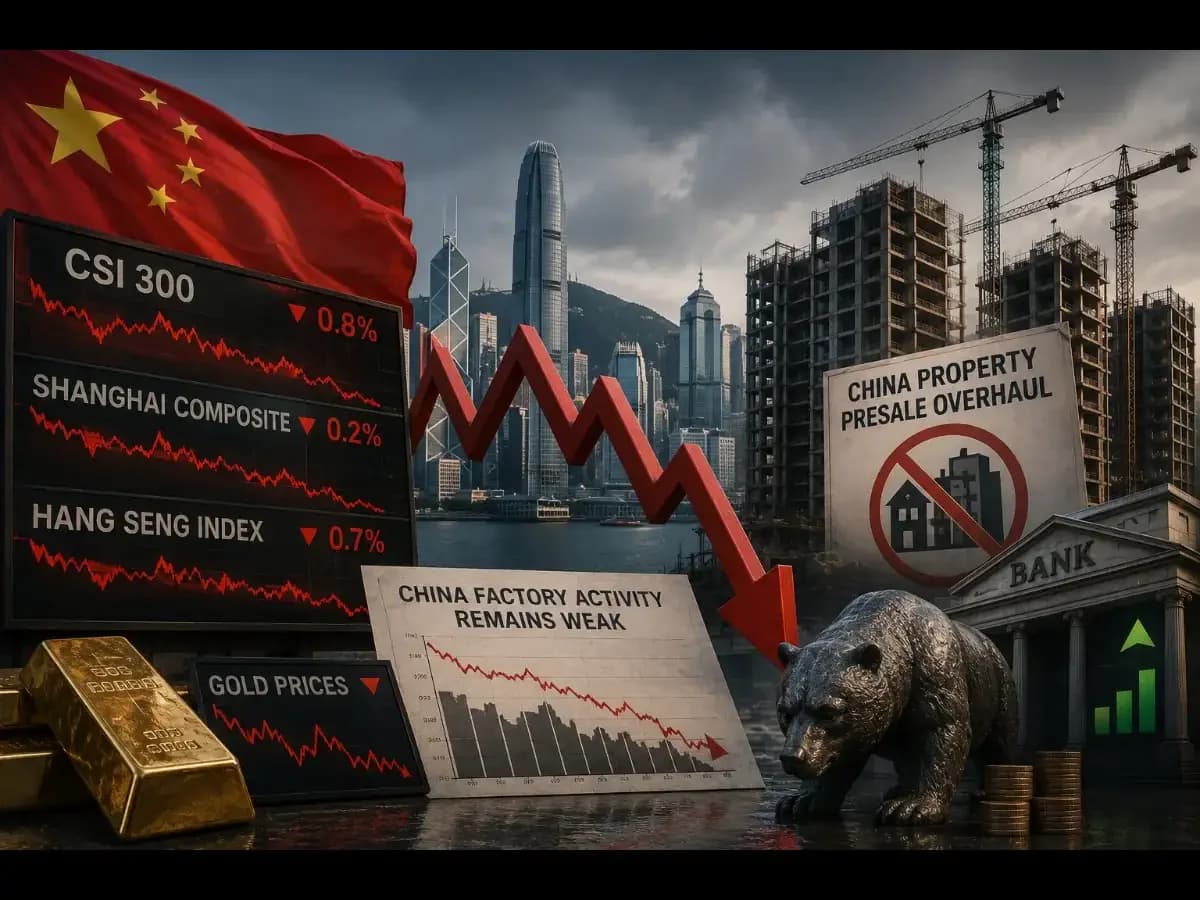
Chinese property stocks have fallen back to levels seen before a series of stimulus measures implemented in September 2024, according to reports from Bloomberg. A Bloomberg Intelligence gauge of Chinese developer shares fell as much as 2.1% on Tuesday, extending losses after data showed a faster decline in home prices. Sunac China Holdings Ltd. dropped 6% while Shimao Group Holdings Ltd. lost 4.4%, highlighting the sector's continued struggles despite previous government support.
Figures from the National Bureau of Statistics released Tuesday showed new-home prices in 70 cities, excluding state-subsidized housing, dropped 0.2% from April, compared to a 0.19% decline in the previous month. As reported by Bloomberg, this data has reinforced investor pessimism about the property sector's recovery prospects. However, recent analysis suggests the bleeding is becoming less disorderly, with the weighted-average new home price decline narrowing to 1.8% month-on-month annualized in May after seasonal adjustment, down from 2.9% in April. While analysts at firms including Citigroup Inc. and Bank of America Corp. have begun asserting that the sector is finally stabilizing, others remain doubtful about the sustainability of the recovery.
The cleanest positive development comes from Tier 1 cities, which are continuing to separate from the broader market decline. Tier 1 prices rose 1.4% month on month annualized in May, accelerating from 0.7% in April, with Shenzhen leading the move at 3.9% after a 1.6% gain the prior month. This represents the part of the market that policymakers will want investors to notice, as the largest and most liquid housing markets are showing signs of stabilization. However, the resale market remains the real barometer of confidence, with resale price data pointing to declines of roughly 5% to 10% over the past year, indicating that household clearing prices remain under pressure despite primary market improvements.
The property sector's decline contrasts sharply with the performance of technology stocks, according to Bloomberg reports. The property gauge has fallen 13% this year while the Star 50 Index, which includes chipmakers, gained 30%. This performance gap reflects how investor appetite for old-economy sectors has waned as capital shifts toward technology and semiconductor stocks tied to the artificial intelligence buildout.
According to Morningstar analyst Jeff Zhang, as reported by Bloomberg, there has been notable improvement in both month-on-month and year-on-year home price trends in higher-tier cities in May, but prices in lower-tier cities remain under pressure. Zhang noted that the divergence between higher- and lower-tier cities will persist, with nationwide new home prices unlikely to bottom out before 2027. With half-year results approaching, investors are focused on whether developers' earnings can stabilize, with China Vanke Co. reporting a net loss of around 6 billion yuan in the first quarter, highlighting deepening stress among major sector players. Recent analysis suggests that while the sector has moved from a flashing red alarm to an amber stabilization signal, it remains a long way from flashing reflation, with the deeper property drag remaining embedded in resale prices, inventory, and household confidence.