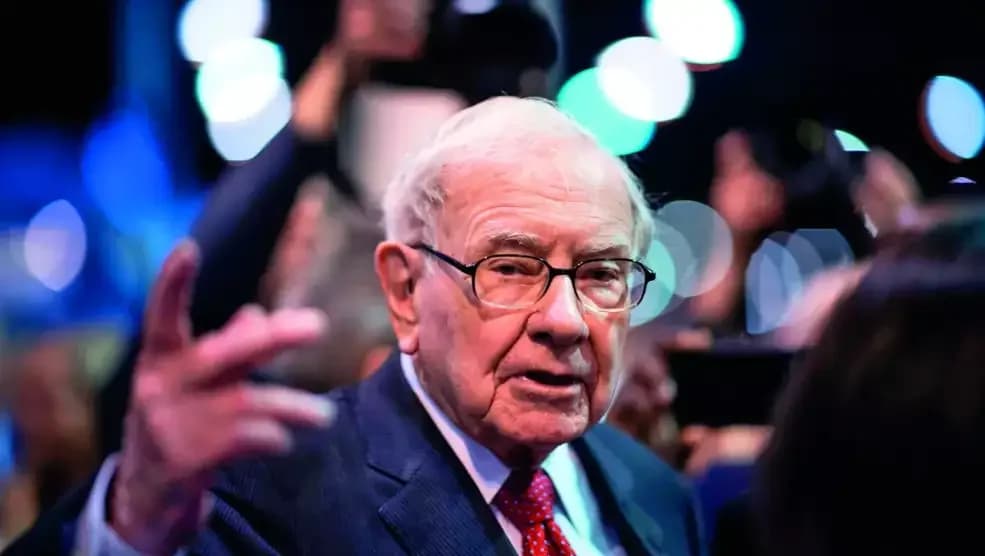
Legendary investor Warren Buffett has issued a fresh warning on the growing 'gambling' culture in financial markets, cautioning that speculative behavior is distorting asset prices and increasing risks for investors. Speaking in a recent CNBC interview, Buffett described the current environment as 'a church with a casino attached', highlighting a widening divide between long-term investing and short-term speculation. 'We've never had people in a more gambling mood than now,' Buffett stated, emphasizing that while traditional investing remains intact, the 'casino' side of markets has become increasingly attractive to participants chasing quick gains. According to the latest reports, Buffett argued that while there are more people in church than casinos, casinos have become very attractive to market participants. His remarks came during the annual Berkshire Hathaway shareholder meeting, often referred to as 'Woodstock for Capitalists'.
At the center of Buffett's concern is the surge in ultra-short-term trading instruments such as zero-days-to-expiration (0DTE) options and prediction markets. Buffett has repeatedly stressed that such activity does not qualify as investing. Instead, he views it as outright gambling, noting that participation in these products has surged to unprecedented levels. He warned that this speculative frenzy could eventually lead to irrational valuations, with many asset prices today appearing unjustifiable in hindsight if driven by momentum rather than underlying business fundamentals. 'If you're buying one-day options or selling them, that is not speculating. That is gambling. Totally. There's nobody who can explain why they're buying an option for one day,' Buffett stated, criticizing that 'There has never been a time when people are so into gambling psychology like now.' He cited a recent case being prosecuted by the US Department of Justice involving a US soldier accused of using classified information linked to a military operation in Venezuela to profit in a prediction market, allegedly making about $400,000 from such trades. 'The quantity of those things is just incredible,' Buffett said, referring to short-term trading activity. His critique aligns closely with his long-held disdain for Bitcoin and other cryptocurrencies, which he has previously dismissed as unproductive assets driven purely by speculative fervor.
Despite Buffett's warnings, Asian markets demonstrated resilience with MSCI's broadest index of Asia-Pacific shares outside Japan gaining 3%, led by tech-heavy South Korean stocks which returned from holiday with a jump of 4.6%. Hong Kong's Hang Seng index gained 1.7%, while S&P 500 futures gained 0.1% and Nasdaq futures rose 0.3% as markets braced for more than 100 earnings reports this week. However, Japanese yen suddenly jumped in Asian trading, with the dollar falling as much as 0.9% to 155.7 yen before paring some of the losses, as traders remained alert for another intervention after Tokyo stepped into the market to shore up the currency last week. The Japanese holiday made for thin trading conditions, leaving Nikkei futures up only modestly at 59,810 versus a cash close of 59,513. Brent crude futures were up just 0.2% at $108.36 per barrel, having recovered from an initial drop of more than 2%, while U.S. crude eased 0.1% to $101.85 as investors drew comfort from signs of patchy progress in settling Middle East conflict.
The meeting marked a historic changing of the guard, with Greg Abel leading the proceedings as CEO for the first time, having taken the baton from Buffett at the start of 2026. Abel guided the conglomerate through a wide array of topics, from efforts to improve the BNSF railway and insurance divisions to a pragmatic stance on artificial intelligence. 'We're not going to do AI for the sake of AI,' Abel assured shareholders, demonstrating the company's measured approach to emerging technologies. To honor his predecessor, Abel hung a jersey from the rafters of the CHI Health Center during the proceedings. The meeting also featured a unique moment where a deepfake version of Buffett asked a question, prompting a discussion on cybersecurity risks associated with artificial intelligence technologies. The exchange highlighted concerns around misuse of AI-generated content, demonstrating the company's proactive approach to emerging technology risks.
Despite these concerns, Buffett did not dismiss investing altogether. Rather, he reinforced his long-standing philosophy of patience and discipline. He emphasised that truly attractive opportunities are rare, as only a handful of years in his decades-long career offered what he considers exceptional bargains. In periods like the present, he suggested that doing nothing can often be the most prudent strategy. This cautious stance is reflected in Berkshire Hathaway's balance sheet, which is sitting on a record cash pile estimated at around $397 billion as of March end, after trimming equity exposure and waiting for better opportunities. When asked about the current environment for Berkshire's funds, Buffett stated 'In terms of executing Berkshire Hathaway's funds, this is not the ideal environment for us.' Meanwhile, Berkshire CEO Greg Able, Buffett's successor, made his debut at the annual shareholders' meeting, expressing optimism about future opportunities. 'We don't know what will happen tomorrow, whether it will be three years later or two years later,' Able stated, adding 'There will be confusion in the market that will open up opportunities for us to act.' He has a 'potential list of investment targets' and has warned that he will use the huge amount of cash to buy stocks when there is confusion in the market.