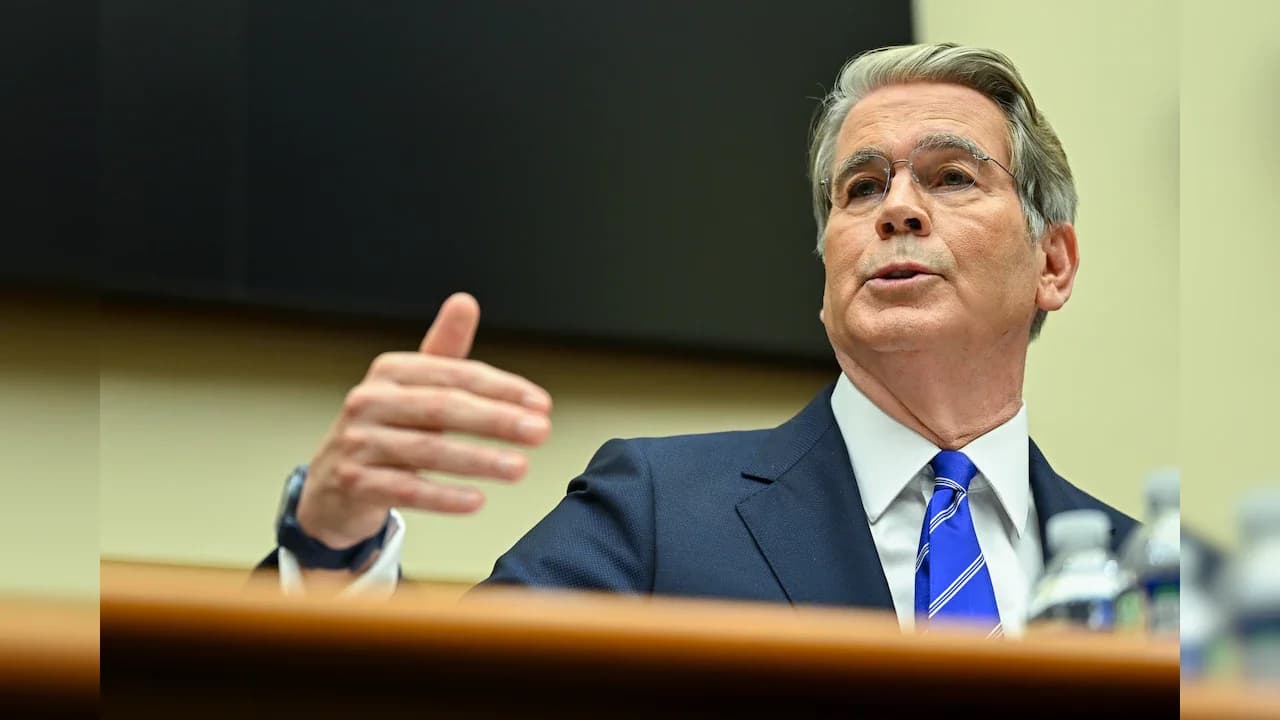
U.S. Treasury Secretary Scott Bessent emphasized that current bond yields indicate 'flat to down' inflation expectations while signaling a robust acceleration in U.S. economic growth. Speaking at the Group of 20 finance leaders gathering in Asheville, North Carolina, Bessent highlighted that these economic indicators provide confidence in the administration's fiscal position. His comments came during discussions where global economic conditions, fiscal policy and financial-market stability featured prominently on the agenda.
Bessent is facing mounting criticism over what macro strategist Jordi Visser describes as a coordinated campaign to suppress bond yields while the AI industry borrows trillions of dollars. According to Visser's analysis on the Bessent Gets Drucked podcast, the administration's intervention pattern is now unmistakable, including yen intervention in late July and August 1, quarterly refunding language changes, a buyback framework in the refunding statement, increased buybacks, CNBC statements about potentially bigger operations, and discussions of tapping the $1 trillion Treasury General Account (TGA). Visser argues that the mainstream reaction to Stanley Druckenmiller's criticism missed the point, noting that while Druckenmiller's core line about the bond market being the only fiscal disciplinarian is correct, it describes what should happen rather than what will happen under current intervention strategies.

Bessent highlighted continued U.S. economic growth despite the country's large budget deficits, arguing that the combination of expansion and fiscal capacity puts the United States in a stronger position than several other advanced economies. His comments came ahead of a two-day gathering of G20 finance leaders in Asheville, North Carolina, where global economic conditions, fiscal policy and financial-market stability are expected to feature prominently. As reported by Reuters, benchmark U.S. Treasury yields were largely stable last week, with the 10-year Treasury yield closing Friday near 4.73% after staying within a narrow band. Long-term yields also remained flat despite renewed U.S.-Iran hostilities during Asian trading on Monday.
Visser attributes the administration's intervention strategy to the unprecedented capital requirements of the AI industry, noting that AI debt issuance is absorbing capital that would otherwise go to weaker credits. The macro strategist points to credit market stress, including triple-C spreads widening while junk spreads hold, reflecting the same concentration dynamic seen in equities. Broadcom's $70 billion deal and widening of single-name credit default swaps while the CDX index holds demonstrate this capital concentration effect. Visser argues that 10-year Treasury yields are wildly mispriced relative to nominal GDP, with rates trading above nominal GDP through the 1980s, breaking below in 1997 before the Asian financial crisis, and staying below except during recessions. With nominal GDP at 6.5% and climbing, fair-value arguments suggest 10-year yields should be at 8% or higher, significantly above current levels.
Bessent defended the Treasury's decision to expand its programme of bond buybacks, following criticism from some central bank policymakers that the move could interfere with normal market functioning. Last week, Bessent announced the Treasury would at least double its buybacks of longer-dated securities to $4 billion per operation, arguing that the spike in yields, which drove 30-year borrowing costs to a 19-year peak, was not aligned with economic fundamentals. As reported by Reuters, he dismissed worries from some central bank officials about the Treasury's unexpected move, rejecting claims that the action disrupted markets or deviated from the Treasury's usual predictable approach. The larger buyback operations are scheduled to begin on September 10.