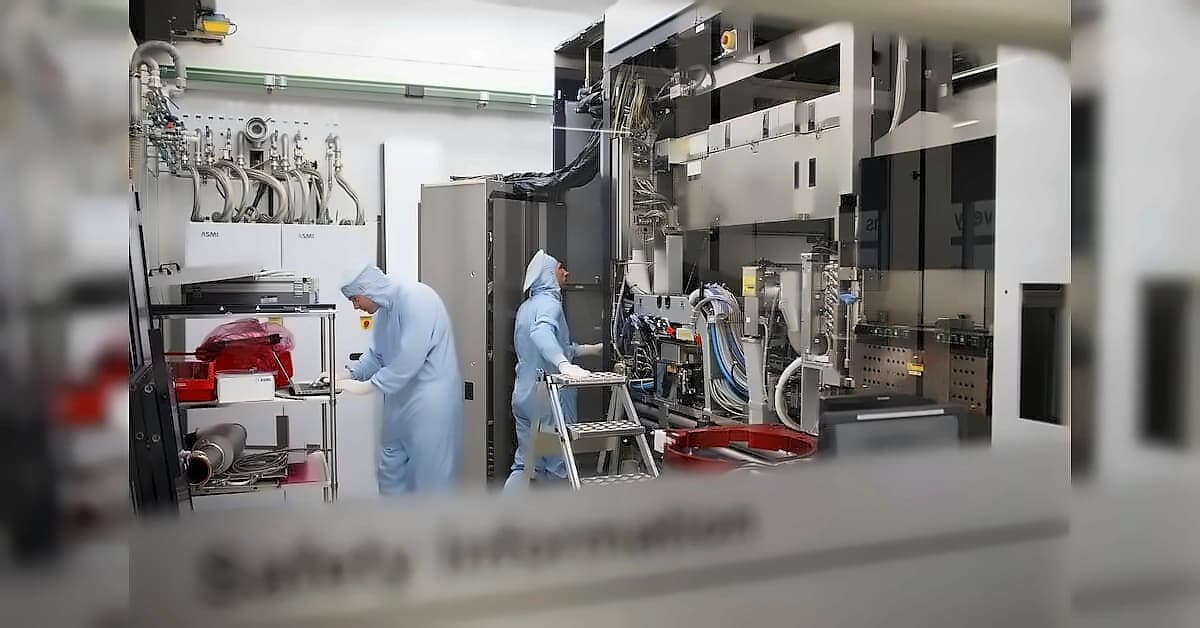
Dutch semiconductor equipment manufacturer ASML has delivered exceptional financial results while confirming the artificial intelligence boom's impact on the semiconductor industry. The company reported quarterly revenue of over ₹90,000 crore (11.66 billion euros), representing a 55.5% year-over-year increase from the previous quarter. Profits doubled to around ₹40,000 crore (4.96 billion euros), demonstrating the strong demand environment despite supply challenges. As per Investing.com, this performance reflects the immense demand for AI infrastructure driving unprecedented growth in the semiconductor equipment market. The company has now raised its 2026 sales guidance to €44-45 billion, marking the third upward revision this year and representing a hard counter-signal to broader chip sector concerns about AI spending overbuild.
The world's leading supplier of extreme ultraviolet lithography machines has issued a stark warning about the artificial intelligence boom's impact on the semiconductor industry, with the supply constraints now extending further than previously anticipated. According to reports from Reuters, ASML stated that demand for its chipmaking equipment will exceed supply through 2028, with the company now looking for ways to push its 2028 capacity beyond the 30% increase it had already planned. CEO Christophe Fouquet confirmed that supply planned for 2027 and 2028 will not fully meet customer demand, with some buyers already expressing interest in orders for 2029 and 2030. As Fouquet told investors, "Our customers continue to increase their short- and medium-term equipment demand forecasts with us, driven primarily by their views on the size and duration of AI-related investments." This supply squeeze represents a fundamental shift in the semiconductor equipment market, as the company faces the challenge of meeting record-breaking demand levels for the critical EUV machines required for advanced semiconductor manufacturing.
The demand surge extends well beyond immediate needs, with ASML providing concrete production commitments that underscore the severity of the supply constraints. The company expects to ship about 65 Low NA EUV systems in 2026, driving EUV net system sales growth of more than 45%. Each of these systems costs well over $100 million, representing significant capacity investments by chipmakers. This commitment is not just a forecast but represents actual factory capacity being built by major semiconductor companies. As Fouquet noted, "When customers are trying to reserve capacity into the next decade, you are not describing a bubble. You are describing a bottleneck." The company's position as the only manufacturer of extreme ultraviolet lithography machines globally makes its capacity outlook one of the few genuinely hard signals in the entire AI supply chain. The latest developments show that customers are already asking for machines to be delivered in 2030, with buyers booking four years out indicating exactly how long the queue has become.
The semiconductor equipment bottleneck is driving significant investment decisions across the industry, with ASML confirming direct engagement with major players. CEO Christophe Fouquet confirmed direct talks with Elon Musk about supplying equipment for the $55 billion Terafab megafab in Texas, calling Musk "very serious." However, he warned that the project only works as an opportunity if ASML avoids becoming supply-constrained. The semiconductor equipment bottleneck is driving significant investment decisions across the industry. According to Reuters, major chipmakers, including Taiwan Semiconductor Manufacturing Company (TSMC), Samsung Electronics and Intel, are ramping up investments to address the capacity constraints. TSMC manufactures chips for Nvidia, while SK Hynix and Micron are also expanding capacity to capitalise on the AI opportunity, demonstrating the widespread nature of the capacity expansion response. The analysis notes that much of the spending trumpeted in recent months depends on equipment, power and production slots nobody has secured yet, with each delay pushing back the timetable for new data centres and returns investors are counting on.
The supply squeeze in semiconductor equipment could serve as a bullish signal for semiconductor capital spending as chipmakers race to expand production capacity. As reported by Reuters, the bottleneck reflects the rapid expansion of AI infrastructure and data centres, creating sustained demand for advanced semiconductor manufacturing equipment. ASML, as the most valuable technology company in Europe by market capitalization, is well-positioned to benefit from this long-term demand trend. The company's strong financial performance and extended order pipeline until 2030 indicate that the AI boom will continue to drive semiconductor equipment demand for multiple years ahead. The analysis emphasizes that money can buy a great deal in this market, but it can't buy a machine that hasn't been built yet, with the companies that locked in their slots early holding an advantage over their rivals. This comes at a time when broader market concerns about AI valuations have intensified, with Broadcom CEO Hock Tan's recent comments about excessive AI investment expectations causing significant market volatility across Asian markets.