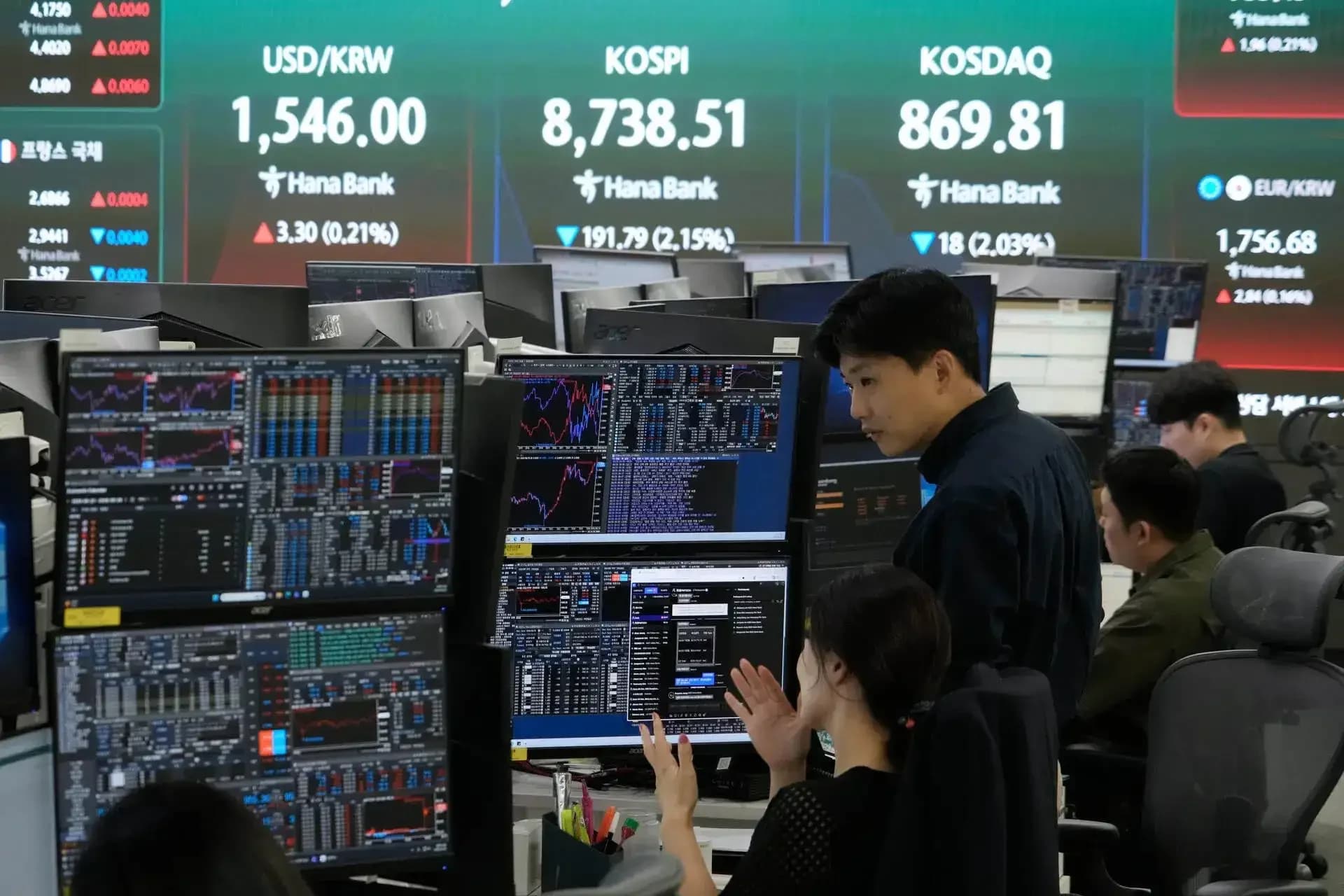
Asian share markets are easing into the new week, with the regional index down 0.1% and South Korea falling 1.2% as the market's most sensitive Asian expression of the AI trade takes the early weight, according to Investing.com India. US futures are marginally firmer, but there is no real conviction behind the move as markets await key developments. MSCI's broadest index of Asia-Pacific shares outside Japan eased 0.2% in the previous session, with South Korean shares falling 0.8% and Taiwan dropping 0.5%. Equity markets were quiet in early trade, with the Nikkei near flat after having fallen almost 4% last week. In Europe, EURO STOXX 50 futures, DAX futures and FTSE futures were all little changed, while on Wall Street, S&P 500 futures and Nasdaq futures were a fraction lower. The mixed performance reflects cautious sentiment as markets digest potential geopolitical developments and await key corporate earnings.
Nvidia may raise prices on systems shipping early next year, including those with its Vera Rubin and Grace Blackwell chips, according to people familiar with the process who asked not to be identified commenting on communications that haven't yet been made public, as reported by The Economic Times. The size of the increase will depend on the chip generation and memory setup, adding to investor concerns about rising hardware costs. The news deepened worries about AI spending with hardware costs rising just as companies commit larger sums to the technology. The entire tech sector is holding its breath for Nvidia's results on Wednesday, with investors aware of how hard it will be for the chip maker to meet stratospheric expectations. Analysts are generally looking for quarterly revenue to almost double to around $92 billion, with full-year earnings guidance seen in a range of $103 billion to $105 billion. Bloomberg reported on Saturday that Nvidia had informed some of its largest customers that AI server prices could rise by more than 15% because of surging memory costs, adding to the sector's concerns about rising costs in the artificial intelligence supply chain.
Oil is providing some relief, with Brent down around 1% as more commercial traffic moves through the Strait of Hormuz along the US-backed route near Oman, as reported by Investing.com India. Iran appears to be losing its grip on the waterway, reducing part of the geopolitical premium that had become embedded in crude. Brent crude had dropped 1.0% to $93.43 a barrel ahead of US Treasury Secretary Scott Bessent's news conference outlining sanctions on Iran, which has shown no sign of relinquishing its control over the vital Strait of Hormuz. US crude eased 1.1% to $86.14 a barrel. Even so, oil remains up more than 50% this year as the six-month US-Iran conflict disrupted global supply, with no resolution on reopening the Strait of Hormuz. Iran has condemned the USA's plan of new sanctions on them, stating that they will add on to the strain on the Islamic Republic's economy and have an impact on its most important trading partners, including China, according to Reuters. Iran stated that oil shipments are already at a standstill at the Strait of Hormuz, a global oil and gas supply chokepoint, while the Islamic regime's economy is already under immense pressure from the sanctions.
US stock market futures traded lower on Monday as investors turned cautious amid a surge in Treasury yields, with the 30-year US Treasury yield jumping to 5.3%, the highest level in over 20 years, as reported by Goodreturns. Dow Jones futures dropped by 23 points to trade around 53,328, while Nasdaq 100 futures slipped more than 100 points to struggle around 29,260 levels, and S&P 500 futures are down by 8 points to trade around 7,683.25. The 10-year yield is also at a 20-month high, while treasury yields in other countries like Japan, France and Germany are also at multi-year highs. Investors remained concerned that the prolonged US-Iran conflict could keep oil prices elevated and fuel inflation, limiting the scope for lower interest rates. During the trading week of August 17-21, the Dow Jones tumbled 386.10 points or 0.72% and the S&P 500 index plummeted by 116.31 points or 1.49%, while the tech-heavy Nasdaq took the worst beating, crashing 604.20 points or 2.3%. Markets are also awaiting the July PCE inflation report and Federal Reserve Chair Kevin Warsh's speech at the Jackson Hole symposium later this week, along with Nvidia and Marvell Technology earnings.
Nvidia has become the quarterly earnings report for the entire AI capital expenditure cycle, as noted by Investing.com India. Its guidance will reach through semiconductors, memory, networking, data centres, power infrastructure and the Asian supply chain, where investors need confirmation that demand remains strong and that suppliers can still capture it without sacrificing margins. The spending machine is still running, but the bill is getting heavier with Nvidia-powered server prices set to rise by more than 15%, raising questions about whether returns can keep pace with rising costs of chips, memory, electricity, and capital. The market is not abandoning AI, but it has stopped accepting the story on faith and now wants to inspect the invoices. Alibaba's $10.2 billion share sale sharpens that point, demonstrating that the AI arms race remains alive but showing how much fresh capital is required to stay on track. While the affected goods only comprise about 5% of Canada's exports to the U.S., "politically the rupture is considerably larger," according to Stephen Innes, managing partner at SPI Asset Management, as reported by MarketWatch. The political trust supporting those supply chains is becoming thinner, and every additional tariff adds another grain of sand to the inflation machinery.