Asian markets experienced a severe sell-off as rising bond yields and higher financing costs threaten to undermine the investment case for AI infrastructure, according to Reuters. Nearly four years after OpenAI launched ChatGPT, billions of dollars have flowed into semiconductor manufacturers, data centre operators, and other AI-related businesses, but signs of strain are emerging as investors increasingly question whether the expected returns from AI investments will justify the capital being deployed. The Philadelphia Semiconductor Index fell 1.7% on Thursday, while Samsung Electronics and SK Hynix dropped 10% and 8%, respectively, in Seoul. Firmus, an Australian data centre operator backed by Nvidia, shelved its planned $5 billion initial public offering last week after investor interest weakened, underscoring how quickly concerns about risk and valuations can disrupt funding plans in the sector. Investors have been unnerved by valuations of companies in the AI ecosystem as more voices question the sustainability of demand for data centers, as noted by Reuters.
Chinese markets have emerged as the biggest losers in the global AI trade crash, with the Nasdaq-style Star50 index down nearly 40% during the first half of the year, becoming the world's worst performing major tech gauge. The decline has been led by MetaX Integrated Circuits Shanghai Co. and Moore Threads Technology Co., both of whom have shed around 50% of their value during this period. A hardware-focused ChiNext index has also declined 36% during the same timeframe. Moore Threads shares, known as the "Chinese Nvidia," had surged 500% on their debut in December last year but are now down to 327 CNY from a high of 942 CNY. Between April and June, the Star50 index had outperformed even South Korea's KOSPI, surging 75% during that period, and traded at 80 times forward earnings at its June 30 peak. The Star50 now trades at 40 times forward earnings, compared to the KOSPI, which trades at less than five times after the recent meltdown, and 21 times for the Nasdaq 100 index.
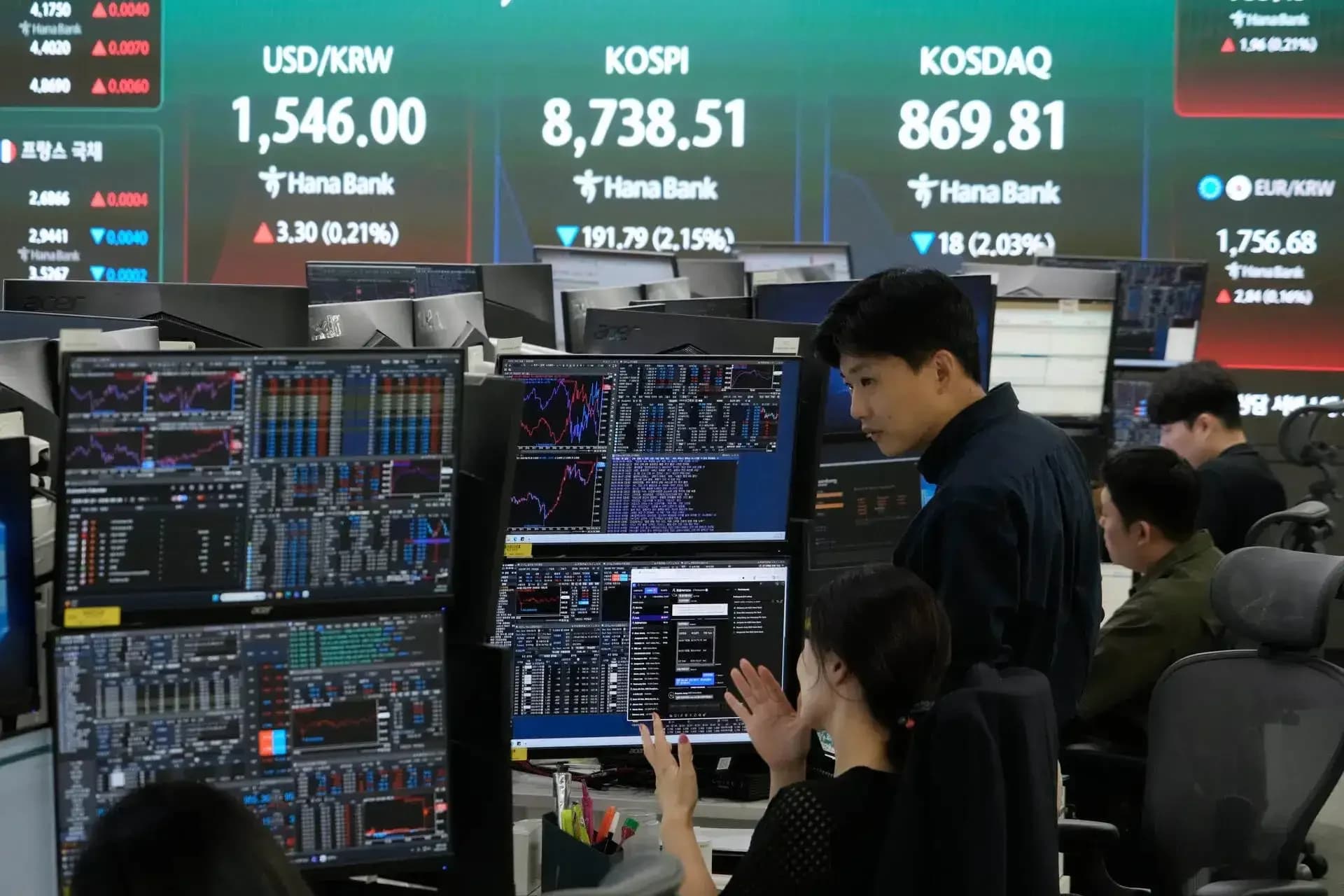
Asian markets experienced their biggest one-day drop since late July, with MSCI's broadest index of Asia-Pacific shares outside Japan closing 3.12% lower. The brutal tech-led selloff hit South Korea particularly hard, with South Korea's KOSPI index plunging almost 8%, while Japan's Nikkei 225 fell nearly 5%. The rout, which pushed the index to its lowest level since late July, had a ripple effect across other Asian markets as Japan's Nikkei and Hong Kong's Hang Seng slipped into the red. The Korean benchmark index marginally pared the losses to trade 6.4% lower at 5,972.91 at 12:55 pm (local time). Samsung Electronics and SK Hynix, the two stocks that carry more than half of Kospi's weightage, were down 7.7% and 8.8%, respectively. The Kospi had crossed 9,000 in June on the back of the global AI boom, meaning the current crash has dragged the index by at least more than a third from its peak.
Wall Street opened mixed on Thursday as investors evaluated earnings from major US banks while the memory chip selloff continued. The Dow Jones Industrial Average rose 1.08%, the S&P 500 gained 0.27%, and the Nasdaq Composite rose 0.11%, reversing early losses. The Philadelphia SE Semiconductor index was last down 1.7%, continuing the pressure on memory chip stocks. Chipmakers such as Micron, SK Hynix, Intel, AMD extended selloff following China's memory chip push and doubts over AI-linked spending. Micron slipped the most, falling 5.55% to $934.16, followed by SK Hynix, down 5.32% at $153.6, while SanDisk was trading 4.29% lower at $1,423.56. The benchmark 10-year US Treasury yields fell back towards 5% in what was their biggest daily drop in more than a year, with the yield on benchmark US 10-year notes falling 10.29 basis points to 5.087%.

The semiconductor weakness coincided with heavy foreign investor selling pressure, which amplified the market decline. According to Securities Times, foreign investors net sold 585.3 billion won (approximately $437.7 million) on the KOSPI, while retail and institutional investors net bought 249.4 billion won (approximately $186.5 million) and 310.4 billion won (approximately $232.1 million) respectively, but failed to stem the decline. Programmatic trading saw net selling of 317.3 billion won (approximately $237.3 million). The selloff in South Korea was particularly severe, with the KOSPI standing at 6,096.35 as of 9:17 am on October 13, down 287.89 points or 4.51% from the previous session. During the third quarter, Bloomberg data shows that outflows from a trading link with Hong Kong, which allows foreign investors access to Chinese local stocks, totaled $13.5 billion, the biggest in a year and reversing more than half of the inflows seen between the April to June frenzy.
Chinese markets edged lower on Wednesday as selling pressure on artificial intelligence-related supply chain shares intensified, with the CSI300 Index falling 0.3% by midday break while the Shanghai Composite remained little changed. According to Reuters, technology shares continued to underperform as sentiment towards companies linked to the artificial intelligence supply chain deteriorated. The 5G Communication Index dropped 1.5%, while the technology-focused STAR50 Index fell 1.1%. Zhongji Innolight, a leading manufacturer of optical transceivers used in AI data centres, declined 2.6%, highlighting the broad-based weakness across AI-related supply chain companies. According to Gavekal Capital, it will be much harder for China to achieve its AI ambitions if its technology stocks remain under pressure for an extended period. They warned that in case this weakness extends for another six months, it will make fundraising difficult and also imply that the market is unimpressed with the technological progress made. Chinese onshore IPOs have fetched $37 billion this year, the highest in three years, according to Bloomberg data, with a third of the funds raised coming from tech firms.