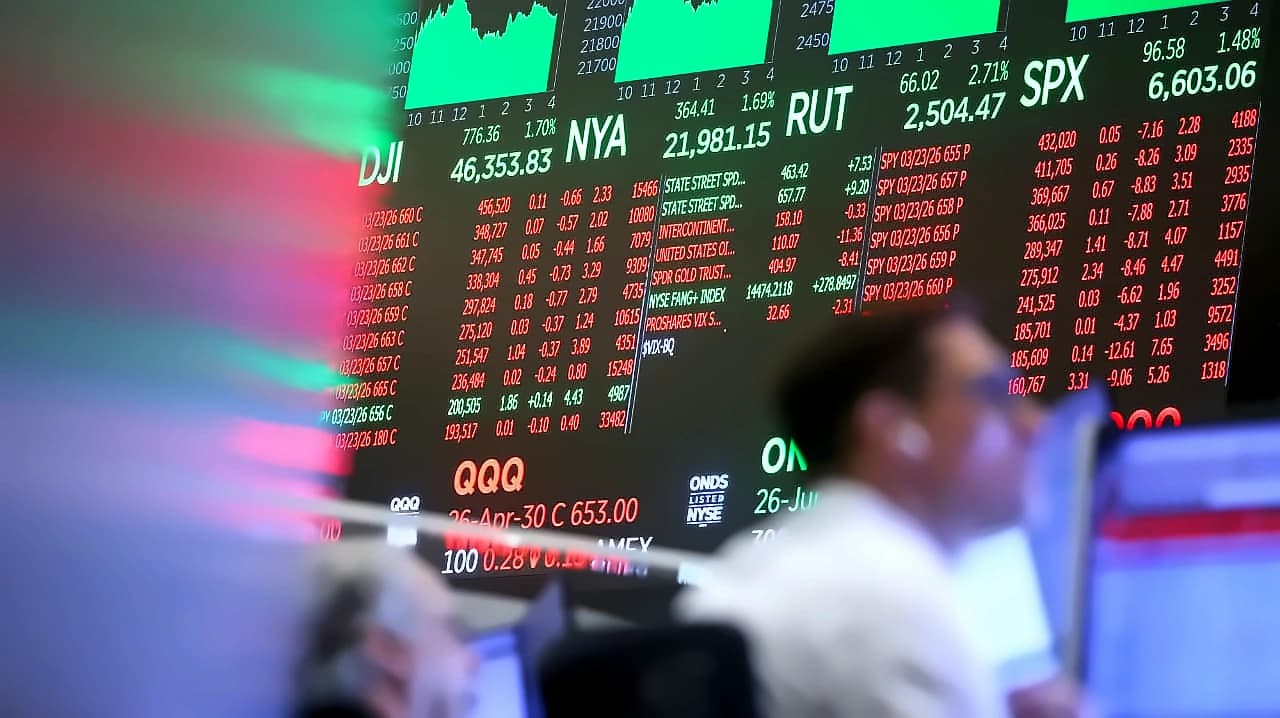
US stock futures rose on Tuesday, August 25, as Treasury yields eased and semiconductor shares recovered ahead of Nvidia's earnings and the Federal Reserve's Jackson Hole symposium. Dow Jones futures gained 0.6% while S&P 500 futures advanced 0.5%, with Nasdaq 100 futures leading at 0.9%, suggesting technology stocks could rebound after the sector weighed on Wall Street in the previous session. The benchmark 10-year Treasury yield fell more than 3 basis points to 4.666%, extending its decline from Monday, following reports that the US Treasury could use its roughly $1 trillion General Account to fund bond repurchases. As reported by CNBC TV18, chip stocks were among the strongest movers in premarket trading, with Nvidia shares rising more than 1%, Advanced Micro Devices and Micron Technology gaining more than 2% each, Intel climbing more than 3% and Broadcom advancing more than 1%. However, market volatility is expected to increase significantly as the 1-day VIX finished below 9, which is unusual given the upcoming earnings and Fed event, with the VIX likely to rise substantially by Wednesday's close.
Wall Street faces a dual test next week with Nvidia Corp reporting quarterly earnings on Wednesday, August 26 after the close, followed by the Jackson Hole economic symposium running August 27-29. However, Allspring Global Investments' Ann Miletti warns that Jackson Hole poses a greater risk to investors than Nvidia's earnings, as reported by The Hindu BusinessLine. Miletti, who serves as Allspring's head of equity investments, emphasized that "the thing that we try to stay focused on with all the craziness going on is what you can control." She advocates for focusing on companies with strong balance sheets and flexibility to navigate any environment, particularly given the current market volatility.
The upcoming week presents an unusual market dynamic as semiconductor implied volatility continues to decline, with the VXSMH dropping to 38.9, its lowest level since August 14 and before that, January. This is particularly surprising given that Nvidia reports today, as the VXSMH was in the mid-60s at the start of July, nearly cut in half in six weeks. The decline in semiconductor volatility is occurring faster than S&P 500 implied volatility, which is somewhat unusual given the earnings event. This is leading to semiconductor-sector implied correlations rising faster than index-level implied correlations, meaning semi options are becoming less expensive relative to index options. The market is starting to price the semiconductor sector more in line with the S&P 500 rather than on its own story, creating less cushion for semiconductor stocks if they decline after earnings.
Miletti highlighted significant concerns about corporate borrowing costs moving from below 5% at the start of the year to above 5.5%, as reported by The Hindu BusinessLine. While the absolute level is not historically extreme, "it's the quickness of the move, the sharpness of the move that can make a difference" — particularly given the scale of capital expenditure spending underway. That concern is amplified by turbulence in bonds, with 30-year Treasury yields spiking to more than 5.3% this week before Treasury Secretary Scott Bessent's decision to double a planned debt buyback to $4 billion. That shock intervention briefly stirred market optimism but failed to deliver lasting relief, creating additional uncertainty around the Fed event.
Nvidia is scheduled to report its fiscal second-quarter earnings on Wednesday after the close, with the company having become a bellwether for the artificial intelligence sector. As reported by FxStreet, the chip giant has issued staggering revenue guidance of $91 billion (approximately ₹11.8 trillion) for the quarter, significantly ahead of the street consensus of $87.2 billion. Analysts project year-over-year growth approaching 100 percent for both revenue and earnings per share. However, perfection is already priced into the stock; anything short of an overwhelming beat will likely trigger a harsh recalibration of tech valuations. Market makers expect a swing of nearly 6 percent in either direction for NVDA shares following the announcement, with crucial metrics including the maintenance of their envious 75 percent gross margin and specific updates on the deployment of their next-generation Vera Rubin architecture. The company has also boosted its dividend to 25c a share and announced an $80 billion share buyback program. According to The Economic Times, Nvidia recently teamed up with six major financial institutions on financing platforms targeting more than $500 billion for AI infrastructure, highlighting the massive capital required as companies and governments race to build data centers for AI workloads.
Technical analysis reveals an asymmetric setup for Nvidia with limited upside potential and significant downside risk. The stock faces clear resistance at $230 and support at $212, with options market data showing a call wall at $230, put wall at $190, and flip level around $214. In this positive gamma regime, dealer hedging supports the stock above the flip zone, but if it falls below $210, gamma could turn negative and hedging flows would become directional. The gamma profile shows resistance at $220, $225, $230, and $240, while on the put side there is little support until $190 and then $185, with a gap to fill around $180. Market analysts suggest the stock probably won't reach levels to reward call buyers, and the proximity to the flip zone increases the chance of negative gamma and potential decline toward $190. This matters for broader indices, as Nasdaq support sits around 28,900 and S&P 500 support at 7,600.