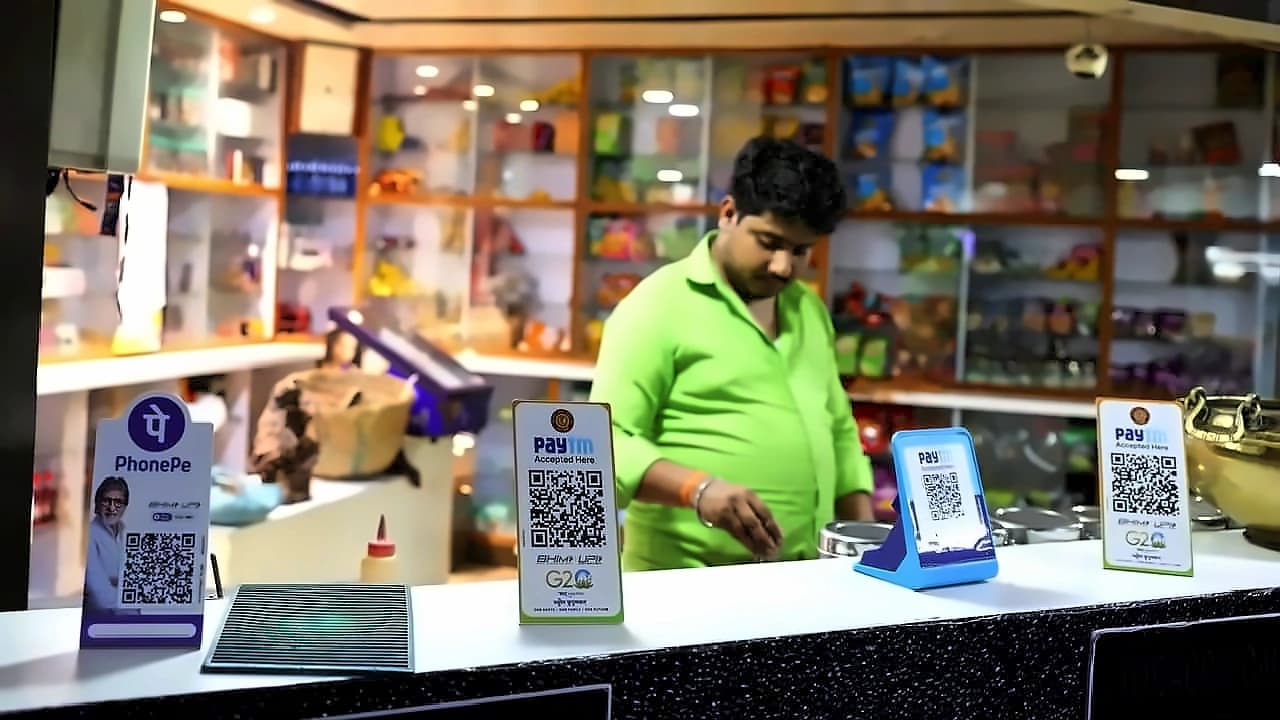
The National Payments Corporation of India (NPCI) has refuted media reports regarding GST implications on UPI Merchant Discount Rate (MDR). According to NPCI's statement, merchants with monthly UPI receipts of up to ₹1 lakh are not liable to pay MDR and therefore do not even have the issue of GST on MDR. The clarification addresses concerns that GST on MDR would impose additional burden on small merchants, stating that over 96% of total transactions to merchant are up to ₹2,000, bringing the majority of merchants outside the MDR scope. As per NPCI, the GST a merchant pays on MDR will be adjusted against the GST applicable on the sale of goods, similar to how input taxes are set off against output tax liability, meaning merchants do not bear the cost of GST on MDR amounts paid.
The government's decision to impose merchant charges on some Unified Payments Interface (UPI) transactions has created confusion among digital payment players regarding merchant classification. According to reports from Business Standard, merchants receiving up to ₹1 lakh a month in eligible UPI payments fall under the 'small merchant' category and can continue accepting UPI payments without paying the new 0.4% Merchant Discount Rate (MDR). However, if a merchant receives more than ₹1 lakh in UPI payments for three consecutive months, the classification changes to the Person-to-Merchant (P2M) category, where eligible UPI transactions above ₹2,000 can attract MDR. The ₹1 lakh limit is not linked to the merchant's total business turnover but applies only to eligible UPI payments received through QR codes and credited directly to the merchant's account. As per the latest implementation from October 15, 2026, the ₹2,000 threshold is not a blanket trigger on every QR payment in India, with government data showing around 96% of P2M transactions are expected to remain unaffected because they are below the threshold or fall within small-merchant protection.
As reported by Business Standard, the ₹1 lakh limit is not linked to the merchant's total business turnover but applies only to eligible UPI payments received through QR codes and credited directly to the merchant's account. According to Ranadurjay Talukdar, partner and payments sector leader at EY India, the threshold comes from the earlier P2PM operating model for small and unorganised merchants and serves as a simple, system-observable proxy for merchant scale. The limit does not include cash, card or other non-UPI receipts, covering only eligible UPI payments received through QR codes and credited directly to the merchant's own account. The ₹2,000 threshold is not a blanket trigger on every QR payment in India, with government data showing around 96% of P2M transactions are expected to remain unaffected because they are below the threshold or fall within small-merchant protection. The Finance Ministry has clarified that a merchant is not moved to the P2M category after crossing ₹1 lakh in a single month, using transaction velocity checks to monitor the threshold, providing protection against one-off rises in collections.
According to the finance ministry, as reported by Business Standard, a merchant is not moved to the P2M category after crossing ₹1 lakh in a single month. The ministry uses transaction velocity checks to monitor the threshold, providing protection against one-off rises in collections. For instance, higher sales during festivals, wedding seasons, or temporary sales events would not change a merchant's status after just one month. However, three months can still cover an entire seasonal cycle for businesses linked to tourism, festive retail, agriculture, or education. The ₹2,000 threshold does not apply to every business - essential and thin-margin categories receive a flat ₹5 rate on applicable payments above ₹2,000, while capital-market payments carry 0.02% MDR subject to the cap. The government's pricing structure ensures that small payments remain free, with every merchant payment up to ₹2,000 remaining outside the MDR framework.
As reported by Business Standard, experts have raised concerns about merchants using multiple QR codes, UPI handles, or bank accounts to make it harder for acquiring institutions to determine total UPI collections. Sridhar Guntuku from Decentro noted that identifying the same merchant across different payment channels can be difficult with current tools. The effectiveness of the process depends on how consistently merchant information is captured, standardised, and mapped across ecosystem participants. Talukdar highlighted that patterns such as repeated monthly receipts just below ₹1 lakh, sudden shifts in transactions between linked QR codes, or multiple merchant identities operating from the same location could require scrutiny. The biggest consumer concern is whether merchants can simply add 0.4% to a bill and call it a UPI fee. The official framework says MDR is a merchant charge, and banks have been advised to stop direct pass-through to customers, while UPI application providers cannot impose platform fees or hidden transaction charges. The ₹300 ceiling means the effective rate falls away on large payments, with the rate decreasing from 0.4% up to ₹75,000, 0.30% on ₹1 lakh, and 0.06% on ₹5 lakh.
The new UPI framework creates an unusual economic experiment that could reveal insights into consumer spending behavior. According to recent analysis, the ₹2,000 threshold creates a particularly interesting boundary that researchers could examine through the concept of Marginal Monetary Sacrifice (MMS). This economic idea asks how much additional money a person is willing to give up to complete a transaction, with the decision revealing something about the value the buyer places on the transaction. The government's policy creates a relatively narrow boundary around which behavioral changes can be observed, potentially providing valuable data for economists studying money demand and payment method substitution. For economists, the boundary may prove more revealing than the fee itself, as it could help develop a Marginal Monetary Sacrifice Index that accounts for income, merchant category, payment frequency and other factors. The framework's implementation produces detailed behavioral records that researchers could use to compare payment behavior before and after transaction cost changes, with appropriately anonymised data and careful controls.