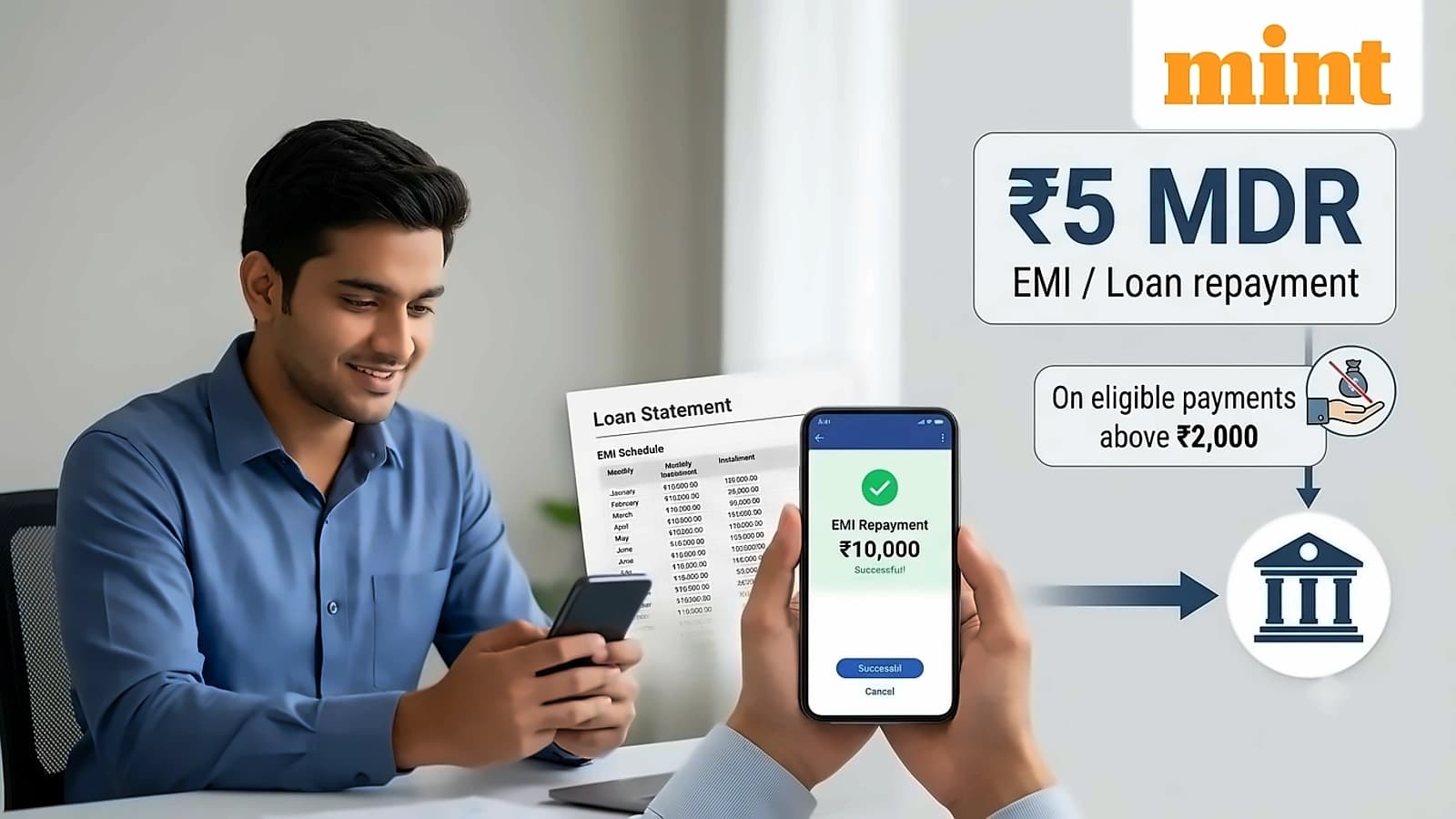
The National Payments Corporation of India (NPCI) has issued crucial clarification to non-banking finance companies (NBFCs) regarding UPI loan repayment charges. According to sources reported by Moneycontrol, loan or EMI payments will incur a flat fee of ₹5 and not a 0.4% merchant discount rate (MDR). This clarification addresses significant confusion among banks and payment aggregators over how to categorise loan repayments. The charge, to be paid by merchants, has been capped at ₹300 for transactions of ₹75,000 and above. NPCI operates UPI, the country's most popular digital payments platform, which is also the dominant channel for loan repayments.
The ₹5 flat fee is a charge on the merchant side and should not be assumed to be an additional cost for the borrower. As reported by Mint, in a normal UPI lending transaction, the lender or the collection agency will pay this fee. For credit card payments, the credit card issuer who receives the payment pays the MDR. According to Siddharth Maurya, Managing Director of Vibhvangal Anukulara, in credit card payments, the cost of processing the payment is charged by the merchant bank to the card company. Government sources have confirmed that no charge will be levied on person-to-person transactions regardless of the amount, with the MDR being capped at ₹300 for transactions of ₹75,000 or more. According to Moneycontrol reports, only loan payments under the autopay mandates attract a ₹5 flat fee, while banks and payment aggregators had previously classified NBFC payments under the financial services category with an MDR of 0.4%.
The clarification is particularly crucial for UPI AutoPay transactions, which face significant operational challenges. According to Moneycontrol data, business declines average nearly 74% across the top 50 banks for UPI AutoPay transactions due to insufficient funds. More than 20 million AutoPay mandates are being revoked every month because customers lack the funds to fulfil them. When these borrowers later make direct, manual payments to the NBFCs to clear their dues, the choice of merchant category code determines whether they are hit with the 0.4% MDR or the flat ₹5 fee. This classification confusion has been a major concern for the fintech lending sector.
There is a clear distinction between using credit to make a purchase and subsequently repaying the loan or EMI linked to that purchase. According to Mukesh Pandey, Founder and MD of Rupyaapaisa.com, for example, if a consumer buys a TV worth ₹60,000 from an LG store using an EMI loan, the MDR rules would apply to the original ₹60,000 purchase, depending on the payment method used. However, the subsequent ₹5,000 monthly EMI payments will not be subjected to MDR treatment. Government sources have confirmed that small merchants using QR codes for up to ₹1 lakh monthly are exempt from the new charges, shielding about 96% of all merchant transactions.
The MDR by itself is not designed to affect the EMI or repayment amount of the borrower, with the government clarifying that borrowers cannot bear the MDR. According to Mint reports, certain lenders may be affected by higher costs of payment processing, which might change certain calculations. However, any additional fee charged should be compliant with lending rules. Pandey noted that structuring loans only for the purpose of avoiding MDR may lead to practical and regulatory issues, emphasizing that borrowers should check the overall cost of credit and not only the EMI amount. Government sources have dismissed criticism that the MDR is a tax on consumers, stating that not a single penny from the proposed MDR will go to the government coffers.