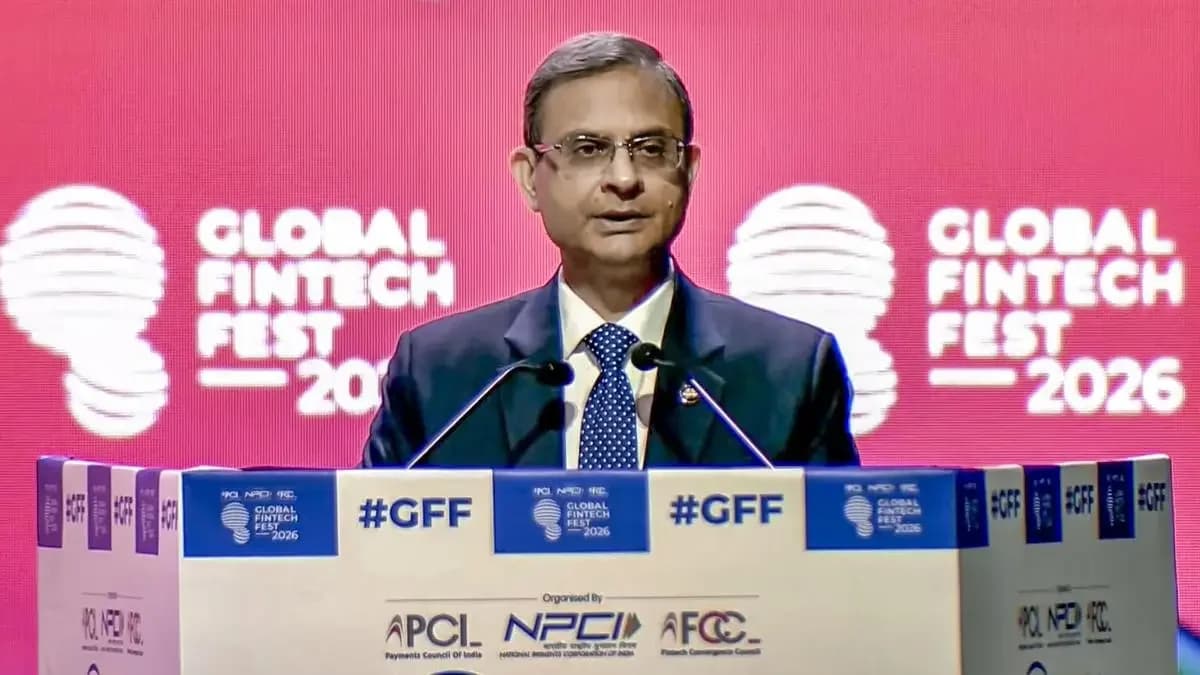
India has emerged as the world's third-largest fintech ecosystem, with more than 14,000 entities and annual growth of around 14 per cent, according to IMF data cited by RBI Deputy Governor Shirish Chandra Murmu at the Global Fintech Fest 2026 in Mumbai. The sector has attracted investments crossing $40 billion over the past decade, driven by rapid expansion through initiatives including Jan Dhan accounts, Aadhaar, mobile connectivity and interoperable payment infrastructure. UPI alone processed about ₹24,162 crore transactions worth nearly ₹314 lakh crore in FY26, accounting for roughly 85 per cent of digital payment volumes. As per The Economic Times, India today accounts for close to half of the world's real-time payment transactions, with UPI rivaling the largest global card networks by daily count, though not on a like-for-like basis as it also carries person-to-person transfers. The Reserve Bank's digital payments index rose from a base of 100 in March 2018 to 516 in September 2025, while the financial inclusion index increased to 70 in March 2026 from 67 a year earlier, with the latest improvement driven largely by greater usage rather than simply wider access.

Speaking at the Global Fintech Fest, RBI Deputy Governor Shirish Chandra Murmu highlighted that quantum computing could challenge important aspects of finance, offering potential breakthroughs in optimization and financial modeling while posing significant risks to existing cryptographic systems. He warned of the 'harvest now, decrypt later' risk, under which encrypted information collected today becomes accessible as computing capability advances. Murmu emphasized that quantum resilience cannot be developed by individual institutions working independently, noting that banks, payment operators, fintech companies, technology providers and standard-setters must move together as quantum resilience is an ecosystem capability, not an institutional one. The RBI has constituted an expert committee on a Quantum Secure and Adaptive Financial Ecosystem to help prepare India's financial infrastructure for quantum computing risks.
Murmu cautioned that the scale of digital finance has heightened risks, making operational resilience, cybersecurity, fraud prevention and customer protection key priorities. He emphasized that cybersecurity is no longer merely an IT issue; it is an enterprise-wide and increasingly ecosystem-wide risk, with vulnerabilities at one participant potentially affecting several others. The Deputy Governor noted that payment systems operate 24x7x365, and institutions must design for stress, not only for normal operations. Redundancy, business continuity, incident response and recovery must be built into the architecture and its governance - and disruptions must be communicated to customers promptly and honestly. The exclusive 'bank.in' domain for banks is one such measure aimed at helping customers distinguish genuine banking websites from fraudulent ones. Fraud prevention also needs a broader ecosystem approach, spanning banks, payment operators, fintech companies, telecom providers and law-enforcement agencies, with the RBI developing a digital payments intelligence platform through the Reserve Bank Innovation Hub and its MuleHunter.AI initiative using artificial intelligence and machine learning to identify mule accounts.
Speaking at the Global Fintech Fest, RBI Deputy Governor Shirish Chandra Murmu emphasized that digital lending should not merely make the process of extending credit faster, but should also make credit 'better' as well as faster. He warned that algorithms used to make or materially influence credit decisions must be able to explain why a borrower has been rejected, putting accountability and explainability at the centre of expectations for technology-driven lending. Murmu cautioned that algorithms can produce decisions that are statistically effective without being readily understandable, with the RBI's concern that past relationships may not persist, a model may be economically inappropriate despite its statistical sophistication, and complex models may be difficult to explain to a customer whose application has been declined. The Deputy Governor stressed that 'the answer cannot be the algorithm' - responsibility rests with the regulated institution, while boards and senior management must understand the models they deploy, their limitations and the consequences of using them.
Murmu urged fintech companies to treat financial inclusion as a design requirement rather than a later addition, emphasizing that digital innovation can exclude unintentionally people with limited connectivity, low digital literacy, disabilities, language constraints or no smartphone. He stressed that while technology could distribute financial services, it couldn't distribute responsibility, with regulated lenders remaining accountable for services delivered in their name. Under the RBI's Digital Lending Directions, 2025, technology can change the channel through which credit is delivered but does not dilute the responsibility of the regulated lender. UPI 123Pay, offline payments and the Aadhaar-enabled payment system are among the mechanisms that can extend digital finance to customers in less-connected and assisted environments. Borrowers must know who is lending to them, the cost of the loan and its terms, while technology should widen customer choice rather than steer borrowers towards unsuitable products. The RBI has also issued a Discussion Paper on curbing digital payment frauds, particularly authorised push payment frauds, with responses currently under examination.
Reserve Bank of India Governor Sanjay Malhotra outlined the central bank's approach to fintech regulation at the Global Fintech Fest 2026 in Mumbai on Thursday. According to reports from ANI, Malhotra emphasized that the RBI's objective is not to make every fintech company resemble a bank, but to ensure that entities performing critical financial functions appropriately manage the risks they create. 'Innovation and regulation are not adversaries,' Murmu stated, adding that regulation creates the confidence needed for innovation to scale, while responsible innovation gives regulators confidence to allow experimentation. The Governor explained that the RBI follows the principle of 'same activity, same risk, same regulatory treatment' irrespective of who performs an activity, while taking into account the capacity of different entities. As per The Economic Times, Murmu noted that the measure of success for a payment system is not only the number of transactions it processes each second, but the trust embedded in each of those transactions. He emphasized that technology can distribute a service, but it cannot distribute responsibility, with data-driven finance requiring trust-driven approaches where customer consent should be genuine, data collection proportionate to its purpose and security maintained throughout the credit lifecycle.