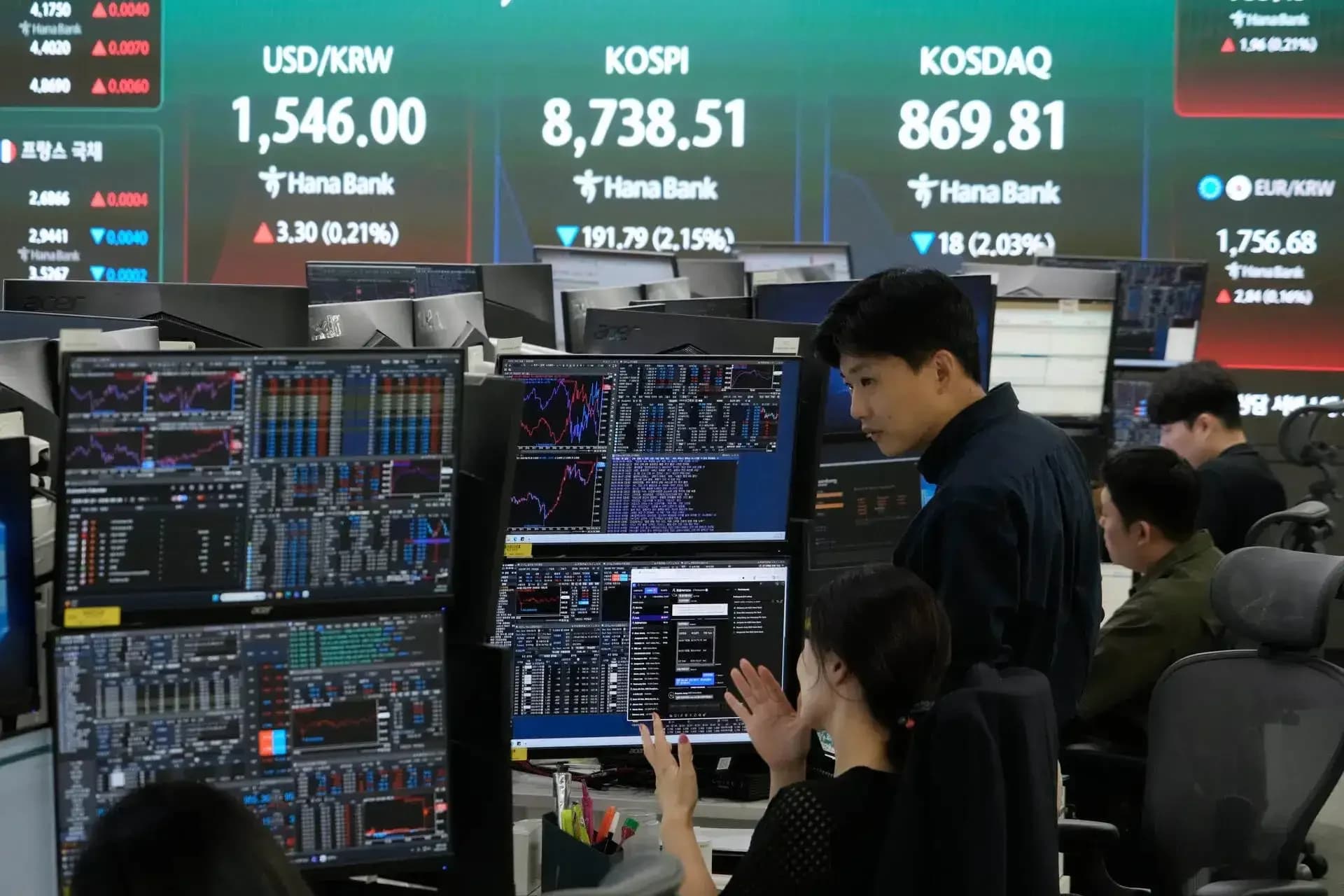
US stocks experienced significant declines on Friday, October 16, as investors processed mounting concerns around artificial intelligence trade financing and AI investment returns. According to CNBC TV18, the Nasdaq 100 dropped 2.5%, continuing its longest losing streak since 2008, while the S&P 500 ended 1.1% lower and the Dow Jones fell 175 points to 35,179.90. For the week, the Nasdaq ended 4% lower, marking its worst weekly drop since June, while the S&P 500 posted a 2% weekly loss. This divergent performance reflects the market's selective approach to different sectors amid ongoing AI financing uncertainties, with the Dow managing to post a weekly advance of 0.7% despite broader market weakness. As per Goodreturns, the Dow Jones fell by 175.28 points or 0.34% to 52,002.41 after Fed Chair Kevin Warsh's speech at IMF Bangkok meeting, but still managed to end the week in positive territory with 237.09 points gains or 0.5% due to strong Q3 earnings from major banks.

The semiconductor selloff extended significantly on Friday, with the VanEck Semiconductor ETF falling 3% on Friday and 10% for the week—the most it has fallen weekly since April 2025. As reported by CNBC TV18, CoreWeave shares fell another 11% on Friday, taking its week-to-date loss to 25%, with the company's total debt now rising to $51 billion. Other major chipmakers also declined sharply, with AMD, Broadcom, and Intel down between 4% to 6% on Friday, while memory chip makers Sandisk, Western Digital and Seagate fell between 7% to 7.5% overnight. The chip stocks-heavy Nasdaq 100 index ended the session with losses of 2.5%, marking the eighth consecutive session of declines—their longest losing streak since 2008. According to Goodreturns, CoreWeave plunged 11.9%, extending its weekly losses to 23.7%, highlighting renewed credit concerns surrounding AI infrastructure companies. The sector has come under pressure following relatively modest revenue figures from Anthropic and growing concerns about higher interest rates for heavily indebted companies.
The Wall Street sell-off has significantly increased market volatility, with the Cboe Volatility Index (VIX) jumping past the 22 mark for the first time since June, and market participants expecting it to go much higher in the near-term. According to CNBC TV18, fears of competition from China and struggles over debt repayments of companies engaged in massive data center buildouts have contributed to the heightened volatility. The market's fear gauge crossing the 22 threshold represents a significant escalation in investor uncertainty, reflecting concerns about the sustainability of AI-related investments and their potential impact on broader market stability. As per Goodreturns, the tech-heavy Nasdaq Composite crashed by 573 points or 2.14% to close at 26,140.03 on October 16, extending its weekly loss to 1,212.48 points or 4.4%. The S&P 500 index slipped by 84.62 points or 1.09% to end at 7,659.44, with the overall week's crash of 153.60 points or 1.97%.
Federal Reserve Chairman Kevin Warsh maintained a neutral stance on interest rates during discussions at the IMF meetings in Bangkok, providing some clarity amid market uncertainty. According to Bloomberg, Warsh avoided commenting on the monetary-policy outlook or the US economy beyond reaffirming the Fed's commitment to price stability. He also said he would not prejudge the central bank's remaining policy meetings of the year. Higher interest rates further complicated the outlook by reducing the present value of future earnings and increasing the cost of financing the infrastructure needed for the next phase of AI expansion. The uncertainty renewed demand for safe-haven US Treasuries, helping bonds pare earlier losses. As per Goodreturns, Warsh specifically avoided giving any clear guidance on FOMC's next rates decision, with the Fed set to declare their bi-monthly monetary policy in the end of October. He shed light on rising energy prices, persistent inflation and higher borrowing costs that create unprecedent uncertainty on the overall global economy, while remaining optimistic about US economy's growth ahead and believing artificial intelligence to become a major driving factor for future growth.
Oil prices continued their positive momentum, with Brent crude jumping to $110 per barrel overnight as Iran escalated attacks in the Strait of Hormuz while Ukraine and Russia continued attacking each other's energy infrastructure. According to CNBC TV18, the sharp jump in crude oil prices further soured sentiment on Wall Street. As per Goodreturns, crude oil has emerged as a key risk, with Brent touching $110 a barrel, with a sustained move near these levels potentially adding to inflationary pressures and complicating the outlook for domestic yields and corporate earnings. US CPI inflation rose to 3.7% in September 2026, higher than market estimate of 3.6%, with inflation surging from 3.4% in the previous month. The reason is the sharp spike in energy prices with gasoline rising by 34.2% YoY and fuel oil prices increasing by 74.2% YoY. The U.S. 10-year Treasury yield, at around 5.081%, continues to keep global financial conditions restrictive, potentially limiting the appeal of emerging-market equities even as domestic earnings provide support. Despite the market turmoil, Nvidia CEO Jensen Huang continues to express optimism about AI's transformative potential, telling Bloomberg during an interview in Berlin that "It's going to be transformative. It's going to impact in a very positive way every single industry and every single country. There's no question it will continue, and we're at the beginning of that."