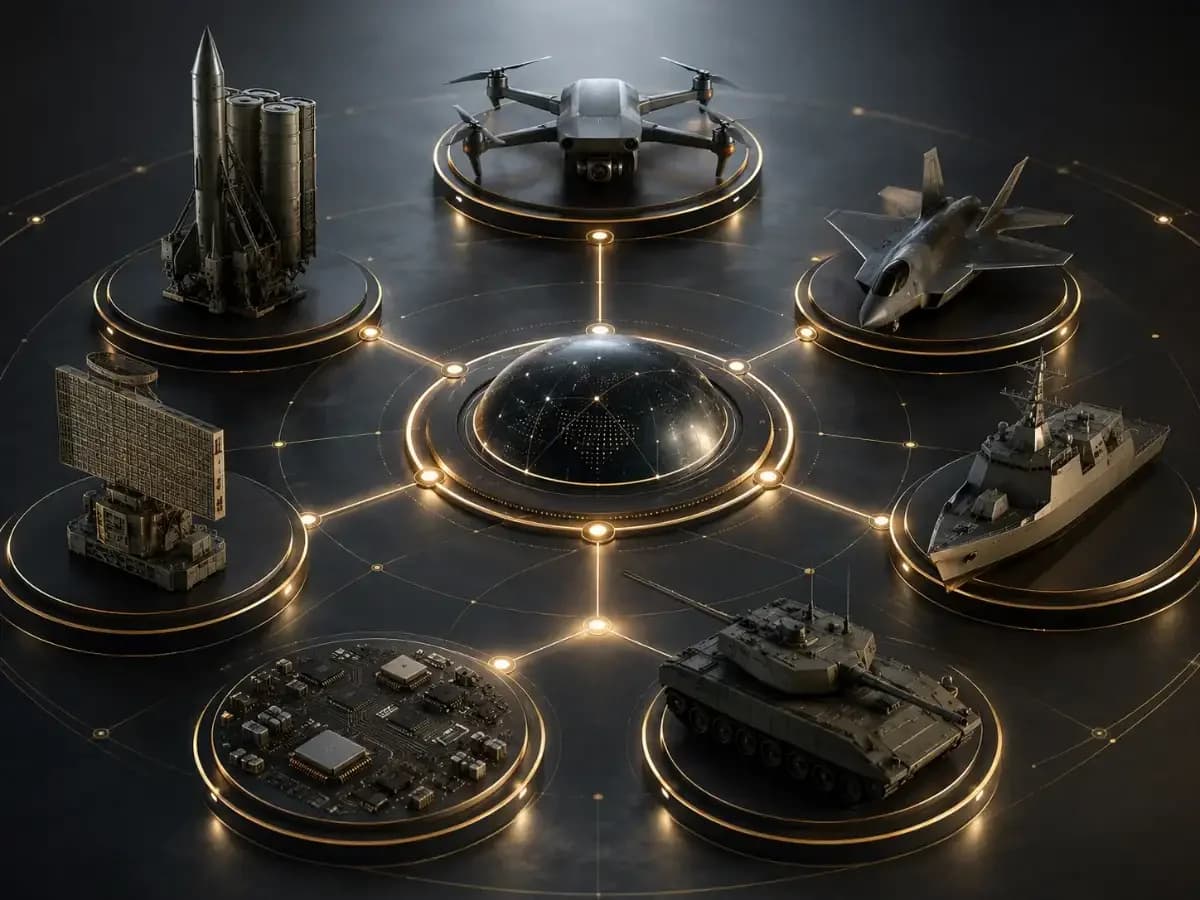
The global defence sector is experiencing unprecedented growth in 2026, driven by escalating geopolitical tensions and technological advancement. According to recent SIPRI-linked analysis, global military spending reached a record $2.89 trillion in 2025 as Europe and Asia accelerated defence investment amid worsening geopolitical instability. BAE Systems has emerged as a key beneficiary, with the company's order backlog nearly doubling since the Ukraine war began and shares surging dramatically as investors anticipate years of elevated military spending. The sector is increasingly being treated as a structural long-term growth theme, with governments prioritizing national security at levels not seen since the Cold War.
Data Patterns (India) has emerged as the top performer with a 62% surge in 2026, rising from ₹2,623 on January 1 to around ₹4,150 currently. The company delivered strong Q3 FY26 performance with revenue growing 48% year-on-year to ₹173 crore and net profit increasing 31% year-on-year to ₹58.3 crore, while maintaining a healthy Ebitda margin around 45%. Krishna Defence and Allied Industries followed with a 41.7% rally, climbing from ₹809 to ₹1,147, backed by record-breaking Q3 FY26 performance where revenue grew 23.4% year-on-year to ₹63.7 crore and net profit surged 163.9% year-on-year to ₹10.2 crore.
Garden Reach Shipbuilders & Engineers (GRSE) has surged 26.3% in 2026, rising from ₹2,450 to ₹3,094, following strong Q4 FY26 performance with revenue rising 29% year-on-year and net profit expanding 24% year-on-year. The company reported its best-ever financial performance in FY26 with revenue crossing ₹7,000 crore and net profit reaching ₹748 crore. Astra Microwave Products has maintained strong performance with a healthy order book of ₹2,226 crore as of December 2025, while Zen Technologies has rallied 18.1% from ₹1,373 to ₹1,622 despite Q4 FY26 revenue declining 45% year-on-year to ₹178 crore due to order execution delays.
Japan is positioned for a significant breakthrough in the global defence market following the lifting of its decades-old arms export ban. According to the country's ministry of economy, trade and industry, the defence business was previously less attractive due to lower profit margins and limited growth potential, prompting companies to withdraw from the sector. However, the lifting of the arms export ban is set to increase Japanese production capacity by incentivizing companies to produce weapons at scale during peacetime, while also bolstering Japan's wartime readiness. Traditional domestic heavyweights like Mitsubishi Heavy Industries, Kawasaki Heavy Industries, IHI Corporation, and Mitsubishi Electric are expected to gain the most from this development, with their scale required for international procurement.
The defence sector is being fundamentally transformed by artificial intelligence and autonomous systems, with modern militaries rapidly investing in AI-first military systems that enable real-time battlefield analytics and intelligent swarm coordination. Britain is positioning itself as one of the world's leading defence AI powers, with BAE Systems significantly expanding its digital intelligence operations focused on military intelligence systems. The Ukraine conflict and Middle East tensions have accelerated the global drone warfare revolution, with governments racing to produce cheaper and faster autonomous systems capable of responding to modern battlefield realities. Cybersecurity has become one of the fastest-growing areas inside the defence sector, as governments increasingly view cyber warfare as central to national security.
According to Equitymaster.com, India's defence sector benefits from the government's strong focus on 'Make in India', higher defence allocation, border security, and technological self-reliance. The sector is seeing rising investments in anti-drone systems, electronic warfare, radars, naval platforms, combat robotics, missile systems, and aerospace electronics. GRSE expects its order book to strengthen significantly from ₹18,400 crore currently to nearly ₹50,000 crore by the end of FY26, while Krishna Defence is positioned well with India's navy targeting 175-200 warships by 2035 and a record defence budget of ₹7.85 trillion in FY27. The global defence landscape is evolving rapidly amid rising geopolitical tensions, making defence modernisation and indigenous manufacturing major priorities globally.