TCS shares tumbled around 4% on Wednesday, recording the biggest single day plunge in more than two months after Tata Sons Chairman N Chandrasekaran resigned from his position. According to The Economic Times, the shares closed at around ₹2,350 apiece on NSE, wiping off around ₹35,000 crore from its market capitalisation and dragging it down to ₹8.5 lakh crore. The stock closed as the top loser on benchmark indices Sensex and Nifty, as well as sectoral index Nifty IT which it pulled down 1.5%, making it the top sectoral loser. At 1:30 pm on August 12, 2026, TCS was down the most by over 5% among all Tata group listed stocks, demonstrating the severity of the impact on the company.
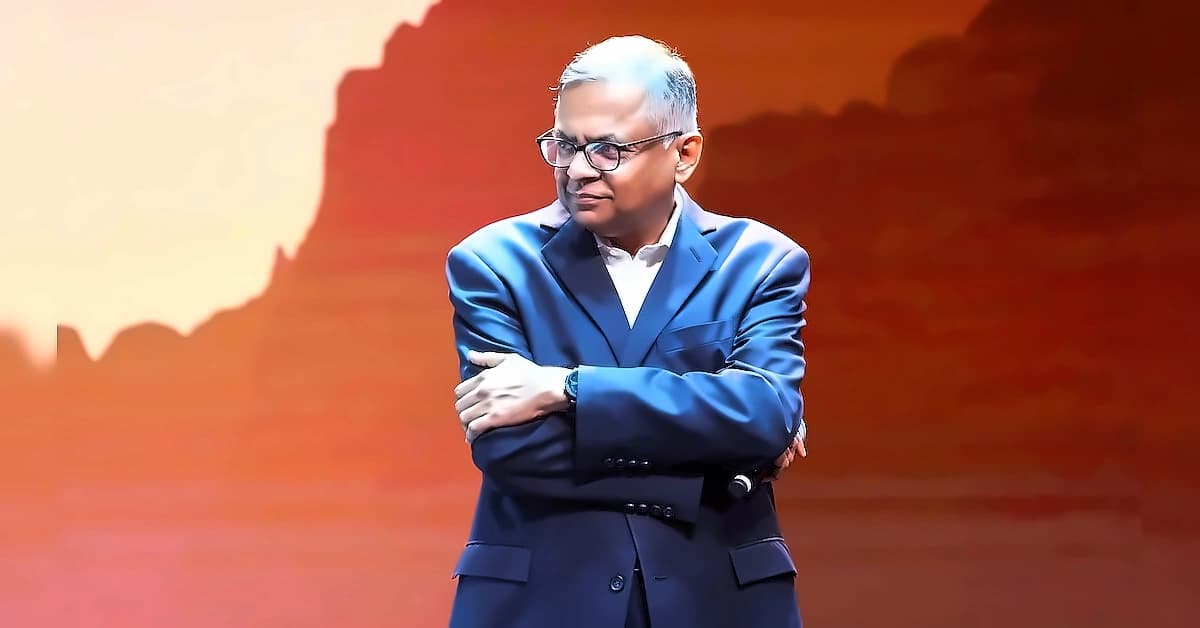
N Chandrasekaran resigned as Tata Sons Chairman after one Board member did not support the proposal to extend his tenure. As per The Economic Times, Chandrasekaran's current tenure as chairman of Tata Sons ends on February 20 next year. In his resignation statement, Chandrasekaran emphasized that "Tata Sons is a very large institution and there are many strategic projects that are under critical stages of execution." He noted that "It is not only necessary to have a leader in place to lead the Group beyond Feb 2027, but also clarity on leadership is important for employees, investors, partners and other stakeholders." Chandrasekaran's long association with TCS spans his entire corporate career, having joined the Tata Group in 1987 as an intern, becoming TCS CEO in 2009, and taking over as Tata Sons chairman in 2017. According to Business Standard, many senior leaders at TCS were aware that Chandrasekaran would make such a decision, with the change likely to be felt most at TCS.
For the quarter-ending June 2026, TCS reported consolidated revenue of ₹72,275 crore, representing an increase of approximately 2.23% from ₹70,698 crore in the quarter-ending March 2026. As reported by Moneycontrol, net profit for the same period stood at ₹13,420 crore, a slight decrease of about 2.64% from ₹13,784 crore in the previous quarter. The Earnings Per Share (EPS) for the quarter-ending June 2026 was ₹36.90.
The leadership transition marks a significant shift for TCS as it navigates AI disruption without Chandrasekaran's deep expertise. As per Business Standard, Chandrasekaran spent the majority of his career at TCS and understands its people, clients, economics, and competitive dynamics at an extraordinary level. TCS CEO and MD K Krithivasan had the unique advantage of having a group chairman sitting above him who previously ran the same company. According to HfS analyst Phil Fersht, "Chandra was instrumental in TCS' foray into data centre services, forming a strategic partnership with TPG and setting up HyperVault, with TPG making an initial investment of $1 billion." A Bank of America note highlighted that Chandra's familiarity with the company meant involvement in strategic and leadership planning, including the company's planned pivot to AI services announced last year. The current leadership at TCS, including CEO Krithivasan and COO Aarthi Subramanian, will now have to steer the company through AI disruption without Chandrasekaran's expertise.
The leadership transition carries significant financial implications for the broader Tata Group, with Tata Sons receiving ₹28,291 crore in dividends from TCS in FY26, down from a record ₹32,184 crore in the previous year. As per Tata Sons annual reports, this decline assumes significance because dividends and buybacks from TCS have historically been a major source of cash for Tata Sons, helping fund investments in group companies, pay dividends to shareholders, and support businesses such as Air India and Tata Digital. Tata Sons received a cumulative ₹1.81 lakh crore from TCS through dividends and buybacks between FY20 and FY26, making the current reduction particularly noteworthy for the group's financial planning.