The Indian stock market will remain closed on Friday, June 26 as NSE and BSE observe a trading holiday for Muharram. According to The Economic Times, this marks the second exchange holiday in nearly a month, following the last market closure on May 28 for Bakri Id. A total of 16 stock market holidays have been scheduled for 2026, out of which nine have already passed. After the Bakri Id holiday, trading will remain suspended on seven more occasions over the remaining nine months of the year. This will be a curtailed week for stock market trading, as the country's major stock exchanges will remain closed for the entire weekend.
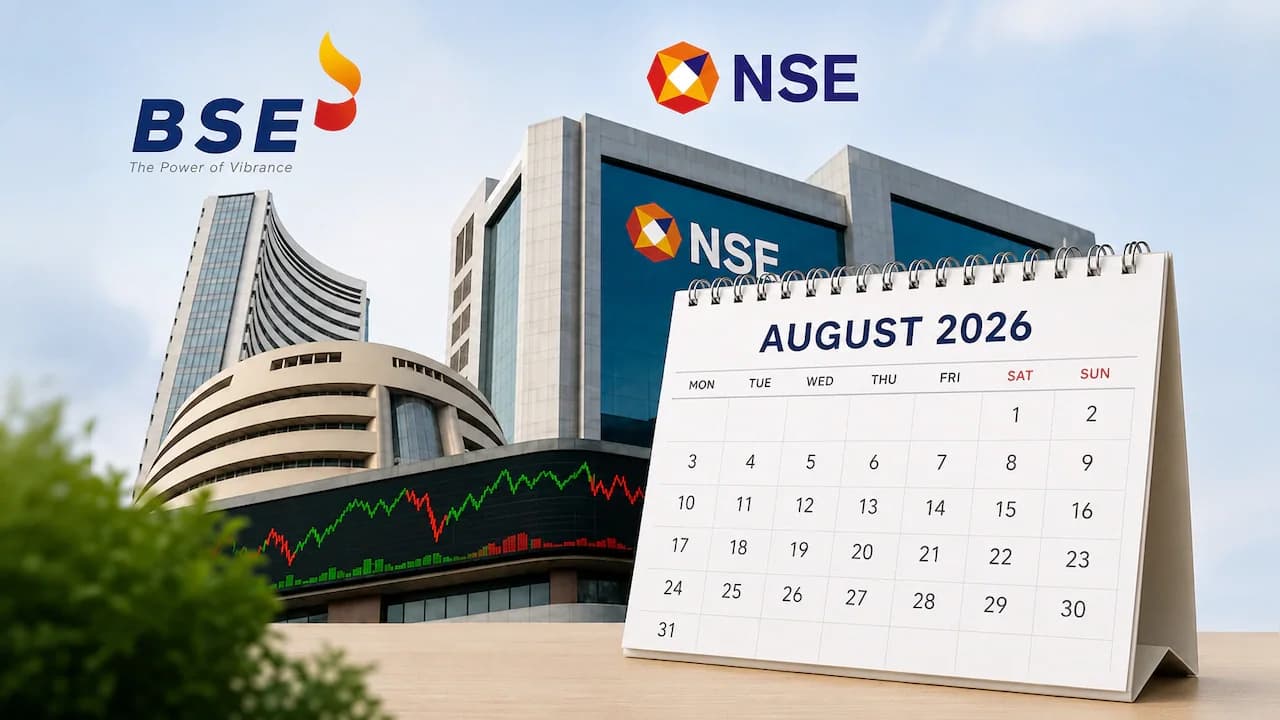
Since the holiday falls on a Friday, it creates a long weekend for the markets, with trading resuming only on Monday, June 29. This means no domestic market activity for three straight days - Friday, Saturday, and Sunday. The closure comes at a time when global cues remain active, so domestic participants will need to adjust positions before Thursday's close. For institutional investors, this also means portfolio adjustments may be completed before Thursday's close, especially in sectors sensitive to global cues such as oil, IT, and financials. After this holiday, there will be no stock market holidays for the next two months, i.e., July and August, providing a significant gap in the holiday calendar.
Trading will remain suspended across all major segments during the holiday period. As reported by The Economic Times, this includes equity cash markets, equity derivatives, currency derivatives, securities lending and borrowing (SLB), and electronic gold receipts (EGR). There will be no settlement activity or intraday trading on June 26. Market infrastructure systems will remain inactive for the day as per standard holiday protocols. This kind of full-market closure typically reduces short-term volatility in domestic markets, but global events during the break can still influence Monday's opening.
The Multi Commodity Exchange (MCX) will follow a partial holiday schedule on June 26, with the morning session from 9 am to 5 pm remaining closed, however, the evening session will resume as usual from 5 pm to 11:30 pm or 11:55 pm, depending on trading products. According to The Economic Times, the National Commodity and Derivatives Exchange (NCDEX) will remain fully shut during this period. This split schedule ensures continuity in international-linked commodity trading, especially crude oil and bullion, which often react to global price movements. Consequently, commodity traders will be able to conduct their business and trade in the market as usual during the evening hours. Banking operations will also be impacted in several states on June 26, with banks remaining closed in most major cities for Muharram. However, banking services will continue in select locations including Ahmedabad, Bhubaneswar, Chandigarh, Dehradun, Gangtok, Guwahati, Imphal, Itanagar, Jaipur, Kochi, Kohima, Panaji, Shillong, Shimla, and Thiruvananthapuram. In addition, banks across the country will remain closed on June 27 as it is the fourth Saturday of the month, which is a mandatory holiday under Reserve Bank of India (RBI) rules.

The next market holiday will fall on Monday, September 14 for Ganesh Chaturthi. As reported by The Economic Times, markets will also remain closed on October 2 for Gandhi Jayanti, October 20 for Dussehra, November 10 for Diwali Balipratipada, November 24 for Guru Nanak Jayanti and December 25 for Christmas, which will be the final market holiday of 2026. Diwali Laxmi Pujan will fall on a Sunday this year, though exchanges will conduct the customary Muhurat Trading session on November 8. The NSE has already announced that details of Muhurat Trading will be provided later via a circular. Following Friday's Muharram holiday, the stock market will remain open for nearly three months before the next scheduled holiday on September 14 for Ganesh Chaturthi.