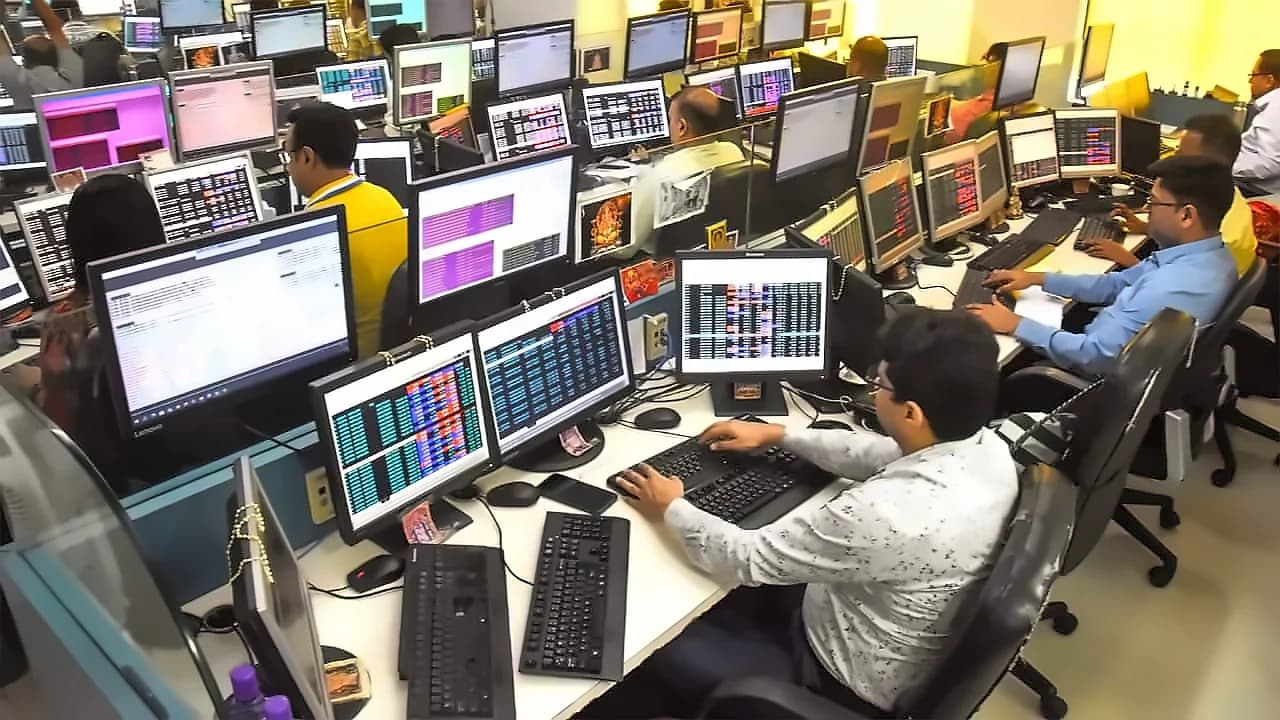
The Indian stock markets closed higher on June 25, 2026, with the SENSEX rising 109.25 points or 0.14% to close at 77,100.47, while the NIFTY50 edged higher by 34.35 points or 0.14% to end at 24,056. However, markets shed their initial gains amid profit booking during the session. The SENSEX dropped 703 points from its intraday high of 77,803.18 to end at 77,100.47, while the NIFTY50 hit an intraday high of 24,261.60 but closed at 24,056. According to market reports, the SENSEX gained as much as 1.05% to hit an intraday high of 77,803.18, while the NIFTY50 rallied as much as 1% to touch the session's peak of 24,261.60. The NSE's India VIX, a gauge of the market's expectation of volatility over the near term, fell 2.05% to 13.05, indicating reduced market uncertainty. Of the 4,406 stocks traded, 1,656 advanced while 2,556 declined and 194 remained unchanged, with 148 stocks hitting 52-week highs and 58 touching 52-week lows. The gains came after benchmark indices soared more than 1% in the afternoon before erasing most of the intraday advances on Sensex monthly expiry day.

The NIFTY50 was led by InterGlobe Aviation, the parent company of IndiGo, which closed 5% higher after the stock jumped 5% to lead gains on Sensex. As reported by market sources, the stock gained as global crude oil prices slipped to pre-war levels. Mahindra & Mahindra followed with a 4% gain, while Maruti Suzuki rose nearly 4%. Other notable gainers included Max Healthcare Institute (3.81%) and Tata Consumer Products (3.04%). The strong performance in these sectors helped drive the overall market gains despite profit booking at higher levels. ICICI Bank also supported the indices with a 1% gain, adding to the banking sector's positive contribution. State Bank of India (SBI), Kotak Mahindra Bank and Hindustan Unilever (HUL) shares rose around 1% each, while Auto stocks surged as crude crashed nearly 37% from its May peak, with Maruti (+4.81%), Motherson (+4.36%), TVS Motor (+4.35%), and M&M (+4.25%) leading the gains. According to Vinod Nair from Geojit Investments, auto stocks outperformed, driven by softer metal prices, easing supply chain constraints, and improving retail demand during the month.
The broader market underperformed frontline indices with significant weakness across segments. The Nifty Smallcap 100 and Nifty Midcap 100 indices fell up to 0.5%, with the BSE 150 MidCap Index declining 0.44% and the BSE 250 SmallCap Index falling 0.51%. According to market data, the midcap segment was dragged down by selling in National Aluminium Company (-4.46%), Tube Investments of India (-3.49%), Supreme Industries (-3.16%), Astral (-3.04%), and Info Edge (India) (-2.95%). On the positive side, Mahindra & Mahindra Financial Services (6.18%), Oracle Financial Services Software (4.65%), Ashok Leyland (4.01%), One 97 Communications (3.26%) and SBI Cards and Payment Services (2.80%) were among the top winners in the midcap space. The market breadth was weak with 1,641 shares rising and 2,581 shares falling on the BSE, while 192 shares remained unchanged. Among sectoral indices, Nifty Auto was the top gainer, rising 2.25%, while Nifty Metal was the biggest loser, falling 1.37%, and Nifty IT index also declined 0.86%.
The gains were primarily driven by a sharp drop in oil prices, which fell to pre-Iran war levels as stranded tankers exited the Strait of Hormuz following an initial peace deal between the US and Iran. This comes after oil prices soared to as high as $120 per barrel earlier this year and remained above $100 per barrel for most of the time since the war in the Middle East broke out at the end of February, effectively shutting the Strait of Hormuz, a narrow 33-kilometre waterway connecting the Persian Gulf with the Gulf of Oman that handles over 20% of the world's daily oil and gas shipments. The Indian Rupee also traded marginally stronger, closing at 94.39 on Thursday and for the week as falling oil prices improved sentiment alongside signs of a pickup in foreign portfolio inflows. Jateen Trivedi from LKP Securities noted that "Rupee traded marginally stronger by around 11 paise, supported by positive domestic equity markets and softer crude oil and bullion prices. The absence of aggressive FII selling has also helped keep the rupee stable around current levels." Sentiment has improved as geopolitical concerns eased following continued progress in the US-Iran talks. However, the Dollar Index above 101.50 continues to cap gains for the rupee, with the rupee expected to trade in the 94.10–94.80 range in the near term.
Market experts remain optimistic about the current momentum, with Nifty expected to head towards 24,500 in the coming week, with strong support placed at around 23,800. As per market analysts, things look positive from the current perspective as well as from the medium-term perspective. The India VIX, which measures volatility in the market, declined 2.05% to 13.05, indicating reduced market uncertainty and providing a supportive backdrop for continued gains. However, Vinod Nair from Geojit Investments cautioned that "Overall sentiment remained constructive; the continued FII outflows can limit the upside. In the near term, sentiment may be influenced by a muted Q1 earnings outlook and an uneven monsoon, which should be monitored going forward." The absence of aggressive FII selling has also helped keep the rupee stable around current levels, though possible monsoon delays or deficit and food inflation risks, along with expectations of higher US interest rates, may limit further appreciation. Foreign portfolio investors net sold shares worth ₹384 crore on Thursday, while DIIs were net buyers at ₹5,748 crore, according to latest market data.