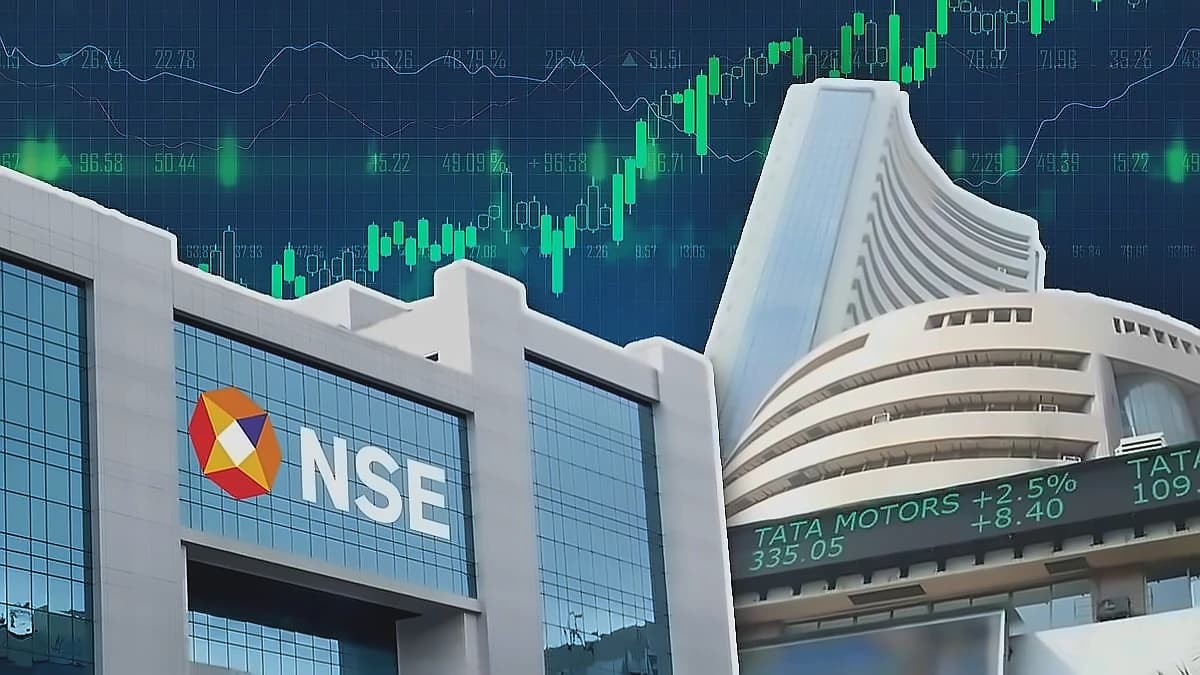
Indian stock markets opened lower on Monday with the S&P BSE Sensex declining 616.15 points to 76,946.97 and the NSE Nifty dropping 190.50 points to 24,015 in early trade. According to The Hindu, after two days of rally, the 30-share BSE Sensex tanked significantly as bearish trend in Asian peers also dragged the domestic markets lower. From the Sensex pack, InterGlobe Aviation, Tata Steel, Maruti, Asian Paints, HDFC Bank and Bajaj Finserv were among the major laggards, while Tata Consultancy Services, NTPC, HCL Tech and Power Grid were the gainers. The broader market outperformed the frontline indices, with the BSE 150 MidCap Index falling 0.56% and the BSE 250 SmallCap Index dropping 0.25%. Market breadth remained weak with 1,550 shares rising and 1,655 shares falling on the BSE, while 221 shares remained unchanged. However, foreign portfolio investors provided some support by buying shares worth ₹2,603.72 crore on Friday, July 10, 2026.
The market decline continues to be triggered by renewed geopolitical tensions between the US and Iran, with US President Donald Trump announcing during the NATO summit that the earlier ceasefire understanding and Memorandum of Understanding (MoU) with Iran had effectively collapsed. According to Reuters, the US launched fresh strikes after accusing Iran's IRGC of attacking the Cyprus-flagged cargo ship M/V GFS Galaxy in the Strait of Hormuz. Iran has said the strait will remain closed until further notice, while the US has demanded that all shipping lanes be reopened. As per The Economic Times, Trump was reported saying in Ankara, Turkey: "To me, I think it's over. I don't want to deal with them. As far as I'm concerned, it's just a waste of time dealing with them." Shrikant Chouhan, head of equity research at Kotak Securities, noted that "the sudden escalation in geopolitical tensions was unexpected and looks like it is likely to remain a near-to-medium-term headwind for the market." The developments have significantly heightened geopolitical uncertainty, with India's Volatility Index soaring 26% on Wednesday, the highest single-day jump since March 23, reflecting a sharp increase in traders' risk perception.
Brent crude, the global oil benchmark, quoted 3.96% higher at $79.02 per barrel in early trade on Monday, according to The Hindu. The escalation in geopolitical tensions has triggered a sharp rebound in crude oil prices, weighing on overall investor sentiment. September Brent was trading some 8% higher at around $79-$80 a barrel, with the West Asia conflict reigniting after the US and Iran exchanged attacks, the first escalation since the two nations signed an interim peace deal in June. The US Department of the Treasury also revoked the temporary suspension of sanctions on Iranian oil, which is seen pushing crude prices higher. For India, rising crude prices are one of the biggest macroeconomic threats as higher prices impact almost every sector of the economy because petroleum products influence transportation, logistics, manufacturing and electricity costs. Market participants will closely monitor progress between the US and Iran, along with the security of shipping routes, as these are expected to remain the key drivers of crude oil prices and overall market sentiment in the near term.
Asian markets traded lower on Monday after surrendering early gains as investors remained cautious amid renewed geopolitical tensions in the Middle East. According to The Hindu, South Korea's Kospi slumped nearly 7%, while Japan's Nikkei 225 index, Shanghai's SSE Composite index and Hong Kong's Hang Seng index also traded lower. The bearish trend in Asian peers also dragged the domestic markets lower, with the escalation in geopolitical tensions weighing on overall investor sentiment across the region. However, U.S. markets ended higher on Friday, July 10, 2026, providing some contrast to the current Asian market weakness. Market participants will closely monitor further developments in the US-Iran conflict, movements in crude oil prices, the ongoing Q1 earnings season and corporate business updates, as well as the progress of the southwest monsoon for cues on market direction.