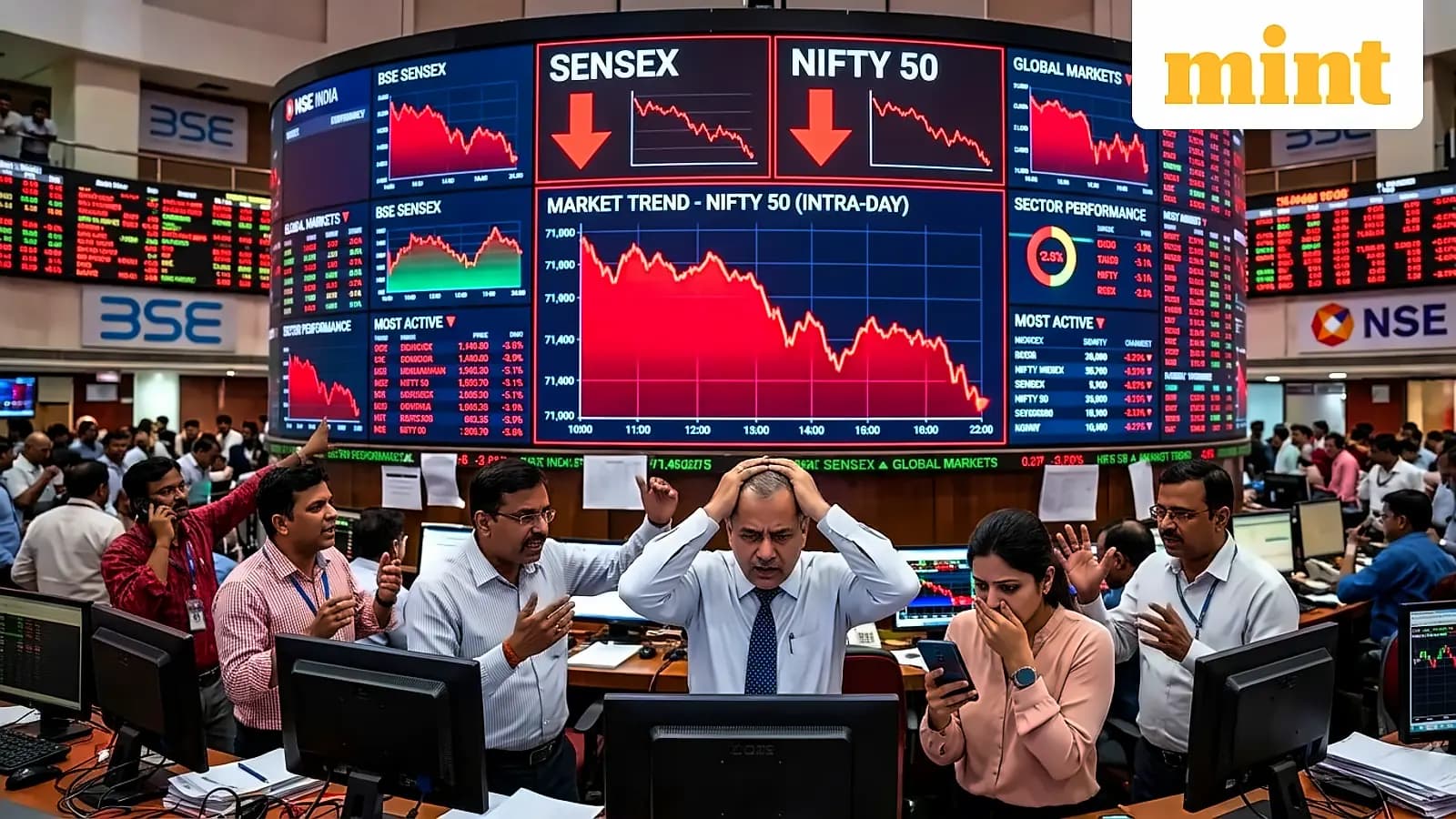
Indian stock markets witnessed intense selling pressure on Monday, with Sensex closing 372.10 points or 0.5% lower at 76,728 and Nifty ending 110 points or 0.5% lower at 23,846, after declining from day's highs. According to Business Standard, the decline comes after the benchmark indices posted a third consecutive weekly gain last week, their longest winning streak this year, as easing crude oil prices and policy measures to support the rupee and mobilise foreign currency deposits boosted investor sentiment. Market breadth was weak with 2,728 stocks declining and 1,628 advancing, while Foreign portfolio investors (FPIs) were net sellers of ₹1,350 crore, while domestic institutional investors were net buyers of ₹2,802 crore. The Nifty had crossed the 24,100 mark before facing renewed selling pressure, with selling pressure led by auto, IT, oil & gas, and banking stocks.
Persistent Systems emerged as the biggest loser, dropping more than 11% after announcing the acquisition of a 21% stake in Germany-listed Nagarro SE, with investors remaining cautious about the acquisition's financial impact despite analysts highlighting long-term strategic benefits. Astral fell 8% after announcing the demerger of its chemicals business and following a JPMorgan downgrade. Reliance Industries, Mahindra & Mahindra, Larsen & Toubro, Axis Bank and Maruti Suzuki were among the biggest drags on the Nifty, pulling the benchmark lower and ending its two-day winning streak. Eternal, Sun Pharma and Tech Mahindra shares rose over 1% each to lead gains, while Kotak Mahindra Bank, TVS Motor Company, Mahindra & Mahindra, Maruti Suzuki India, InterGlobe Aviation and Eicher Motors were the biggest laggards. The Nifty Auto index emerged as the top losing sectoral index, shedding 2%, while the Nifty Metal and Nifty Pharma indices bucked the broader market trend to close as the top gainers, with Metal and Pharma sectors up 0.5-1%. From the Sensex basket, Max Healthcare Institute Ltd, Dr Reddy's Laboratories Ltd, Eternal Ltd, NTPC Ltd, Trent Ltd and Hindalco Industries Ltd were the major gainers, as reported by CNBC TV18.
A series of tit-for-tat strikes between Iran and the US began after Iran attacked a container ship on Thursday in the Strait of Hormuz, raising concerns about the US-Iran peace deal and the movement of oil through the Strait of Hormuz, a critical chokepoint through which a fifth of the world's oil flows. However, both sides agreed to stop attacking each other before peace talks resume this week. As per Business Standard, "Profit booking persisted near key psychological levels as investors remained cautious about the sustainability of the interim US-Iran peace agreement. The market currently lacks a clear near-term direction, with expectations for the Q1FY27 earnings season remaining subdued amid supply constraints, persistent inflationary pressures, and a weak monsoon outlook, all of which are likely to weigh on margins," said Vinod Nair, Head of Research, Geojit Investments. US equity-index futures climbed after reports the US and Iran backed away from a fresh escalation of their conflict, easing concerns over the fragile ceasefire underpinning peace talks.
The Indian rupee closed modestly stronger at 94.39 on Thursday and for the week as falling oil prices improved sentiment alongside signs of a pickup in foreign portfolio inflows, while caution lingered over the prospect of US rate hikes. Falling oil prices improved sentiment and signs of a pickup in foreign portfolio inflows supported the rupee's strength. Foreign institutional investors reduced the pace of equity outflows during June, helped by easing crude oil prices and improving market sentiment. February remains the only month in 2026 in which overseas investors were net buyers of Indian equities. FPI debt flows hit 15-month high in June with $2.2 billion invested, making it the best month of the calendar year so far. The rupee is expected to open in the 94.40–94.44 range on Monday, after settling at 94.3950 on Thursday, with traders noting that last week's range reinforced that 94 to 95 is the settled band for the near term.
Going ahead, 23,850-23,800 is expected to act as immediate support for the Nifty. A decisive breach below 23,800 could trigger further downside, dragging the index towards 23,650. On the upside, the zone of 24,070-24,100 is likely to act as a key resistance, posing a significant hurdle for any sustained upward move, said Sudeep Shah, Head - Technical and Derivatives Research, SBI Securities. India VIX, the volatility gauge, rose over 6% to trade at 13.88, suggesting short-term volatility is possible in the markets. Analysts said while easing geopolitical tensions and stable crude prices supported sentiment, the recent rally left little room for fresh gains. Technical analysts believe the Nifty has to decisively cross 24,100 for markets to trade higher, with Axis Securities noting that for bulls to regain control, the index needs to decisively close above Thursday's high of 24,262, which could pave the way for a move toward the upper Bollinger Band near 24,365.