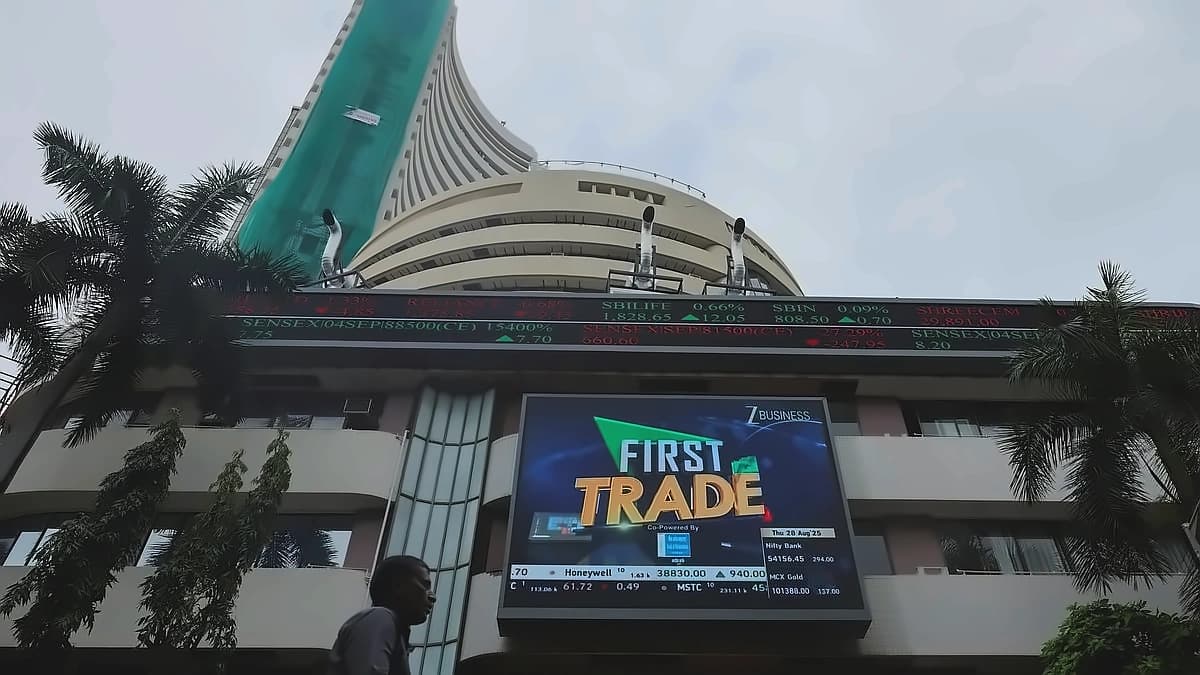
Indian equity markets ended Thursday's session virtually unchanged, with the BSE Sensex closing marginally up 1.44 points or 0.00% at 77,186.67 and the NSE Nifty50 settling at 24,072.75, down 5.75 points or 0.02%, according to Business Standard. The session was marked by sharp intraday swings driven by geopolitical anxiety, a weakening rupee, and elevated crude oil prices, with markets trading in a narrow range amid the weekly Sensex expiry which amplified volatility. The Nifty slipped below the 24,100 mark after touching an intraday high of 24,186.50 in morning trade, while the Bank Nifty ended weaker, falling 175.60 points or 0.30% to 57,582.25, as private banks sat out the recovery while select PSU banking names cushioned the fall. The broader market fared worse, with the BSE 150 MidCap Index declining 0.30% and the BSE 250 SmallCap Index jumping 0.10%, reflecting a cautious undertone beyond the headline indices.
Sectoral trends remained mixed throughout the session, with Consumer Durables, IT, and Auto emerging as standout gainers, while Realty, Banking, Financial Services, PSU Banks, Capital Markets, and Metals faced selling pressure, as reported by Business Standard. The Electronics Manufacturing Services index rose roughly 3.2% for the second straight session after the Union Cabinet approved the second phase of the India Semiconductor Mission with an outlay of approximately ₹1.27 lakh crore. Among individual stocks, HCL Tech, Wipro, IndiGo, and Maruti Suzuki led gains, while Eternal (down 3%), SBI Life Insurance Company (down 2.27%), and HDFC Bank (down 0.87%) were major Nifty drags. The market breadth was negative with 2,012 shares rising and 2,224 shares falling on the BSE, while 213 shares remained unchanged. The advance-decline ratio on the Nifty 50 stood at 34:16, with 105 stocks hitting 52-week highs against 67 touching 52-week lows, and 180 stocks in the upper circuit and 140 in the lower circuit.

Global sentiment provided bleak comfort, with Japan's Nikkei falling 2.8% and South Korea's Kospi tumbling 6.4%, as reported by Business Standard. US Federal Reserve officials maintained a cautious tone on rate cuts, citing persistent inflation risks, particularly from energy prices, with US crude inventories falling 1.7 million barrels last week, tighter than market expectations. The decline in Asian markets reflects ongoing investor caution amid uncertainty surrounding global geopolitical developments. In contrast, US markets opened mixed on Thursday, with the Dow Jones Industrial Average extending gains while the Nasdaq Composite and S&P 500 traded lower in early deals, as weakness in semiconductor stocks weighed on broader sentiment. As of 9:32 a.m. EDT, the Dow Jones Industrial Average was up 126.52 points or 0.24% to 52,785.16, while the Nasdaq Composite was down 116.73 points or 0.44% at 26,152.50 and the S&P 500 was down 15.48 points or 0.20% to 7,556.92. US Dow Jones futures were up 89 points, signalling a positive start for Wall Street.
The Indian rupee extended its losing streak into a fourth consecutive session, edging lower against the dollar to 96.3300 compared with its close of 96.2500 during the previous trading session, according to Business Standard. Geopolitical friction between the US and Iran pushed Brent crude above $85 per barrel, with Brent crude for September 2026 settlement falling 22 cents or 0.26% to $84.73 a barrel, despite remaining close to one-month highs amid escalating Middle East tensions. MCX Gold futures for 5 August 2026 settlement fell 0.19% to ₹1,41,585, while the US Dollar Index (DXY) was up 0.01% to 100.53 and the United States 10-year bond yield rose 0.62% to 4.573. The NSE's India VIX declined 2.92% to 12.88, indicating reduced market volatility expectations.
Technically, the Nifty remains range-bound with a decisive move above the 24,200-24,260 zone needed to revive bullish momentum, while a breach below 24,000 could trigger fresh selling, as noted by Business Standard. Markets are likely to take cues from the ongoing Q1FY27 earnings season, with results from Reliance Industries, JSW Steel, Hindustan Zinc, and RBL Bank due Friday, and Wipro and Tech Mahindra numbers released Thursday evening will set the early tone for IT. Ajit Mishra from Religare Broking noted that markets remained volatile in the narrow range on the weekly expiry day and closed flat, extending the ongoing consolidation phase, with mixed sectoral trends as IT, auto and FMCG supported the move while realty, metal and banking stocks traded under pressure.