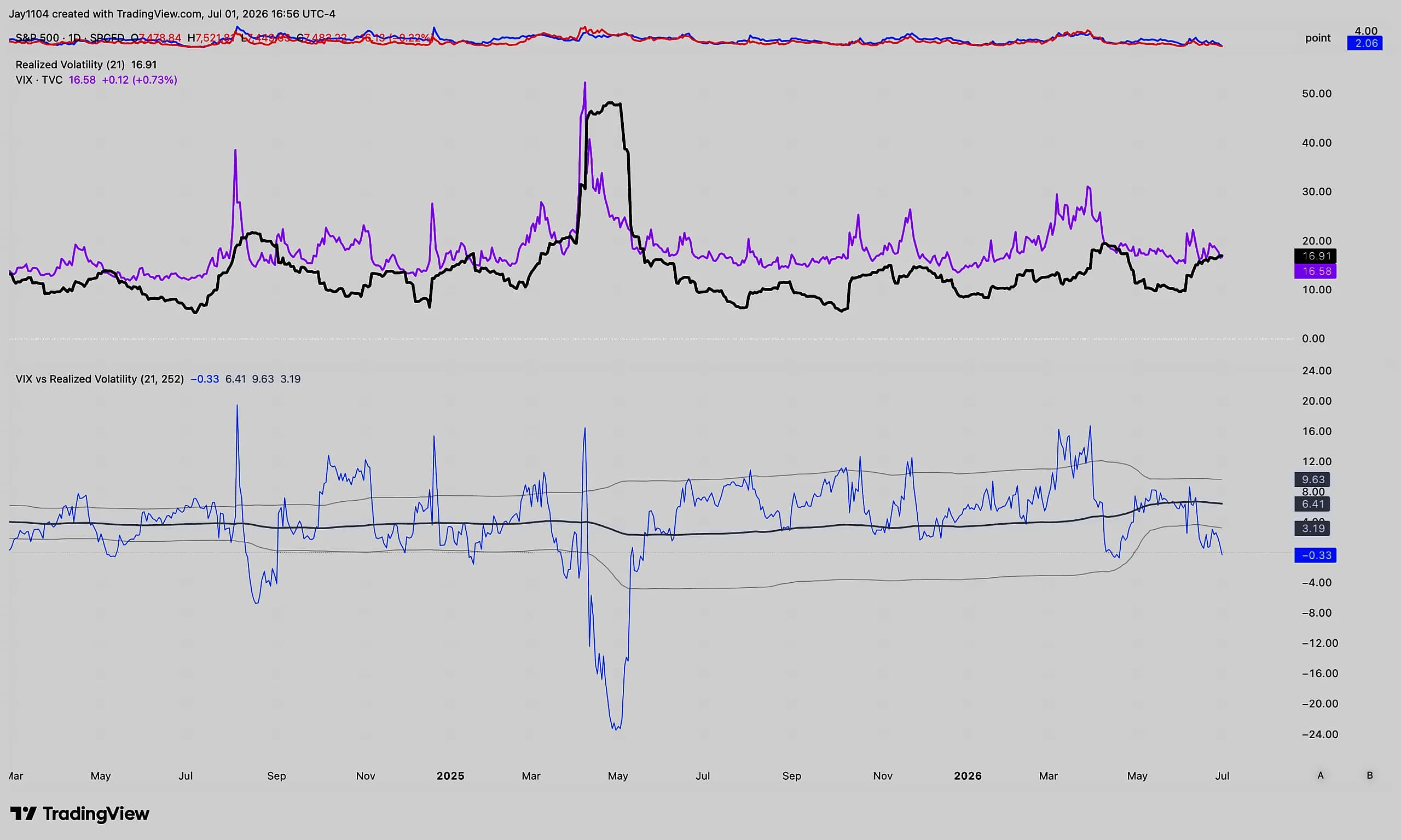
The CBOE Volatility Index (VIX) is currently trading at levels where it faces limited downside potential, according to market analysis from Investing.com. The implied volatility of the VIX is positioned at a point where it is either expected to bounce or fall to 2024-like levels, last seen in June and July of that year. This current positioning suggests the market has reached a critical juncture where significant volatility movements are becoming increasingly constrained, with the VIX approaching that time in the cycle where single-stock implied volatility is expected to rise.
The VIX Equity (VIXEQ) is approaching levels that could impact the broader market volatility structure. According to the analysis, a big reason the VIXEQ rose so much last quarter was the significant move in semiconductor implied volatility. Market experts suggest that VIXEQ could rise to around 45, but would be surprised to see it reach 50. This potential rise in VIXEQ is expected to be more moderate compared to the previous quarter's semiconductor-driven spike, with the current analysis indicating that 45 is possible, but 50 would be really surprising. The semiconductor-driven spike that occurred in July is not expected to be replicated this time, suggesting a more measured approach to volatility increases.
The Correlation 1 Month (COR1M) is currently at 8, with the analysis indicating there is limited room for further decline. In March, the COR1M was nearly 42, and in June it peaked at 17.8. If COR1M stays around 8 and VIXEQ rises to 45, the formula SQRT(COR1M) × VIXEQ would result in a spread staying in the 4-point range, potentially pushing the VIX to around 17. The analysis notes that if the VIXEQ only rises to around 45 and implied correlation is at 8, there just isn't as much room for the COR1M to fall this earnings season. Even a more modest decline in correlation to around 6 would leave the model VIX roughly where it is currently.

The analysis suggests that single-stock implied volatility is expected to rise as the market approaches the typical cycle period for increased volatility. Market experts note that if the VIXEQ only rises to around 45 and implied correlation is at 8, there is limited room for the COR1M to fall during the upcoming earnings season. The current market positioning suggests that while volatility may increase, the magnitude of potential declines appears to be constrained by existing correlation levels. The analysis indicates that dispersion and correlations are already starting out fairly stretched, which may not allow for much additional volatility compression ahead of earnings.