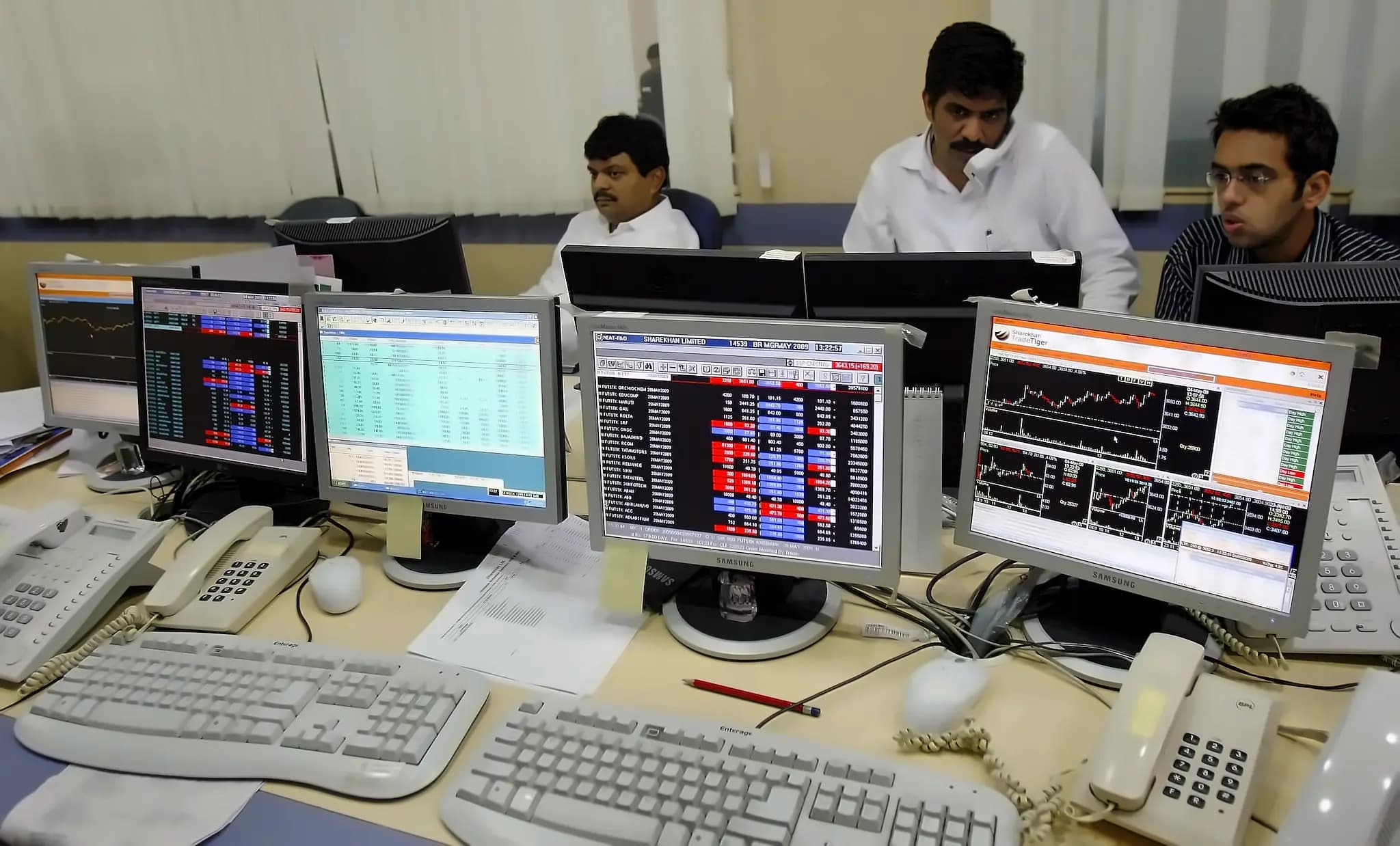
Indian markets witnessed a sharp selloff on Monday, with the Sensex plunging 1,124.02 points, or 1.52%, to close at 72,771.72 and the Nifty 50 declining 360.25 points, or 1.56%, to settle at 22,780.25. According to latest reports from Business Standard, selling pressure was broad-based, with all sectoral indices ending lower, led by declines in banking, realty and metal stocks. The sharp decline comes amid growing concerns over Iran-US tensions, rising crude oil prices, higher US bond yields, a weakening Indian rupee and continued foreign investor selling. The selloff was so severe that it wiped out nearly ₹7.52 lakh crore from the total market capitalisation of BSE-listed companies, bringing it down to around ₹474.36 lakh crore. 47 of the 50 Nifty stocks ended lower, with stocks declining by as much as 3% during the session. Among the Nifty constituents, Reliance Industries (down 2.32%), HDFC Bank (down 2.25%) and ICICI Bank (down 1.87%) were major drags. The broader market also witnessed significant weakness, with the BSE 150 MidCap Index and BSE 250 SmallCap Index declining 1.63% and 1.85% respectively. Market breadth was weak with 3,108 losers against 1,356 gainers on the BSE, while the NSE's India VIX jumped 12.54% to 13.69 indicating heightened volatility. In dollar terms, the market capitalisation fell below the $5-trillion mark to $4.94 trillion, marking the Nifty's lowest level in six months since early April. The Nifty is now down 5.40% this month and is on course to record its worst monthly performance in six months, with September seeing the Sensex and Nifty decline 5.44% and 5.40% respectively.
Escalating tensions between Iran and the US have increased uncertainty in global financial markets, with the key trigger being renewed geopolitical uncertainty involving Iran and the US. As per latest reports, one of the biggest concerns for investors is the Strait of Hormuz, a critical route for global oil shipments. Any disruption to oil flows through the region could potentially tighten global crude supplies and push energy prices higher. Market participants reacted nervously after US President Donald Trump rejected an Iranian proposal aimed at reopening the Strait of Hormuz and easing hostilities, while Iran maintained that diplomacy remains the only solution to its conflict with the United States and Israel. The geopolitical uncertainty reverberated across global financial markets, triggering risk-off sentiment. US President Donald Trump said he expected the conflict with Iran to end "very soon", while continuing to signal uncertainty over further military action. Major Asian markets ended lower as investors remained cautious amid uncertainty over developments in the US-Iran conflict and the outlook for the Strait of Hormuz. US Dow Jones index futures were down 303 points on Monday, pointing to a weak opening for US stocks, while European shares edged higher on Monday, supported by a rally in British housebuilders. Indian markets were the third-worst performers in Asia, after South Korea, which declined 2.70%, and China, which fell 1.67%. Pankaj Pandey from ICICI Securities noted that volatility due to higher crude prices and rising expectations of a rate hike are the key reasons for market volatility.
Brent crude futures were trading around $108 per barrel on Monday evening, as uncertainty over the US-Iran conflict and the reopening of the Strait of Hormuz continued to influence supply concerns. Brent crude moved close to $107 a barrel, while the US 10-year Treasury yield climbed above 5.2%, adding to investor concerns. Indian 10-year yields were at a two-year high of 7.18%, with US 10-year Treasury yields at their highest level since June 2007. Higher energy prices are seen as a key risk for India, which is heavily dependent on crude imports and remains vulnerable to inflationary pressures stemming from elevated oil costs. The uncertainty surrounding the strategic waterway has raised concerns about potential disruptions to global oil supplies, with any prolonged disruption could push crude prices higher, adding to India's import bill and putting pressure on sectors sensitive to energy costs. The latest available Asian session showed the Nikkei 225 stood at 66,364.20, up 1.30%, while the Hang Seng closed at 24,510.09, down 1.01%. Asian markets such as Japan, China, and South Korea fell 0.7-2.7%, while Hong Kong ended 0.54% higher.
The Nifty Bank index dropped 1.99% to 54,471.65, making it the biggest underperformer among the four frontline indices, with all sectoral indices closing in the red. According to Business Standard, Yes Bank (down 5.87%), Union Bank of India (down 4.69%), IDFC First Bank (down 3.88%), Canara Bank (down 3.47%), Punjab National Bank (down 3.43%), Bank of Baroda (down 3.3%), HDFC Bank (down 2.25%), AU Small Finance Bank (down 2.23%), State Bank of India (down 2.14%) and ICICI Bank (down 1.87%) declined. However, Federal Bank rose 0.93%. Gold financiers also declined, tracking gold prices, with Manappuram Finance slipping 6%. Bajaj Finance, Kotak Mahindra Bank and HDFC Bank shares fell nearly 2% each to lead losses on the benchmark index. Jio Financial Services Ltd, Larsen & Toubro Ltd, Power Grid Corporation of India Ltd, Oil and Natural Gas Corporation Ltd, Shriram Finance Ltd, ICICI Bank Ltd, Trent Ltd, Hindalco Industries Ltd, JSW Steel Ltd and NTPC Ltd were the biggest laggards in the session. The BSE Bankex declined 2.05% and the Bank Nifty fell 1.99% on Monday, with PSU banks being the top sectoral losers with a 3.24% decline, followed by realty, oil & gas and metals. Pankaj Pandey from ICICI Securities added that the banking sector is also feeling the impact of IRDAI's capping of commissions and leadership issues at HDFC Bank and Kotak Bank.

Despite Monday's sharp fall, the Nifty is now up 2% in the first half of FY27 and is set for the first half of a financial year in four years. However, investor sentiment remained fragile amid concerns that the ongoing conflict in West Asia could further disrupt global energy supplies and fuel inflationary pressures. Global bond yields moved higher as investors reassessed inflation risks, with yields on rate-sensitive US two-year Treasury notes rising five basis points to 4.90% and the benchmark 10-year Treasury yield advancing four basis points to 5.20%. Higher yields in developed markets tend to reduce the attractiveness of riskier emerging-market assets, including Indian equities. Foreign portfolio investors sold shares worth ₹5,353.22 crore ($557.71 million), while domestic institutional investors purchased shares worth ₹5,189.02 crore, according to provisional data. The Indian rupee traded weak by 0.19% at 96.0100 compared with its close of 95.7500 during the previous trading session, as dollar strength and higher crude prices continued to weigh on the currency. The US Dollar Index (DXY) was up 0.18% to 101.15, while MCX Gold futures for 5 October 2026 settlement fell 2.14% to ₹1,47,490. Christy Mathai from Quantum Mutual Fund noted that while first-quarter earnings of 2026-27 were strong, sustaining this momentum through the year could be challenging, though signs of earnings recovery after two years with expectations of double-digit growth are emerging among the top 150 companies. Devender Singhal from Kotak Mutual Fund observed that the geopolitical situation has become worrying with the US-Iran conflict escalating, with US bond yields already climbing above 5% and markets seeing little respite from overseas fund outflows.