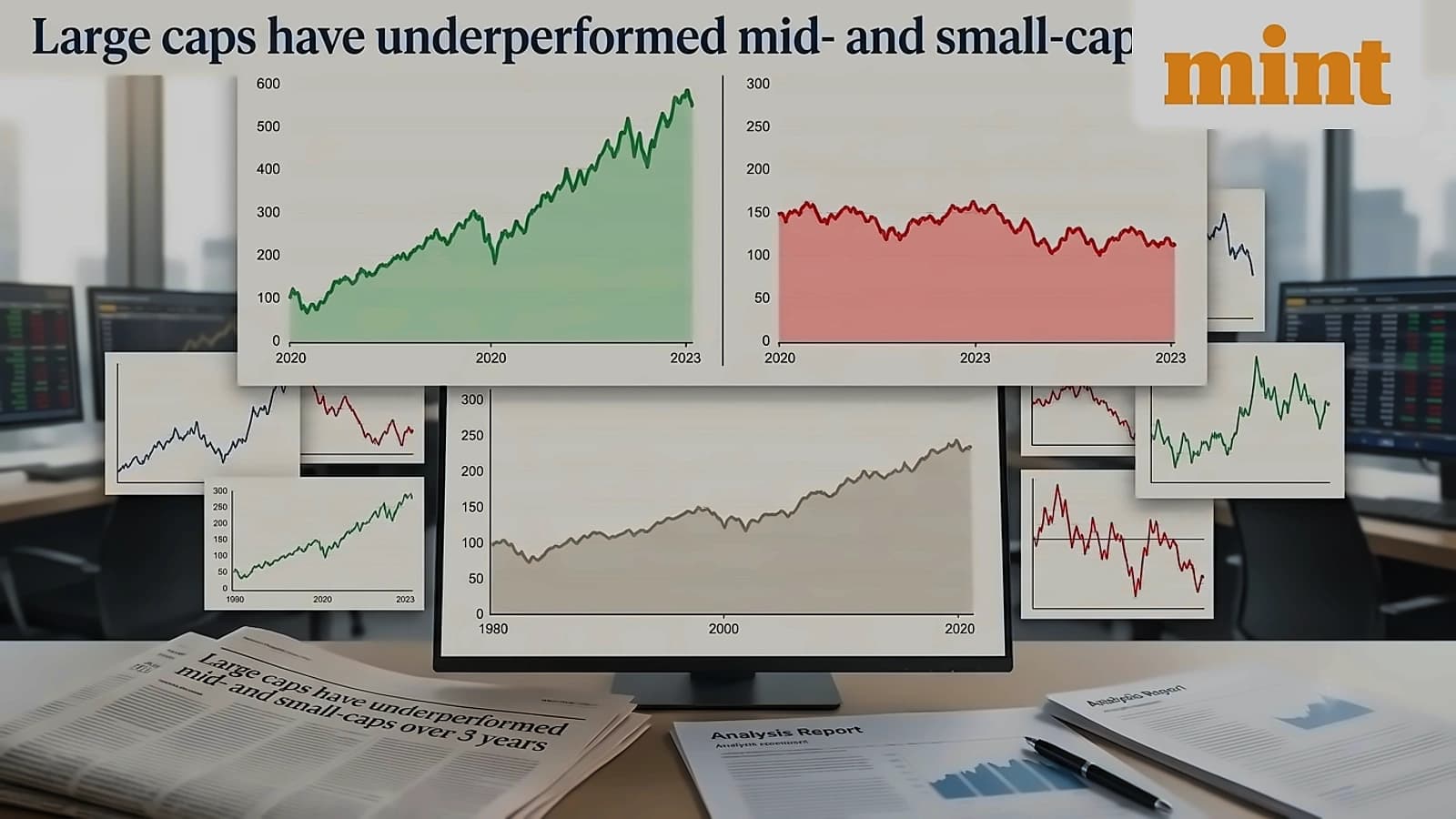
The Indian stock market is experiencing its fifth consecutive week of sharp losses, with the Nifty 50 losing 936 points (around 4%) since the downtrend began in the second week of August. According to reports from The Economic Times, the overall index has fallen nearly 2% in September so far. In contrast, the Nifty Midcap 100 index has fallen less than 1% while the Nifty Smallcap 100 index gained over 1.3% since the second week of August. This divergence highlights the current trend where largecaps are underperforming despite their attractive valuations, with analysts noting that Dalal Street is moving closer towards a trend reversal, as the setup appears ripe for largecap bulls to take charge. However, the latest data from Abakkus Mutual Fund reveals that the Nifty 50 remains 8.5% below its January 2026 peak of 26,329, requiring another 9.3% gain to recover to that level even after rebounding from its March low of 22,331.
Large-cap mutual funds witnessed net outflows of ₹1,147 crore in August 2026, marking the second consecutive month of redemptions despite positive flows during the first six months of the year. According to the Association of Mutual Funds in India's (AMFI) monthly data, this represents a 13% reduction in the pace of outflows compared to July's ₹1,322 crore outflow, but the category remained in negative territory. The funds had previously attracted ₹2,998 crore in March, ₹2,525 crore in April, and ₹2,067 crore in June, highlighting a significant shift in investor preference toward mid and smallcap segments. As reported by Mint, this divergence raises questions about whether investors are reassessing their preference for established companies and what it means for large-cap fund investors.
The recent outflow from large-cap funds appears to be more of a rotation within equities than a loss of confidence in the asset class, according to Harendra Zatakia, founder of Wealth Aligned Financial Advisory. He noted that overall equity inflows and IPOs remain strong, but investors are directing more incremental money towards mid and small-caps for their perceived growth opportunities. Sharad Kohli, economist and market expert, explained that some large-cap stocks have reached peak or stretched valuations, prompting investors to move towards mid and small-cap funds where valuations may appear more attractive. The mid- and small-cap universe offers greater exposure to newer businesses, emerging sectors and companies that are still in the process of scaling, as noted by Zatakia, making these segments more appealing to growth-oriented investors.
Despite the current underperformance, largecaps present attractive entry valuations compared to the richer valuations in mid and smallcap segments, according to market analysts. According to reports from The Economic Times, Srimal highlighted key drivers including valuation gap, month-end liquidity from IPOs, institutional flow preferences and mean reversion potential. The anticipated mega IPOs such as those of Jio and NSE could draw significant institutional and HNI liquidity, potentially triggering a catch-up rally across the large-cap segment. Investors may rebalance into liquid large caps to fund or participate in these offerings, with both FIIs and domestic institutions favoring large caps for ease of entry and exit, enabling swift portfolio realignments as risk sentiment shifts.
Vinod Nair, Head of Research at Geojit Investments, recommends a greater focus on largecap stocks and non-equity ETFs as safer options. According to reports from The Economic Times, he suggests that defensive and deep-value areas such as healthcare, telecom, FMCG, diversified businesses, and IT can continue to provide portfolio advantages. Both experts advise against exiting large-cap funds based on recent outflows, with Zatakia emphasizing that strategic allocation should be based on risk capacity, investment horizon, goals and the portfolio's overall balance. Sharad Kohli reiterated that large-cap funds are meant for value creation, meaning investors should ideally stay invested for long periods, as these funds typically hold companies with solid business models and strong fundamentals. Recent analysis from Abakkus Mutual Fund highlights the importance of staying invested, showing that investors who remained invested in the Nifty 50 TRI between April 2005 and August 2026 earned a robust CAGR of 13.55%, while missing even the best 5 days could reduce returns to just 0.94% CAGR, demonstrating the significant opportunity cost of market timing.