IT stocks continued their decline on Friday morning, with major players experiencing significant losses despite the broader Indian stock market trading in green. According to Live Mint, TCS share price opened with a downside gap at ₹2,177.20 per share on the NSE and touched an intraday low of ₹2,115.40, logging over 3% intraday loss. HCL Tech share price lost around 2%, while Tata Elxsi shares corrected by more than 2%, Route Mobile shares fell around 2.50%, and Tech Mahindra share price declined by around 2%. The weakness stems primarily from the Bank of Japan's interest rate hike, which is expected to put pressure on US Treasury yields and the US Dollar (USD). As reported by Live Mint, Indian IT companies deal in US dollars because they export IT services to the US and other countries, making them vulnerable to currency fluctuations. In the wake of a decline in the US Dollar, IT companies are expected to earn US Dollars in India, which will be worth less against the Indian National Rupee (INR).
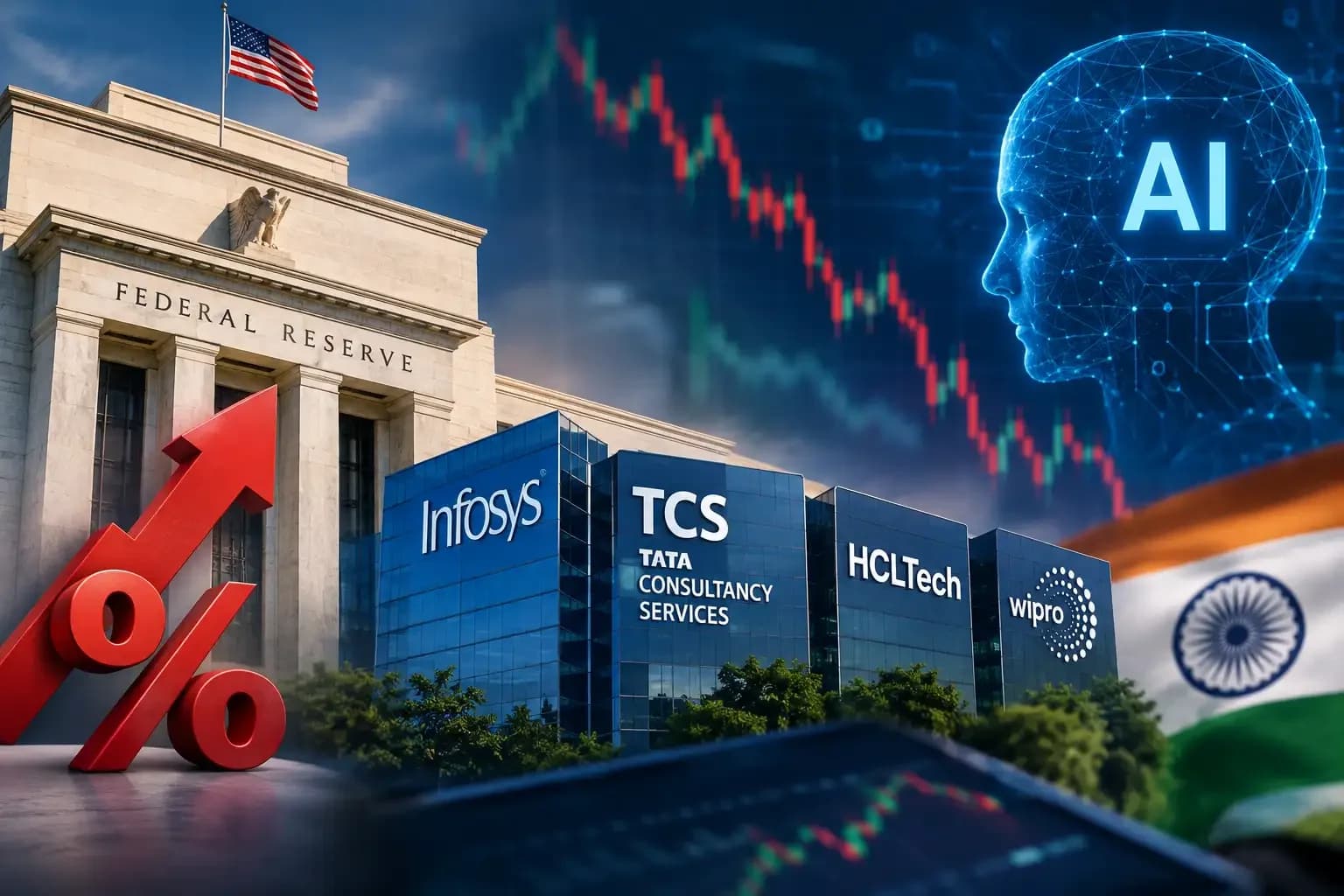
The Fed's decision represents the first interest rate hike since 2023, with the central bank flagging further increases in borrowing costs in the coming months. According to Business Standard, new policy projections showed 16 of 18 policymakers anticipate at least one more quarter-percentage-point hike by the end of this year. The decision came as consumer inflation remained at 3.4% in August, staying at the same level as last month but well above the Fed's 2% target. Fed Chairman Kevin Warsh acknowledged that the central bank has no real capability of cutting off the main source of inflation: higher energy prices, stating that today's policy action will support a timelier return to the Committee's 2% goal. The median Fed official now expects the federal funds rate to end this year at 4.1%, up from the current range of 3.75%-4% and higher than the median forecast of 3.8% given three months ago.
Sunny Agrawal, deputy vice president of fundamental research at SBI Securities, explained that IT stocks are marginally under pressure due to expectations that increasing US interest rates will lead to IT budget cuts by US corporates. As reported by Business Standard, Agrawal noted that IT companies have been strong underperformers due to the deflationary impact of AI, and we have already seen a sharp correction across the entire IT pack. However, he emphasized that today's reaction is muted and growth outlook for FY27 has penciled in these global challenges, with at least for Tier 1 IT companies, growth likely to be in the range of 3-5%. Agrawal remained bullish on select IT companies ahead in the AI race, including Coforge and Persistent Systems. He added that most of the negative development is already in the price as far as the IT pack is concerned, suggesting IT stocks may not correct further as stock prices have already corrected significantly.
Despite initial volatility, historical data suggests that Fed rate hikes typically create short-term market disruptions followed by recovery. According to new analysis from The Kobeissi Letter, the S&P 500 has declined by an average of 4.0% over the six weeks following the first Fed rate hike of a cycle across seven such episodes since 1988. However, stocks recovered all of those losses over the next five to six weeks on average, with the S&P 500 returning 4% on average in the six months following the first interest rate hike. After 12 months, the S&P 500's average gain tallied 9%, with positive returns occurring in every episode except 2022 over the 12-month period. As noted by The Kobeissi Letter, "Fed rate hikes have historically been great buying opportunities," suggesting that current market weakness may prove temporary.