The NIFTY IT index surged as much as 1.3% or 407.3 points to hit a three-month high of 31,955 during Monday's trading session, compared with the closing of 31,547.70 on Friday, August 7. As per exchange data, seven out of the benchmark sectoral index's 10 constituents were trading in the green zone, while only three declined. At around 11:56 AM, the index was trading 0.53%, or 166.25 points, higher at 31,713.95. The index has been seeing an uptrend since the second half of July, following robust earnings for the first quarter of the 2026-27 fiscal year (Q1 FY27).
Tech Mahindra emerged as the standout performer among IT stocks with its August futures rising 2.30% to ₹1,675, while open interest increased by 9.86%, indicating fresh bullish positioning. According to latest F&O data, the contract traded at a discount to the underlying stock with a basis of minus ₹3, suggesting traders were adding new long positions rather than rolling existing positions. This divergence from other major IT stocks makes Tech Mahindra stand out in the current market setup, with the increase in open interest being larger than seen across other major IT stocks in the available data.
LTM Ltd was the top gainer of the NIFTY IT index, with shares surging as much as 3% to hit an intraday high of ₹4,797.30 on the National Stock Exchange (NSE), compared with the previous closing price of ₹4,658.10. At the time of writing, it was trading 2.86% higher at ₹4,791.10. The stock has gained 2% in the past week and more than 18% over the month, though it has fallen 22% on a year-to-date basis. Coforge advanced as much as 2.6% to reach the session's peak of ₹1,822.60, against the closing price of ₹1,776, and was trading 1.51% higher at ₹1,802.80. Infosys jumped as much as 1.7% to hit an intraday high of ₹1,195, compared with Friday's closing price of ₹1,175.10, and was up 1.12% to stand at ₹1,188.30. MphasiS grew as much as 1.8% to touch the session's peak of ₹2,518.70, in contrast to the previous session's closing price of ₹2,475.
Foreign portfolio investors (FPIs) turned net buyers in the IT sector in July for the first time in 2026, fuelling the current surge. As per NSDL data, FPIs purchased equities worth ₹3,298 crore in the IT sector in the second half of July (July 16-31), compared with an investment of ₹60 crore in the first half of the month (July 1-15). The inflow comes at a time when the semiconductor sector witnessed a sharp decline, with South Korea's chip-heavy KOSPI falling 20.6% and the Philadelphia Semiconductor Index losing 20.7% in July. Since the beginning of 2026, the IT sector had seen significant outflows, with FIIs selling equities worth ₹6,733 crore in June, ₹1,911 crore in May and ₹4,212 crore in April 2026.
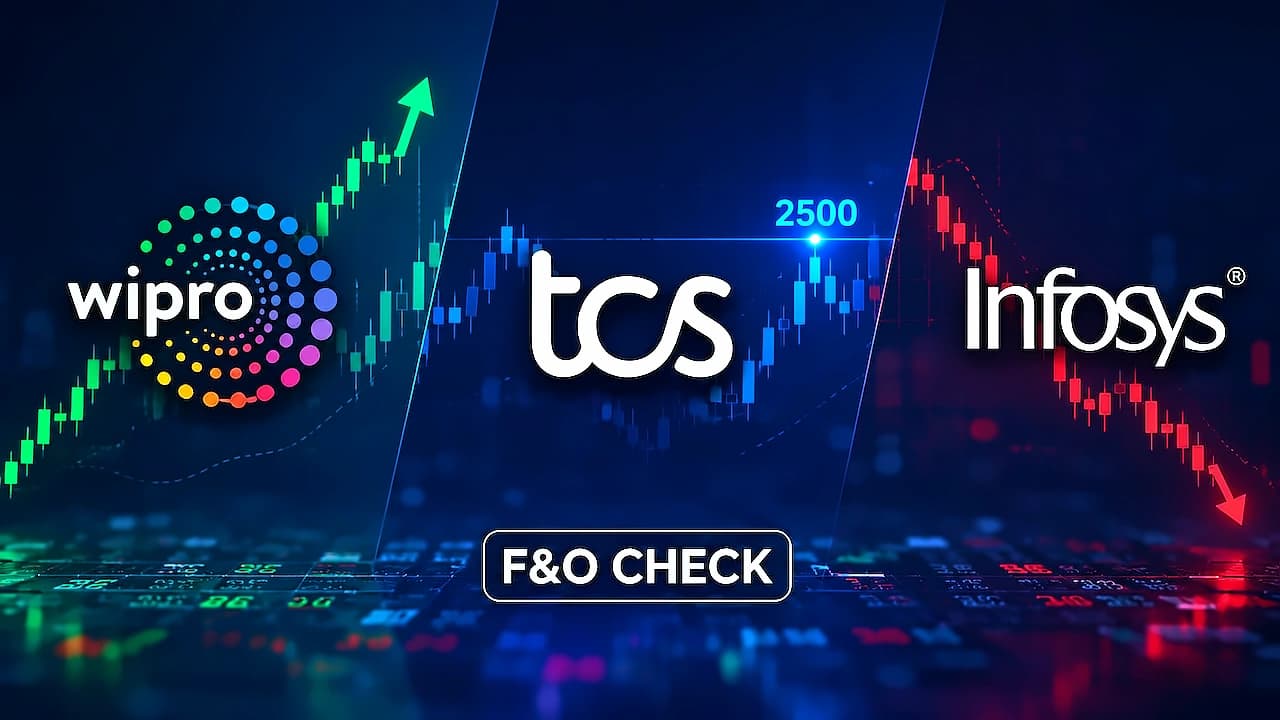
Wipro recorded the clearest build-up among the three IT stocks in the options data, with call open interest at the 200 strike standing at more than 10 million contracts, compared with put open interest of about 2 million contracts. According to reports from Essential Business Intelligence, the latest change in positions was concentrated on the call side, with call open interest rising by roughly 2.7 lakh contracts while put open interest changed only marginally. The concentration of call open interest at 200 makes it the key strike to track for Wipro in the options market.
TCS options traders concentrated their positions around the 2,400-2,600 strikes, with call open interest at the 2,500 strike standing at about 1.8 million contracts, the highest among the strikes shown in the data. As reported by Essential Business Intelligence, call open interest at 2,600 was around 1.1 million contracts, while put positioning was stronger at lower strikes with put open interest at roughly 9 lakh contracts at 2,400 and about 7.5 lakh contracts at 2,300. The 2,800 strike also had put open interest of more than 1 million contracts. Fresh positioning added another layer to the set-up, with call open interest increasing by about 56,000 contracts at 2,500 while put open interest changed little. At 2,400, traders added about 29,000 put contracts against roughly 16,000 call contracts.