Indian stock markets opened sharply lower on Wednesday, October 28, with the BSE Sensex declining 601.57 points, or 0.82% to 72,997.10 and the Nifty 50 slipping 136.40 points, or 0.60% to 22,613.35 by 11:30 AM. According to Dalal Street Investment Journal, the 30-share BSE Sensex tumbled 601.57 points while the 50-share NSE Nifty tanked 136.40 points, with both benchmark indices trading near the day's lows. The decline came despite a positive overnight session on Wall Street, where the S&P 500 rose 0.6% to 7,722, the Dow Jones added 0.03% to 52,377, and the Nasdaq gained 1.18% to 26,477. As per Choice Broking, the GIFT Nifty was down 196 points at 22,616, indicating weak opening sentiment. The market weakness was primarily driven by a broad-based selloff in technology stocks, with IT sector bearing the heaviest selling pressure.
Market sentiment remains severely impacted by crude oil price movements, with Brent crude trading 1.08% higher at $110.91 per barrel, following an attack on a Saudi Arabian refinery, reigniting supply-side concerns. As per Dalal Street Investment Journal, Brent crude, the global oil benchmark, traded 1.08% higher at USD 110.91 per barrel, with the attack on a refinery in Saudi Arabia raising concerns about supply disruptions and inflation. Dr. V K Vijayakumar, Chief Investment Strategist at Geojit Investments Limited, noted that "There are reports of possible renewed strikes by the US on Iran after the midterm elections in the US. Brent crude has again firmed up to above USD 115, which is bad news for the Indian economy and markets." The US Federal Reserve begins its two-day meeting today, with the central bank widely expected to hold its benchmark interest rate unchanged at 3.75%–4.00%. The Fed funds futures market is pricing in a roughly 92% probability of a hold, according to the CME FedWatch Tool. A hawkish signal could lift yields and restrain emerging-market flows, while balanced guidance may allow the recent equity recovery to broaden.
The information technology sector bore the heaviest selling pressure on Wednesday's trade, with major stocks experiencing significant declines. Infosys fell 4.89%, TCS declined 3.26%, and Tech Mahindra slipped 3.25%, reflecting broad-based selling pressure across the information technology sector. According to Dalal Street Investment Journal, Nifty IT emerged as the worst-performing index, declining 3.35%, followed by Nifty FMCG, which fell 1.68%, while Nifty Energy slipped 0.85%. The IT index fell 3.5% during Wednesday's trade, with IT stocks succumbing to selling pressure due to renewed concerns over the impact of AI. Gaurav Sharma, vice president & head of research at Globe Capital, noted that "The IT index, which fell 3.5 per cent, is underperforming following Microsoft's announcement of a steep workforce reduction. This highlights the ongoing transformation in the IT industry, driven by AI developments, where India is still lagging to some extent." However, Gaurav believes this is a knee-jerk reaction and expects the trend not to persist, citing that "over the past two quarters since the AI spending boom began, Indian IT companies have reported reasonable numbers. AI-related orders have also remained healthy and have started making a positive impact on their financial statements."
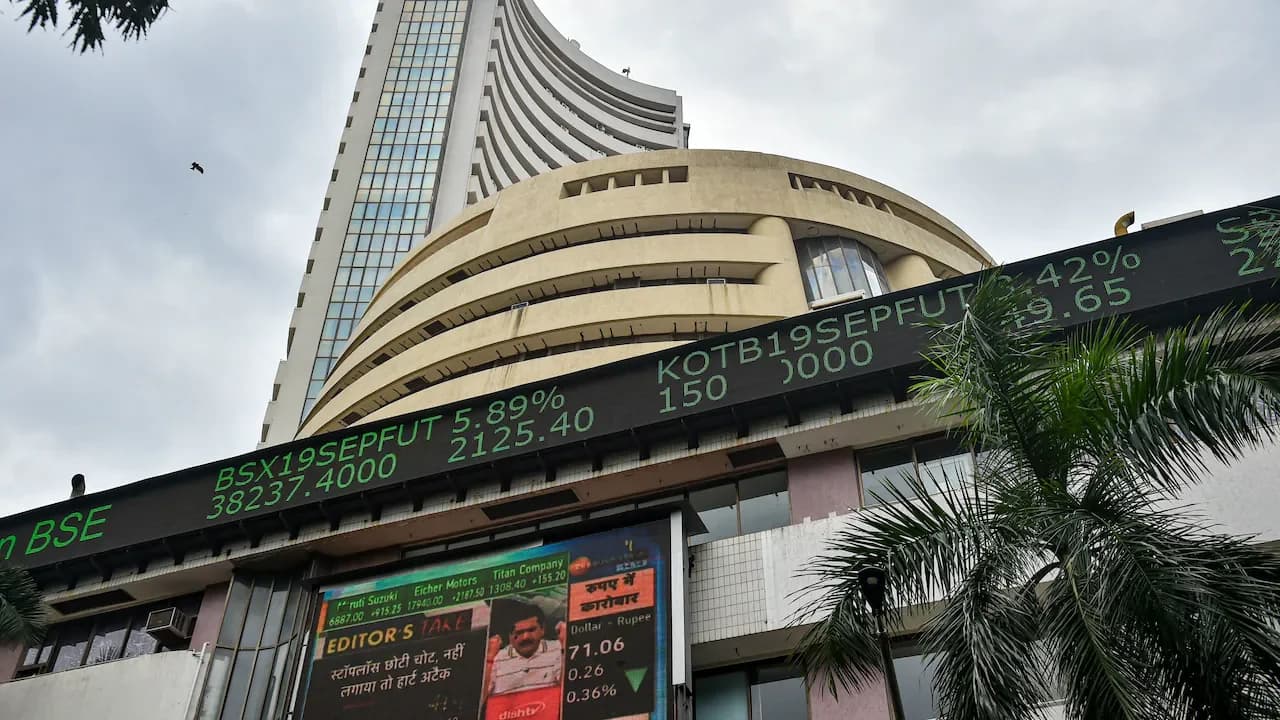
Despite the broad-based decline, some individual stocks showed resilience with Larsen & Toubro gaining 3.96% after the engineering major reported a 32.5% rise in consolidated net profit to ₹5,202.10 crore for the quarter ended September 2026, driven by higher revenue. As per Dalal Street Investment Journal, Apollo Hospitals advanced 3.33% and SBI Life Insurance rose 2%, indicating selective buying interest despite the broader market weakness. On the positive side, Nifty Pharma and Nifty Auto gained 0.89% each, emerging as the top-performing sectoral indices, while Nifty Mid Select advanced 0.36%, Nifty Bank and Nifty Financial Services rose 0.23% and 0.10% respectively. In Asian markets, South Korea's Kospi surged 6.11%, while Japan's 225 index, Shanghai's SSE Composite index and Hong Kong's Hang Seng index were trading higher, as reported by The Hindu.
Foreign Institutional Investors remained net buyers for the tenth straight week, with FIIs buying equities worth ₹4,240.39 crore on Tuesday (October 27, 2026), according to exchange data as reported by The Hindu. Gaurav noted that FIIs have been selling Indian equities for quite some time, with US bond yields once again starting to move higher, with the 10-year yield rising to around 5.42% after correcting from 5.38% to 4.9% over previous sessions. The renewed rise in US bond yields could put further pressure on Indian equities, as higher yields tend to make US assets more attractive to foreign investors. Despite the current sharp decline, improving corporate earnings and domestic fund inflows provide some support against market headwinds. However, Foreign Institutional Investors turned net buyers on Tuesday, recording equity purchases of ₹4,240 crore, while Domestic Institutional Investors emerged as net sellers with outflows of ₹1,250 crore, snapping a five-session buying streak. The Indian rupee snapped a three-day losing streak on Tuesday, appreciating 8 paise to close at 95.11, though currency volatility is expected to remain elevated with three major central bank decisions due this week. Vijayakumar suggested that changes to long-term capital gains (LTCG) taxation could become necessary to attract foreign investors back to Indian markets, citing FPI outflows of $19 billion in 2025 and $31 billion so far in 2026, warning that sustained selling was beginning to affect India's otherwise favourable macroeconomic fundamentals.