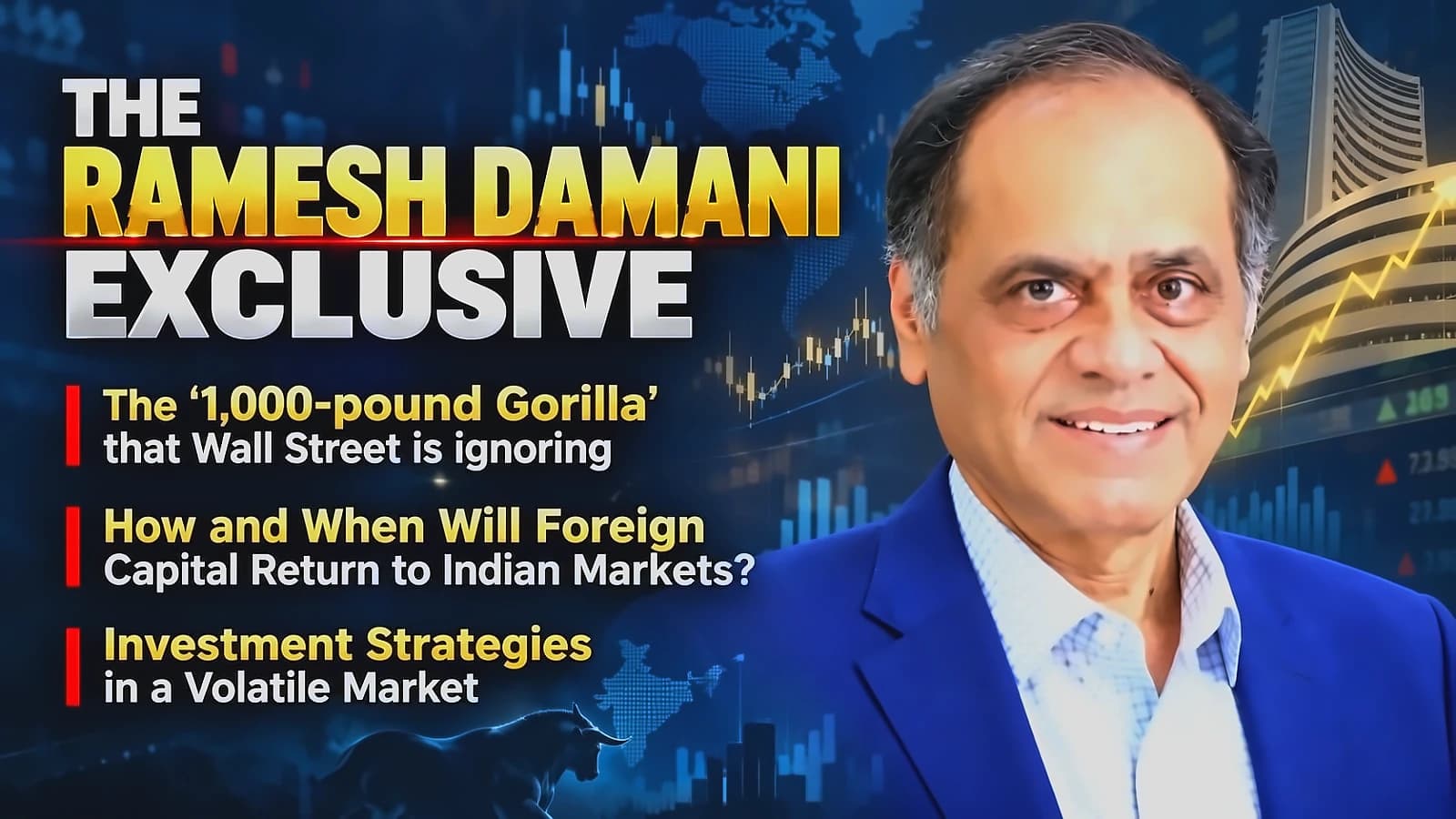
The global artificial intelligence (AI) race narrative may be overstated for most countries, with India being one of the few exceptions facing genuine AI deficits, according to CNBC TV18. The report challenges the widespread perception that AI capabilities are concentrated among a small group of nations, suggesting that the lack of AI argument holds true for all countries except the US, China, South Korea, and Taiwan. This assessment comes as India continues to struggle with attracting global investor money due to its limited position in the AI supply chain, while countries like Taiwan and South Korea experience unusually strong trade surpluses from semiconductor exports and technology spending. Former RBI Governor Raghuram Rajan has now added his voice to this debate, warning that market euphoria around AI has become worrisome in his recent Project Syndicate essay titled 'A Cold Shower for AI Mania'.
India is struggling to attract global investor money because it is not being seen as a major artificial intelligence (AI) or semiconductor market, according to UBS. Arend Kapteyn, Global Head of Economics & Strategy Research at UBS, explained that global investors are currently focused on countries that are deeply linked to the AI supply chain, such as Taiwan and South Korea, where semiconductor exports and technology spending are driving both economic growth and stock market gains. This shift in investor preference is now showing up clearly in market rankings, with Taiwan recently overtaking India to become the world's fifth-largest equity market, while South Korea is rapidly closing the gap. The latest developments show this momentum continuing, with Taiwan and Korea experiencing unusually strong trade surpluses as chip demand continues to outpace supply.
The AI export boom has become so powerful that it is offsetting the economic damage caused by higher oil prices, as reported by UBS. According to Kapteyn, countries that are part of the AI supply chain have over 50% of GDP and have experienced significantly larger terms of trade gains than oil price increases. Taiwan and Korea are seeing unusually strong trade surpluses because chip demand continues to outpace supply. In Taiwan's case, the AI-driven export cycle is adding nearly 10 percentage points to gross domestic product (GDP) growth through net exports alone. The momentum has now extended to memory systems, with UBS effectively turning Micron into the latest AI supercycle poster child by arguing that memory demand will become the next critical bottleneck in artificial intelligence infrastructure.
Former RBI Governor Raghuram Rajan has issued a stark warning about AI market hype, questioning whether investors are overestimating the speed at which companies will generate massive profits from AI technology. In his recent essay, Rajan acknowledged that large language models are already capable of producing referee reports on academic research papers that often rival those written by humans, noting that AI systems can identify analytical weaknesses, check proofs and suggest improvements while drawing on vast literature almost instantly. However, he cautioned that risks exist at multiple points across the AI supply chain, from chipmakers and infrastructure providers to data centres, AI model developers and end users. Rajan warned that companies continue to grapple with challenges including organising historical data, integrating AI into existing workflows, data-security concerns and the risk of errors or hallucinations damaging their brands. He also highlighted potential obsolescence risks if chips become significantly more powerful and energy efficient, making it difficult for data-centre operators to recover their investments.
Despite stable domestic markets, global investor interest in India remains extremely low, with expensive valuations emerging as the biggest hurdle for foreign investors. According to UBS's Gautam Chhaochharia, Head of Global Markets, overseas investors continue to remain underweight on India even after months of market consolidation. Investor conversations at the UBS Asia Investor Conference in Hong Kong were largely centred around technology opportunities in Korea, Taiwan and Japan, while India drew selective interest only in bottom-up stock ideas. As Chhaochharia noted, "We have seen them being sellers for the last few months, but even the interest level is quite low as we speak." India's macro narrative, including concerns around oil prices and the rupee, has not helped sentiment among global investors, though local liquidity flows continue to support domestic equities despite the absence of strong foreign inflows.

Despite current challenges, Kapteyn believes India's situation could improve quickly if energy prices cool and geopolitical tensions ease. He noted that many global investors do not want all their money concentrated in just a few AI-heavy markets, and if the West Asia conflict stabilises and pressure on oil prices reduces, investors could begin looking again at large economies like India that offer domestic growth, demographics and diversification. The UBS analyst also believes the AI investment cycle still has room to run, with massive spending by technology giants such as Meta, Amazon and Google continuing to support semiconductor demand globally. However, Rajan's warning about AI market hype suggests that "AI advances will likely pay off eventually, though not every provider will profit, or even survive." He concluded that "The good news is that a more limited, careful AI rollout could give firms more time to find labour-augmenting (as opposed to labour-displacing) uses," while acknowledging that "euphoric visions of quick exceptional profits could be unfounded."