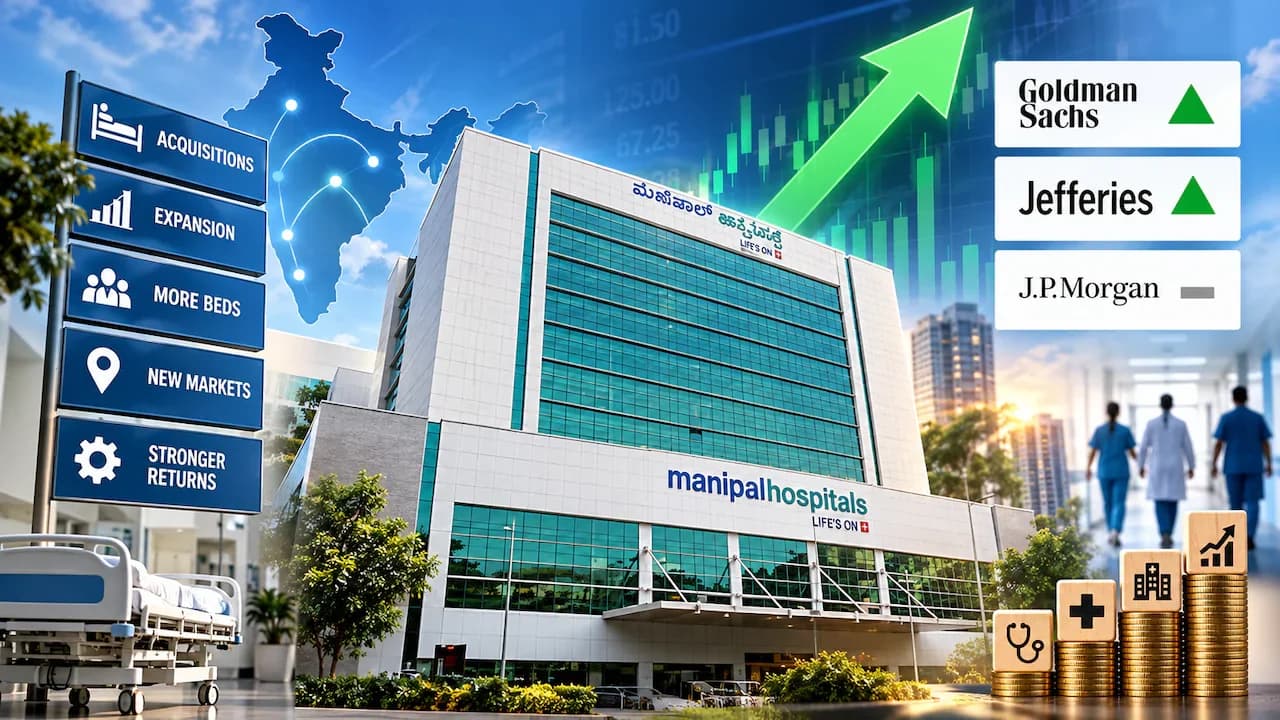
Global investment bank Jefferies has endorsed Max Healthcare and Manipal Health as its top picks in the hospital sector following healthy Q2 results that exceeded expectations. According to The Financial Express, Max Healthcare beat Jefferies estimates supported by strong volume growth, though the impact of price caps on select oncology drugs continues to be a concern. The brokerage noted that "after many lackluster quarters, Max beat Jefferies estimates, supported by strong volume growth; however, impact of price caps on select oncology drugs continue – Dec-Q to provide a favorable base." Meanwhile, Manipal Health reported a 37% increase in revenue and 30% rise in EBITDA growth, ahead of consensus estimates, with earnings aided by strong performance in core clusters and sequential improvement in Sahyadri margins.
Hospital stocks have extended their impressive rally for the fifth consecutive session, with Max Healthcare leading gains at 3% to ₹1,039 per share on Tuesday, bringing total gains to approximately 12% over the past five trading sessions. According to Moneycontrol, the sustained buying interest comes amid expectations that healthcare companies could increase prices of other services to offset the impact of price caps on oncology drugs. The Nifty Healthcare index rose 0.3%, with other major hospital companies including Fortis Healthcare (0.56% to ₹798.65) and Apollo Hospitals Enterprise (0.31% to ₹8,730.50) also participating in the rally. The gains follow the sector's strong performance on Monday, where Max Healthcare had led with 5.90% gains to ₹1,007.75.
Max Healthcare's strong performance was supported by robust quarterly results, with network profit after tax rising 10.34% year-on-year to ₹448 crore during the September quarter FY27, compared to ₹406 crore in the same period last year. As reported by Moneycontrol, network gross revenue stood at ₹3,219 crore, reflecting 20% growth, mainly driven by increase in occupied bed days. International patient revenue stood at ₹307 crore, a rise of 33%, accounting for about 10% of hospital revenue. The company's average trading volume jumped 1.5 times with 6.48 million shares changing hands on NSE and BSE, indicating strong investor interest in the recovery story. According to The Financial Express, Max has the most aggressive capacity addition plan relative to its existing bed base, with 1,112 beds expected by FY29, though the Vaishali facility has seen delays with plans pushed to FY30 from FY29 earlier.

Jefferies has issued 'Buy' ratings on both Max Healthcare and Manipal Health with specific price targets. For Max Healthcare, the brokerage has set a price target of ₹1,200, implying an upside of 17% from Wednesday's close, citing the company's highest occupancy at 77% in the September quarter and 14% IPD volume growth and 13% OPD growth. For Manipal Health, Jefferies has set a price target of ₹900, implying an upside of 30%, noting the company's 37% revenue growth and 30% EBITDA growth ahead of consensus estimates. According to The Financial Express, Jefferies' pecking order is Max>Manipal>Apollo>Dr Agarwal>Medanta>Fortis, with aggressive capacity additions, growth in core clusters, and faster ramp-ups expected to drive healthcare stocks in coming quarters.
India's hospital industry has mounted a comprehensive defence of its pricing practices before the Supreme Court, arguing that capping medicine margins could disrupt healthcare economics without necessarily reducing patient bills. According to The Economic Times, the Healthcare Federation of India, representing more than 100 hospitals and healthcare providers, submitted written submissions challenging the premise that hospital medicine charges represent pure profit. The federation argued that medicine charges incorporate 29 separate clinical activities including pharmacy operations, emergency stocking, cold-chain maintenance, nursing support, and drug preparation, costs that are not reflected in drug procurement prices alone. The industry contends that if hospitals cannot recover these costs through medicine charges, they would need to recover them through other bill components, potentially maintaining overall patient expenditure levels.
The recent buying interest comes amid concerns around possible regulatory intervention in healthcare pricing, with the Supreme Court questioning the Centre on the possibility of applying a uniform 16% markup across medicines. However, market analysts view this as a manageable challenge, with Choice Equity Broking's Deepika Muraka noting that the earnings impact of price caps could be limited to 2% if companies raise prices for other services to offset losses. Earlier, companies in the sector were estimated to face a 7% impact on their earnings before interest, tax, depreciation and amortisation (EBITDA). According to The Economic Times, the Healthcare Federation also raised concerns about the proposal to link permissible margins to procurement costs, warning that this could perversely penalise facilities securing deeper discounts from manufacturers.