Goldman Sachs has raised its forecast for the MSCI AC Asia Pacific ex-Japan Index to 1,080 from 990, representing a 17.2% upside potential. According to reports from CNBC TV18, this revision reflects the investment bank's optimistic outlook for the regional equity markets excluding Japan, driven by exceptional second-quarter earnings performance across key markets. The upgrade underscores how Asia's equity outlook is increasingly being powered by tech-heavy markets tied to the artificial-intelligence supply chain, even as higher bond yields and geopolitical risks keep global investors cautious.
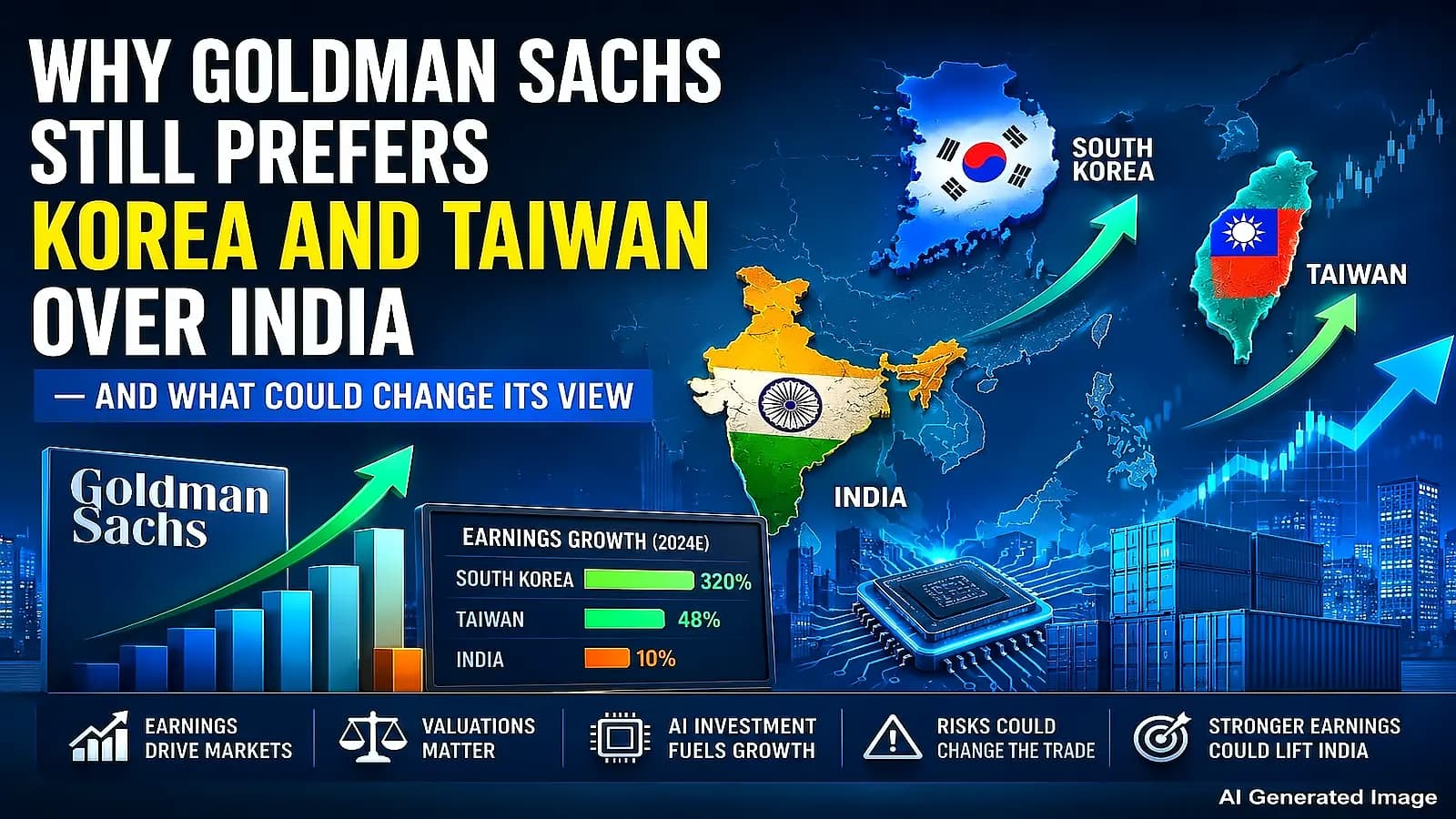
The upward revision is supported by second-quarter earnings growth of 102% across the MSCI AC Asia Pacific ex-Japan Index, with 44% beats compared to 27% misses. As reported by Goldman Sachs, earnings growth was led by Korea, Taiwan and Singapore, with Singapore and Taiwan producing the largest number of companies that topped forecasts. Singapore and Taiwan emerged as the standout performers with the most companies exceeding earnings expectations for the quarter. The region's recent market leadership has been concentrated in semiconductor and hardware exporters benefiting from AI-related spending, while weaker domestic demand in parts of Australia, Malaysia and India has left those markets behind. According to Goldman Sachs, the earnings revisions are genuinely eye-catching, with the bank raising its 2026 EPS growth forecast for the broader MSCI Emerging Markets Index from 45% to 55%, driven almost entirely by anticipated demand for AI hardware.
Goldman favors North Asia and AI-related tech hardware exposure, with the key themes also including energy security, defense and shareholder returns. According to Goldman Sachs, the most favored sectors are tech hardware and semiconductors, capital goods, healthcare and non-Australian or Chinese banks, while transportation, utilities and auto sectors are ranked as underweight. The investment bank has simultaneously upgraded Taiwan's equity rating to overweight and raised South Korea's KOSPI target from 9,000 to 12,000, implying a staggering 36.3% upside for South Korea. This represents the most aggressive part of Goldman's view, with the bank maintaining a 12-month target of 12,000 for South Korea's benchmark Kospi, representing 79% upside from current levels. The bank sees Japan, Korea, China 'A' share markets and Taiwan as overweight, while Singapore, Hong Kong, Malaysia, India and offshore China are rated as market weight, with Australia, Thailand, Indonesia and Philippines rated underweight.

Taiwan's semiconductor ecosystem has become arguably the most strategically important supply chain on Earth, anchored by foundries producing the advanced chips that power AI training and inference. As reported by Goldman Sachs, Taiwan's semiconductor ecosystem, anchored by foundries producing the advanced chips that power AI training and inference, has become arguably the most strategically important supply chain on Earth. South Korea's memory chip manufacturers, including SK Hynix and Samsung Electronics, produce the high-bandwidth memory that AI servers consume in vast quantities. The MSCI Asia Pacific ex-Japan Index was up 27% year-to-date as of early June, but when South Korea and Taiwan are stripped out, the rest of the region was actually down 4%. Goldman's Moe reiterated the bullish KOSPI stance as recently as September 2026, arguing that the surge in demand for memory chips is expected to extend through 2028 and beyond.
Despite concerns over Middle East tensions, higher bond yields, near-term volatility and upcoming U.S. midterm elections, Goldman Sachs remains constructive on Asian equities. The investment bank cites strong tech-driven earnings growth, attractive valuations in selected markets, and cleaner positioning after recent unwinds as key support factors for the positive outlook. The next catalyst is the pace of revisions to Korean and Taiwanese corporate profits, especially from chipmakers and exporters tied to AI capital spending. With U.S. midterm elections, Middle East tensions and elevated bond yields still hanging over risk assets, the near-term test will be whether the earnings rebound spreads beyond a handful of tech-led markets. The concentration risk embedded in this rally deserves attention, as a 27% year-to-date gain for the broader index sounds impressive until you realize the non-tech portion of Asia ex-Japan is nursing losses, with markets across Southeast Asia, parts of South Asia, and other segments of the region not participating in the AI-driven updraft.