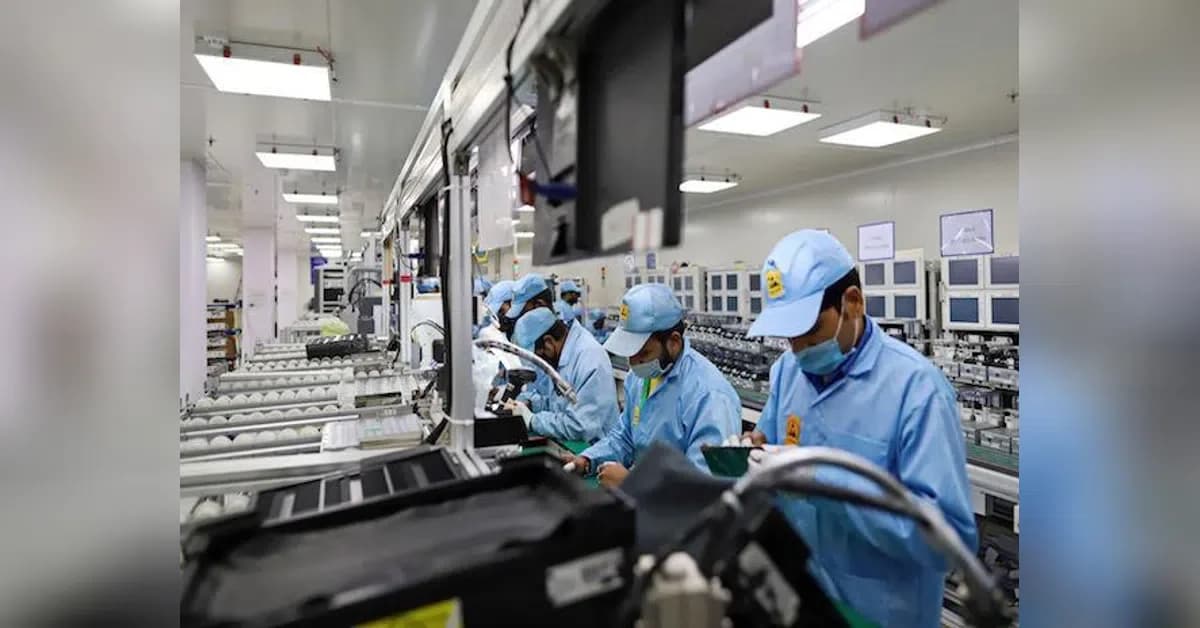
Electronic manufacturing services (EMS) companies witnessed significant gains on Thursday following the Union Cabinet's approval of key manufacturing schemes. According to latest reports, Cyient DLM emerged as the top gainer, surging 7.49%, while Dixon Technologies (India) advanced 6.15%, PG Electroplast gained 2.60%, Kaynes Technology India rose 2.51%, and Syrma SGS Technology added 1.14%. The BSE Sensex was up 0.30% at 77,419.48 at 09:24 AM, showing more modest gains compared to the EMS sector performance. Syrma SGS Technology and Amber Enterprises also traded higher on Thursday, as reported by The Hindu BusinessLine. Motilal Oswal has reiterated its positive stance on the sector, expecting the schemes to accelerate capital expenditure and encourage companies to deepen backward integration and local sourcing.
The Union Cabinet granted approvals to two significant manufacturing schemes that are expected to boost the EMS sector. As reported by Live Mint, the Mobile Phone Manufacturing Scheme received approval with a budgetary outlay of ₹62,500 crore, with production-linked incentives (PLI) to be provided for five years from FY2026-27 to FY2030-31. Additionally, the India Semiconductor Mission (ISM) 2.0 was approved with a budgeted outlay of ₹1.27 lakh crore, marking a strategic shift from semiconductor fabrication to ecosystem development across chip design, equipment, materials, and R&D. The schemes are designed to generate up to 5 lakh direct jobs and around 15 lakh indirect jobs in the coming years, according to India Cellular and Electronics Association (ICEA) Chairman Pankaj Mohindroo.
The Mobile Phone Manufacturing Scheme (MPMS) aims to expand domestic production, boost exports, and increase local value addition in the mobile phone sector. According to Live Mint reports, Minister Vaishnaw announced that the government expects to more than double the export of mobile phones to around ₹15 lakh crore under the new scheme from around ₹7.5 lakh crore under the previous scheme. The scheme will provide PLI incentives for five years from FY2026-27 to FY2030-31, representing a significant expansion of India's mobile manufacturing capabilities. The five-year programme will provide production-linked incentives ranging from 2.25% to 5% on eligible mobile phone sales, with additional incentives for companies increasing domestic sourcing of components and investing in product design and research. Motilal Oswal expects Dixon Technologies and Amber Enterprises to be among the key beneficiaries of the MPMS, noting that Dixon is particularly well placed due to its stronger backward integration and domestic sourcing capabilities. Global brokerage Macquarie described Amber Enterprises as a "sleeper beneficiary" of the scheme, indicating potential upside from the localisation push and expansion in component manufacturing.
The new Mobile Phone Manufacturing Scheme is expected to provide significant margin improvements for EMS companies through enhanced incentives for domestic value addition. As reported by Mint, stakeholders said the move to incentivize domestic value addition would sharply benefit most EMS firms, including the privately held Tata Electronics. Harshit Kapadia, vice-president at brokerage firm Elara Capital, stated that "Additional incentives for investing in moving away from a China-linked component supply chain to more sourcing from vendors within India were strongly requested by the industry". Analysts Vishal Goel and Sandesh Shetty at HSBC Global Investment Research concurred that the scheme "hugely benefits Dixon, alleviating our concerns on margin erosion and customer retention", noting that Dixon is the country's largest listed electronics maker. Under the old PLI scheme, Dixon used to pass on the 'lion's share' of incentives (3.3-3.4% out of 4% it received) to customers, leading to margin concerns, but the new scheme is expected to support margins through the MPMS.
The latest approvals represent a comprehensive manufacturing strategy with a combined investment of nearly ₹1.9 lakh crore (about $22 billion). As reported by Mint, the government approved a ₹62,500 crore Mobile Phone Manufacturing Scheme and the ₹1.27 lakh crore Semicon 2.0 programme, along with the National Investment Policy for Urea-2026 and several infrastructure projects. Minister Vaishnaw stated that seven major decisions were taken today, with the first two decisions relating to infrastructure development in Varanasi, the third and fourth decisions covering Semicon 2.0 and the Mobile Phone Manufacturing Scheme, and the fifth decision aimed at making India self-reliant in urea production. Ajai Chowdhry, co-founder of HCL Enterprise and founder of industry consultancy body Epic Foundation, added that the early contours of the policy "appear mature, and show that the country's electronics ecosystem has climbed up the global value chain over the past years". The three policies—ECMS, Semicon 2.0 and MPMS—complement one another and, for the first time, provide a roadmap to localize the entire electronics value chain amid rising geopolitical concerns.