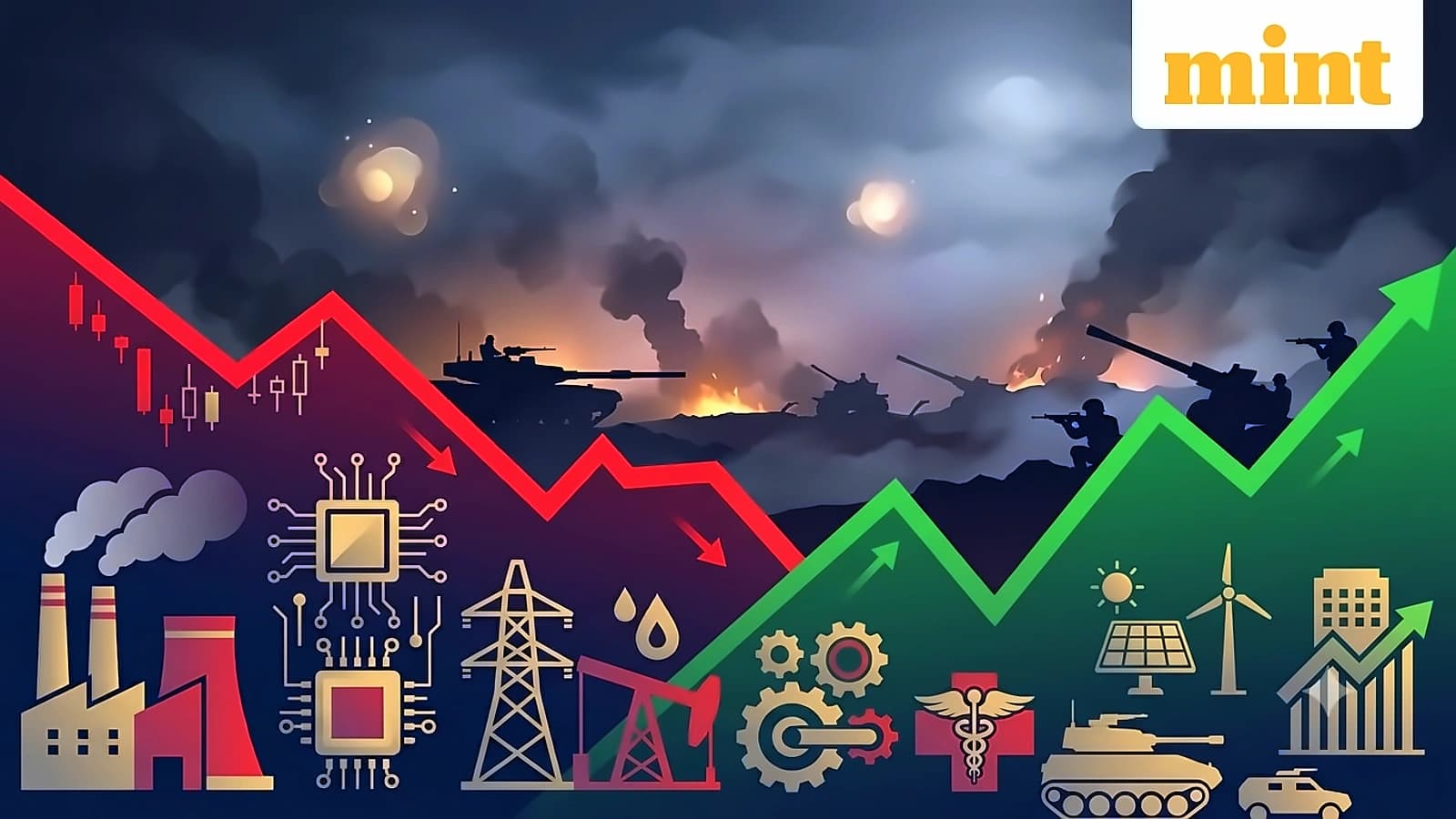
Defence stocks experienced significant declines during Monday's trading session following escalation in the US-Iran conflict. HAL shares declined over 0.58% to ₹4,474 apiece, while BEL and Bharat Dynamics dropped 0.78% and 0.55%, respectively. According to reports from Live Mint, the defence sector witnessed a setback as geopolitical tensions intensified between the two nations.
The conflict intensified after Iran announced that the ceasefire with the US had effectively broken down, heightening concerns over potential disruptions to energy shipments through the Strait of Hormuz. As reported by Live Mint, the US Central Command completed the ninth consecutive evening of strikes against Iran at 10 p.m. ET on Sunday, targeting Iranian military command centers, air defense and coastal surveillance sites, maritime capabilities, missile and drone launch sites. The warring powers have intensified their attacks in the region, with Washington and Tehran accusing each other of violating a memorandum of understanding reached in June. Iranian authorities said Sunday that at least 50 people were killed and more than 500 wounded in the renewed US strikes this month.
Iranian officials are now warning of potential ground operations as the conflict escalates. Amir-Hossein Sabeti, a hardline lawmaker from Tehran, wrote on social media that the destruction of the south's transport links was most likely the prelude to a ground attack, arguing that damaged roads and bridges would hamper the movement of Iranian forces ahead of any attempt to seize islands or key points on the coast. Mohsen Rezaei, an adviser to Iran's supreme leader and a former Revolutionary Guards commander, warned that if US strikes continue for several more days, Iran will move into what he called full-scale offensive operations. The US has intensified targeting of civilian infrastructure, with UN Secretary-General Antonio Guterres expressing concern over attacks on civilian infrastructure in Iran and across the Persian Gulf, where Kuwait's desalination plants have been hit twice in two days by Iranian strikes.
The United States has reinstated its blockade of the Strait of Hormuz, while Iran's attacks on vessels near the strategic waterway have disrupted the 'shuttle run' operations used by Persian Gulf oil producers to transport cargo. According to Live Mint, the UK Maritime Trade Operations reported a vessel on fire northwest of Kumzar, Oman, though the cause remains unconfirmed. Kuwait Petroleum Corp. said an Iranian strike on Saturday caused significant damage to one of its oil facilities, with Kuwait being the primary target of Iran's retaliatory strikes over the weekend. Hormuz traffic has slowed to the lowest level in three weeks amid renewed hostilities, with only eight passings on Thursday compared to 15 a day earlier, according to maritime intelligence firm Kpler.
The escalating conflict has significantly impacted global energy markets, with Brent crude futures climbing almost 3% to about $90.7 a barrel and US WTI futures rising 2.5% to $84.6 on the escalation. Energy Secretary Chris Wright said Sunday that about two-thirds of pre-conflict traffic — roughly 14 million barrels a day — is moving through the chokepoint. The Strait of Hormuz, which handled around 20% of the world's oil traffic before the war, has become the central battleground of the conflict that began on February 28 when the US and Israel launched strikes on Iran. Trump has made no secret of the targeting, telling Fox News this week that the United States would knock out Iran's power plants and bridges unless Tehran returned to negotiations, with the strikes continuing "until I say it's enough."
Harshal Dasani, Business Head – INVasset PMS, explained that the consolidation in defence stocks represents the market working through a gap created two years ago. As reported by Live Mint, the PSU defence rally of 2023-24 was built on order-book announcements, with HAL, BEL, Bharat Dynamics, Mazagon Dock, and the broader cluster re-rating three to five fold as procurement approvals and indigenisation headlines compounded into a narrative of permanent earnings acceleration. Dasani noted that while order books are not earnings, defence execution runs on long conversion cycles with platform deliveries stretching five to ten years, making annual execution growth structurally slower than order-book growth suggests.