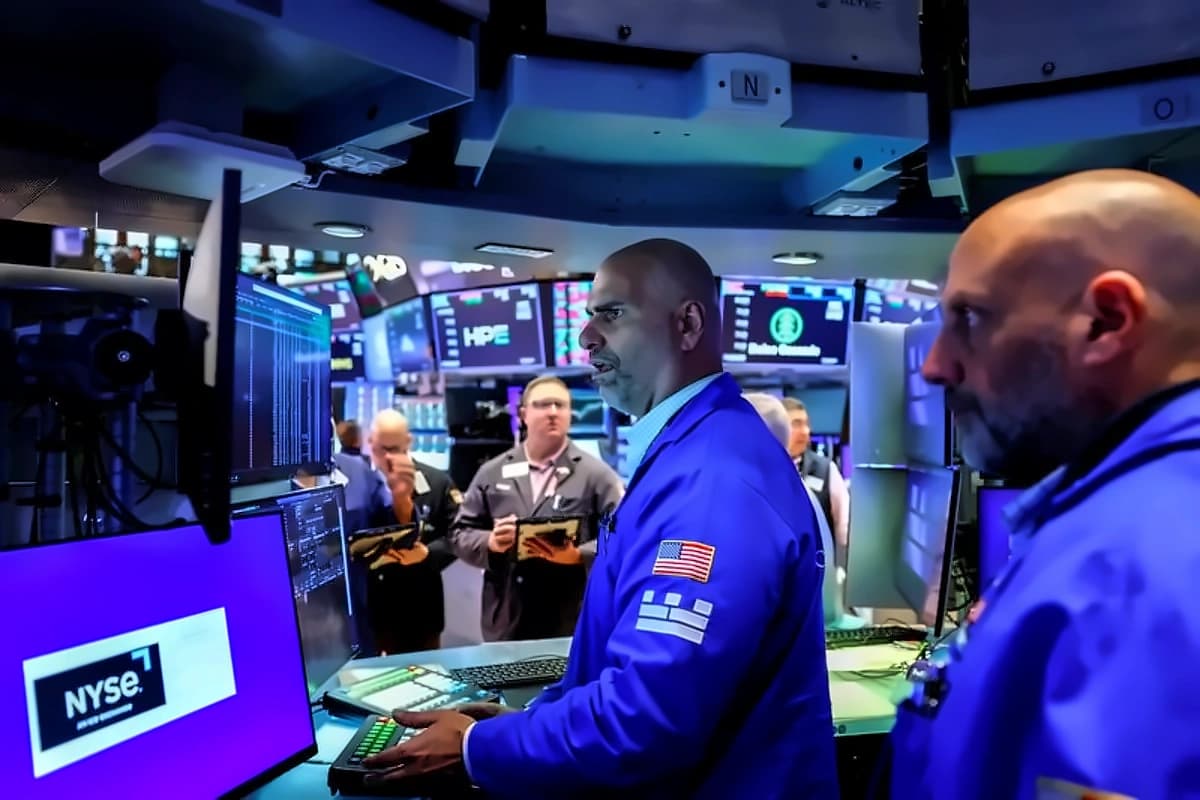
The AI trade experienced significant volatility over the weekend as industry leaders called for a pause in development. According to reports from Investing.com India, Anthropic CEO Dario Amodei urged the industry to tap the brakes on AI frontier development through a blog post that made the rounds ahead of Fed Week. OpenAI CEO Sam Altman backed Amodei's stance, while SpaceX chief Elon Musk also joined the cool-it bandwagon. The tech leader's comments left a mark on early-week trading, with the Nasdaq 100 ETF (QQQ) briefly dipping to a seven-week low, while the VanEck Semiconductor ETF (SMH) sank further toward its late-July nadir before dip-buyers stepped up.
Despite AI drama, corporate America continues to provide market-moving catalysts through upcoming events. As reported by Investing.com India, Wednesday, September 16 features Salesforce Dreamforce & Dow Fireside Chat, with Salesforce CEO Marc Benioff and co serving up software industry developments alongside CNBC's Jim Cramer. Tuesday, September 22 brings FedEx Dataworks Chief Vishal Talwar speaking at HumanX Amsterdam 2026, followed by FedEx's Annual General Meeting. Wednesday, September 23 sees General Mills Q1 2027 earnings date and McDonald's Investor Day, while Thursday, September 24 includes Darden Restaurants Q1 2027 earnings and Sherwin-Williams Financial Community Presentation.

Several major companies are scheduled to provide key updates during this period. According to Investing.com India, General Mills faces scrutiny as the Consumer Staples stock is down 25% from a year ago, stung by GLP-1 adoption and potentially in the crosshairs of the Secretary of the U.S. Department of Health and Human Services. Dow Inc presents at the Morgan Stanley 14th Annual Laguna Conference 2026, with shares under pressure since peaking when the S&P 500 troughed in late March. Sherwin-Williams remains in no-man's-land with the stock flat year-to-date despite an earnings triple play in July, while FedEx continues to struggle with higher fuel prices and record-high diesel costs.
The McKinsey Technology Trends Outlook 2026 reveals that AI has already transformed screen-based workflows—generating answers, drafting documents, and summarizing calls—and is rapidly advancing into an agentic era where it will complete many end-to-end digital tasks on its own. Agentic AI is becoming the connective tissue of the enterprise, with agents working alongside humans to change not just tools but operating models. The report identifies five themes that leaders must understand to steer their organizations into the future, with physical AI emerging as the next frontier where general-purpose robots are being trained to learn about their environments and execute complex tasks. Physical AI is arriving first in manufacturing and logistics, where the economics are clearest, but the trajectory points well beyond the factory floor toward hospitals, construction sites, farms, and city infrastructure.
The AI revolution is driving massive investment, with energy technologies alone drawing nearly $200 billion in 2025—among the highest capital influx in any technology domain. Spending on AI infrastructure doubled in a single year, while five of the 14 trends are on track to receive more than double the investment in 2026 compared with 2025. However, the race to deploy AI at scale has run headlong into power constraints, with US data centers running AI workloads alone projected to consume as much electricity by 2030 as California does today. The race to deploy AI at scale has run headlong into a constraint that hyperscaler ingenuity cannot entirely solve, as more than 2,500 gigawatts of energy projects are stalled in grid queues worldwide, waiting for connections that may be years away.