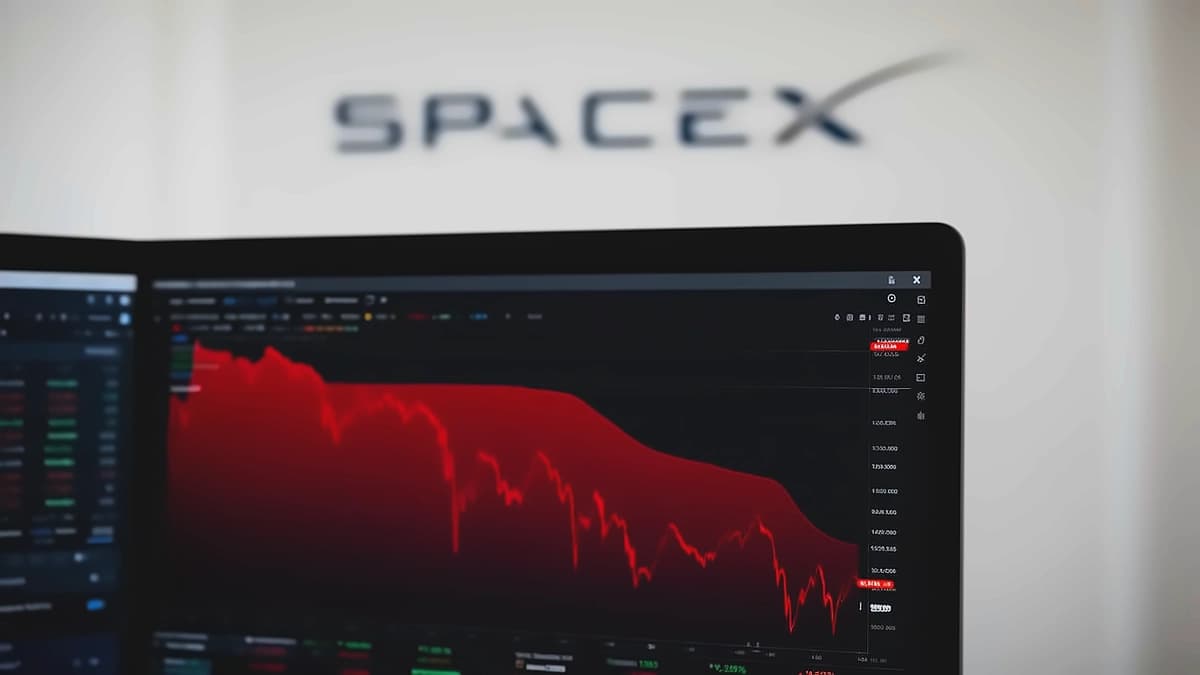
Retail investors turned net sellers for the first time since SpaceX's June IPO on Friday, marking a significant shift in sentiment as shares rebounded. According to The Times of India, individual investors sold a net $4.5 million worth of SpaceX shares on August 7, representing the first net negative reading since the company went public on June 12. As reported by Reuters, this comes just days after individual investors "bought the dip" as shares slumped 13.6% on August 5, when retail net-buying was the fourth-highest since the company's debut. Market analyst Sam North from eToro noted that "Friday is particularly interesting because retail turned net sellers while the shares were rebounding strongly and trading back around the IPO price," suggesting investors are using strength to take profits rather than panic selling. By comparison, the highest single-day net buying in SpaceX's trading history reached $144.6 million on June 16, suggesting the outflow remains modest by the stock's own standards.

The stock's performance reflects broader market dynamics as shares have closed below the IPO price every day since July 16 and were trading up 1.4% at $134.95 in early trading after surging nearly 23% last week. According to The Times of India, the stock surged as much as 67% above its $135 IPO price in June before giving back all of those gains and falling more than 22% below its debut price in August. The reversal in sentiment tracks a broader unwind in SpaceX's share price, with liquidity conditions shifting as the number of SpaceX shares available for public trading more than doubled following the expiry of the first of several lockup restrictions last week. Small investors have been crucial in the company's public market history, as at least 30% of shares made available on debut were set aside for retail buyers. Jai Malhi, senior equities strategist at Vanda, estimates that retail traders on average paid $147 for SpaceX shares since the IPO, so "the selling may have been a function of cutting losses at an opportune time."
SpaceX's stock is experiencing one of its best days following the company's major AI infrastructure announcements, with shares rising significantly as investors respond to the company's comprehensive expansion plans. The rally comes alongside plans for a $16.8 billion Terafab AI chip factory in Texas to expand AI hardware production capacity, as reported by multiple market sources. The company also outlined intentions to build a terrestrial mobile network that would compete with major U.S. wireless carriers, extending the Starlink thesis into ground-based telecom operations. These developments move SpaceX further toward becoming an AI infrastructure and connectivity utility beyond its traditional launch and satellite operations.
Ontario Teachers' Pension Plan booked billions of dollars from its stake in Elon Musk's SpaceX this year, even as the stock experienced sharp volatility following its mid-year mark. The Canadian pension manager reported a 9.5% net return for the first half of 2026, driven largely by its venture growth portfolio, which includes an early bet on SpaceX. Teachers posted $26.6 billion in net investment income for the six months ended June 30, more than four times the $6.0 billion it earned over the same period in 2025. The gain traces back to 2019, when the Ontario Teachers' Pension Plan invested about $300 million in SpaceX through its venture arm at a time when the company was valued near $33.3 billion. By June 30, a filing with the U.S. Securities and Exchange Commission showed Teachers' stake worth close to $8.7 billion, though the stock subsequently fell sharply and lost close to 20% of its June 30 value within about six weeks.
The week's results demonstrate that AI infrastructure investments are creating opportunities across multiple layers of the technology stack, with SpaceX's stock rally reflecting investor confidence in the company's comprehensive expansion strategy. However, the recent retail selling suggests investors are reassessing the risk-reward profile of SpaceX's ambitious AI and telecom expansion plans. The agentic internet represents a new investable theme as Cloudflare monetizes the shift from human to machine traffic, while the optics sector is positioned as a 2027 trade with structural supply constraints creating pricing power similar to memory markets. SpaceX's expansion into AI infrastructure and telecom positions the company as a comprehensive connectivity utility, though investors will need to see concrete data on AI segment revenue beyond the $2.6 billion reported in Q2 2026 and utilization metrics for new compute capacity to assess the durability of these projects. In the last one week, SpaceX was the second most mentioned ticker on Reddit forum r/WallStreetBets, per sentiment aggregator SwaggyStocks, indicating continued retail interest despite recent selling pressure.