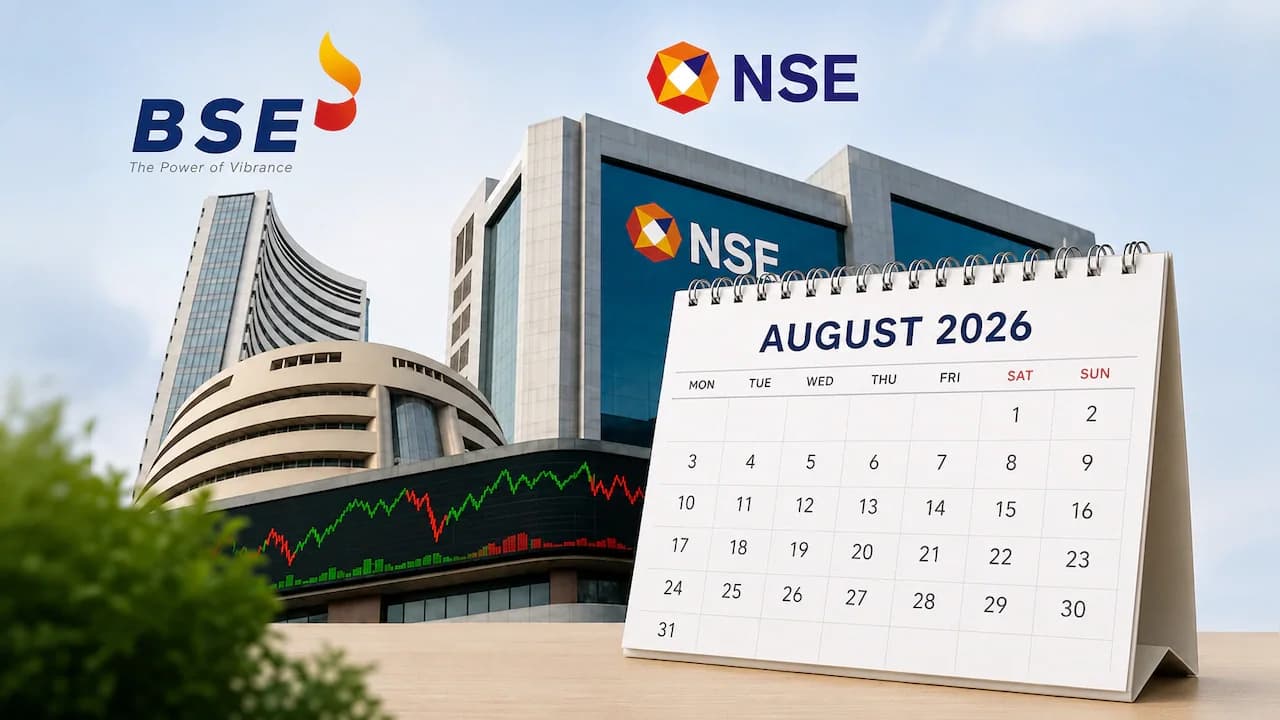
The Indian stock market will remain open on August 28 despite Raksha Bandhan being observed on Friday. According to ET Now, the National Stock Exchange (NSE) and Bombay Stock Exchange (BSE) will remain open for trading as per their usual timings, with standard operations in both the country's leading stock exchanges running as usual today as the date is not designated as a trading holiday in the 2026 exchange calendar. Regular trading applies to all major segments, including Equity, Equity Derivatives, Currency Derivatives, NDS-RST, and Tri Party Repo, with Indian equity markets running from 9.15 AM to 3.30 PM following the 9 AM pre-open session. The National Commodity & Derivatives Exchange Limited (MCX and NCDEX) will also remain operational as usual on August 28, with MCX open for both morning (9:00 AM to 5:00 PM IST) and evening (5:00 PM to 11:30 PM IST) sessions, while NCDEX will commence trading from 10:00 AM to 5:00 PM IST. Neither Id-e-Milad nor Raksha Bandhan is designated as an official trading holiday by BSE or NSE, making these days regular trading sessions.
While trading will continue on August 28 for regular sessions, there is a crucial operational difference due to the settlement holiday designation. According to CNBC TV18, August 26 is designated as a settlement holiday for the equity market, meaning that while trading will proceed as normal, the clearing and settlement of shares and funds will not occur on Wednesday. This differs from a trading holiday, where investors cannot buy or sell shares, as trading will proceed as usual on August 28. The settlement interruption only affects the clearing process, with proceeds or securities from eligible trades not undergoing the standard clearing and settlement process on Wednesday. Shares acquired on August 25 and August 26 may be sold on August 27, and the settlement cycle will recommence following the holiday. The currency markets will be closed on August 26, while the commodity exchange will continue its operations with MCX open for both morning and evening sessions. For August 28, no settlement holiday has been announced, meaning trading, clearing and settlement activities will continue normally.
According to ET Now, stock markets declined for the second consecutive day on Thursday, with the benchmark Sensex dropping by 539 points due to last-minute selling in blue-chip shares such as HDFC Bank and Reliance Industries amid persistent geopolitical uncertainty. The 30-share BSE Sensex dropped 539.35 points, or 0.70 per cent, to settle at the day's low of 76,933.59 on the monthly derivatives-expiry day, while the 50-share NSE Nifty declined 116.90 points, or 0.48 per cent, to end at the day's low of 24,090.85. HDFC Bank was the biggest loser among 30 Sensex firms, dropping by 2.08 per cent following news of a US class-action lawsuit, with Index heavyweight Reliance Industries falling by 1 per cent, dragging the index down. Bharti Airtel, NTPC, Mahindra & Mahindra, HCL Tech and ITC were also among major laggards, while Kotak Mahindra Bank, ICICI Bank, Tech Mahindra and Bharat Electronics were among the winners. This contrasts with earlier reports where the Nifty was trading relatively flat with gains of around 40 points, near the 24,350 mark, while the Nifty Bank index was surging with gains of nearly 1% or over 400 points.

With no equity market suspensions scheduled for the ongoing festive week, market participants can maintain normal trading activities. As per official trading holiday calendars released by the exchanges, neither Id-e-Milad nor Raksha Bandhan are listed as official trading holidays for 2026. However, investors and traders are advised to check local banking and fund settlement timelines, as individual branch closures across different states may occasionally influence physical fund transfers while electronic exchange trading continues uninterrupted. The stock market holiday calendar for 2026 lists 16 trading holidays, in addition to regular closures on Saturdays and Sundays. The remaining holiday schedule includes September 14: Ganesh Chaturthi, October 2: Mahatma Gandhi Jayanti, October 20: Dussehra, November 10: Diwali-Balipratipada, November 24: Prakash Gurpurab Sri Guru Nanak Dev, and December 25: Christmas. Trading on the equities segment happens on all days of the week (other than Saturdays and Sundays and holidays declared by the Exchange in advance). Banks observe holidays on the second and fourth Saturdays of every month under RBI rules, with all government, private, foreign and rural banks remaining closed every Sunday.
The Multi Commodity Exchange of India will be open on 26 August and 28 August for both morning and evening trading periods, based on MCX's yearly trading schedule. According to LiveMint, the exchange observes 16 trading holidays in 2026, during which the markets may be fully or partially closed. The National Commodity & Derivatives Exchange Limited will also operate normally. Despite 8 November falling on a Sunday, the stock markets will remain open for a special Diwali Laxmi Pujan session, with the BSE and NSE conducting the annual Muhurat Trading session on the day. The exact timings for the Muhurat Trading session will be announced separately by the BSE and NSE ahead of Diwali. Market participants will assess the effectiveness of CAS during Tuesday's Nifty 50 monthly expiry as well as on 31 August, when the latest MSCI index reshuffle takes effect after market hours. The currency derivatives market will remain closed on Wednesday, August 26, with traders dealing in currency contracts advised to check their open positions and relevant expiry instructions in advance.