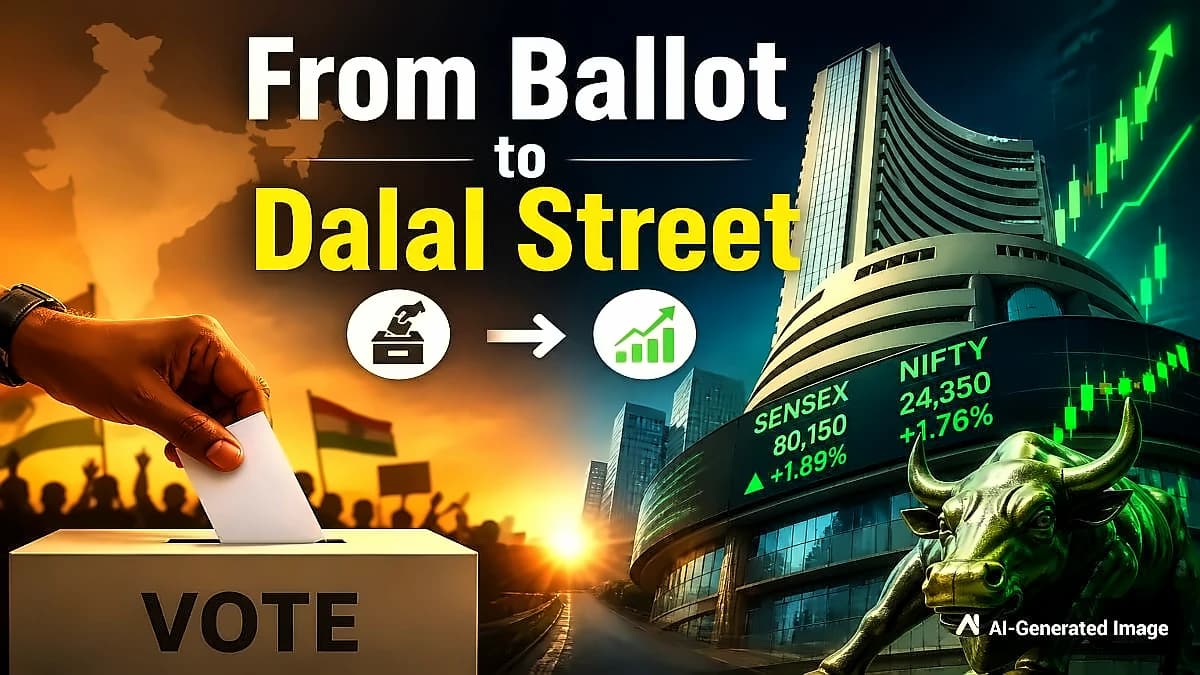
West Bengal's election results have triggered a significant market response, with the Sensex surging nearly 1,000 points in early trade following the BJP's strong performance. According to The Economic Times, the Nifty briefly pushed toward 24,300 before gains moderated, reflecting immediate investor optimism about the political shift. Sunny Agrawal, Head of Fundamental Research at SBI Securities, noted that markets are positive as Bengal, which has significant growth potential, would now be ruled by BJP. However, he emphasized that fundamentally, things will improve only gradually with the true impact being felt only in the long term. The NIFTY50 closed 0.51% higher at 24,119.30 points on Monday, while the BSE SENSEX closed 0.46% higher at 77,269.40 points, as reported by Upstox.

The election results show the BJP leading in 194 of 294 seats against incumbent Trinamool Congress's 83 seats, well past the 148-seat majority threshold. As reported by The Economic Times, this victory would ease the Modi government's path to passing legislation in the Rajya Sabha, representing a structural advantage that could have far broader market implications than any state-level spending plan. In West Bengal, the BJP secured a majority of 206 seats while TMC managed only 80 seats, marking the first central party state government in over 50 years. In Assam, the BJP-led NDA alliance secured 82 seats against the Indian National Congress's 19 seats. According to Upstox, this represents a third consecutive term for Chief Minister Himanta Biswa Sarma in Assam, with the state successfully clocking the highest GDP growth in the country. The BJP's victory in West Bengal expands its national footprint, with the party and its allies now controlling 21 of India's 36 states and union territories.
The end of a 15-year political regime in West Bengal has rekindled investor interest in companies headquartered in the state, triggering a sharp rally in select stocks on expectations of a policy reset. On 4 May, the BJP registered a watershed win in the 294-member assembly, unseating the Mamata Banerjee-led Trinamool Congress and ending its 15-year rule. Sentiment surge has driven shares of RP Sanjiv Goenka Group companies, Bandhan Bank, Emami Limited and others to touch all-time highs. Bandhan Bank shares touched an all-time high of ₹212.5 on Monday, emerging as the top gainer in the Nifty Private Bank pack, with West Bengal accounting for 24% of the bank's total loans and advances as of FY26. RP Sanjiv Goenka Group companies—power distribution firm CESC Limited and PCBL Chemical Limited—also saw their shares touch all-time highs of ₹204.4 and ₹312.75, respectively, on Monday. Emami Limited rose 2.6%, making it the second-highest mover in the Nifty FMCG index.
While sentiment has surged, analysts caution that the rally reflects anticipatory positioning rather than earnings visibility. As noted by market expert Ajay Bagga, "The market is largely anticipatory positioning, not earnings-led yet. Any regime shift that improves industrial policy clarity and capex visibility can expand earnings multiples but sustainability depends entirely on execution, not sentiment." Madhavi Arora from Emkay Global Financial Services highlighted that "Expansion of BJP's eastern footprint in a big state ahead may also accelerate administrative clearances for central schemes in the state with better Centre-State alignment and could be positive for the State's industrial policy & manufacturing in the medium term." However, she flagged fiscal concerns, stating that "The immediate challenge lies in maintaining fiscal discipline against the backdrop of populist-driven spending trends, which have proven to be a winning electoral formula, but threaten the long-term fiscal health of states." Dhananjay Sinha from Systematix Group emphasized that "A change in government does not automatically translate into improved economic outcomes for a state. Structural constraints such as weak state finances, low private capex despite strong corporate profits, land acquisition challenges, and poor employment generation continue to dominate outcomes irrespective of political leadership."