**Fed Chair Kevin Warsh is sensitive to AI developments, according to Jeffrey Rosenberg, a managing director at BlackRock. Rosenberg said Warsh linked tightening financial conditions to AI after the Fed held rates at 3.75% to 4% on Wednesday. As reported by 24/7 Wall St., Rosenberg noted that market rates stopped looking at oil and started looking at the AI trade, with the market "sniffing out that AI is a macro event as much as it is a micro event." Fidelity's Jurrien Timmer reports that the Goldman Sachs AI basket, which tracks AI-linked stocks, has fallen 22% since early June, while the 10-year Treasury yield closed at 4.96% on October 22, marking its first close below 5% since September 22. Recent market data shows AI stocks and long-term Treasuries have moved in opposite directions, which could make bonds a hedge against AI volatility.
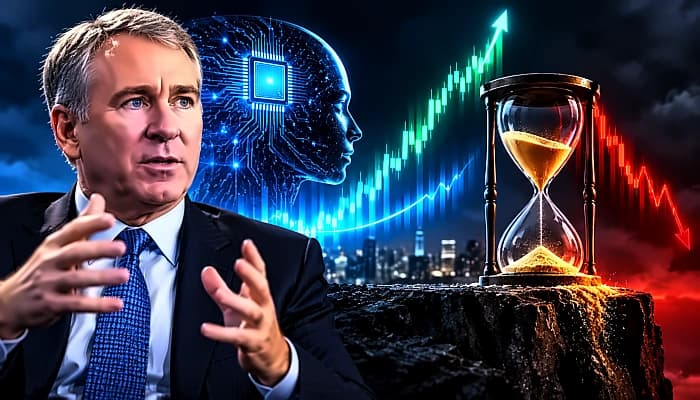
Ken Griffin of Citadel recently told investors at the Future of Global Markets conference that the AI market is 'almost certainly' in a bubble, while Larry Fink of BlackRock argued the opposite on Bloomberg Television. According to reports from Investing.com India, Griffin noted that 'Any radical transformation of our economy is generally intertwined with a bubble' and that 'Corporate America has been very uneven in its ability to extract value from its AI models'. Fink countered that 'the faster we can build out more data centers, the more compute we have, the faster we can bring down the cost' and warned that 'jeopardizes the economy' if buildout slows. However, as noted by recent analysis, 'being right and being early is the same thing as being wrong' - timing the bubble is where investors make or lose money, and history shows that smart people who correctly called bubbles can still cost clients fortunes by acting prematurely.
Ed Yardeni, president of Yardeni Research, now argues that air is leaving the AI bubble without a burst, as bond markets ration capital to weaker AI borrowers. As reported by CNBC, Yardeni says bond investors are grading AI borrowers more sharply, and faster than credit rating agencies, which he sees as the healthiest outcome. Elon Musk issued an AI cloud warning over the weekend, stating that lenders have largely cut off firms whose only business is AI data centers, with Musk warning that 200-plus AI cloud firms could fold. Yardeni concedes some AI companies will fail but expects stronger players to bail out weaker ones. Anthropic filed its public registration for an initial public offering (IPO) on Monday, with Yardeni suggesting the company could use IPO proceeds to help a struggling AI cloud provider, though the filing lists general corporate purposes with no commitments for material acquisitions or investments.
Despite optimistic projections, Union Bancaire Privée estimates that five major hyperscalers will spend $820 billion in 2026, exceeding their projected $750 billion operating cash flow. The Bank of England has also warned that AI infrastructure increasingly relies on borrowing and complex financing arrangements, creating potential vulnerabilities. Recent earnings highlight the financial strain, with Alphabet shares plunging after Wednesday's earnings as AI investments pushed quarterly free cash flow to negative $9.07 billion, while Microsoft shares rose after reporting $18.6 billion in positive free cash flow. Amazon expects to spend about $220 billion in 2026, while Alphabet has budgeted up to $205 billion in AI spending, with the figures including infrastructure investments beyond AI. Raoul Pal believes Big Tech debt fears are overblown, estimating their debt at roughly 3.5% of their stock-market value, arguing that companies are 'barely in debt at all' and comparing the expansion to the railroad boom that lasted 35 years.
Fidelity's Jurrien Timmer warns that rising rates can hurt stocks unless earnings growth offsets them, as junk bond spreads jump. According to Fidelity's analysis, the junk bond spread, the extra yield over Treasuries, is at 3.37 percentage points, up from a low of 2.67, which exposes equity and high-yield holders if it keeps widening. Fidelity's chart shows the Barclays high-yield bond index peaking in September, a month before the S&P 500 total return index, historically marking 2014 to 2016 as a stealth bear market with spreads rising from 3.29 to 8.20. Global corporate bond spreads reached their widest since May 2025 on October 23, with worries over debt-funded AI spending fueling the move. The 10-year Treasury yield climbed back above 5% on October 29, reaching 5.05%, with Timmer noting that yields near 6% could imply a P/E closer to 16 compared to the current forward P/E near 19. If margins and spreads hold, Timmer's framework shows no bubble, but if spreads resume widening as yields climb, equity valuations and junk bond prices could face pressure together.
Recent technical analysis reveals concerning breadth indicators that historically have warned of market tops. A chart flagged days when the S&P 500 fell 1% or more while more stocks rose than fell, with seven of the 13 such days since 1990 coming in 1999 and 2000. Ari Wald, Oppenheimer's head of technical analysis, rules out a collapse but sees lower highs in small caps and credit that could weigh on holders of both. Wald still expects a year-end rally, citing oversold conditions, but warns that lower highs in small caps, market leadership and credit could undermine it, setting up a market reset in 2027. Global credit spreads, the extra yield lenders demand over safe bonds, have climbed to their highest since May 2025, with Anthropic's listing expected to test whether fresh capital backstops weaker AI borrowers as Yardeni expects. Amazon's October 29 earnings provide the next test, with strong cloud demand and improving cash flow potentially strengthening Pal's argument, while further cash burn could raise questions about valuations and future spending.