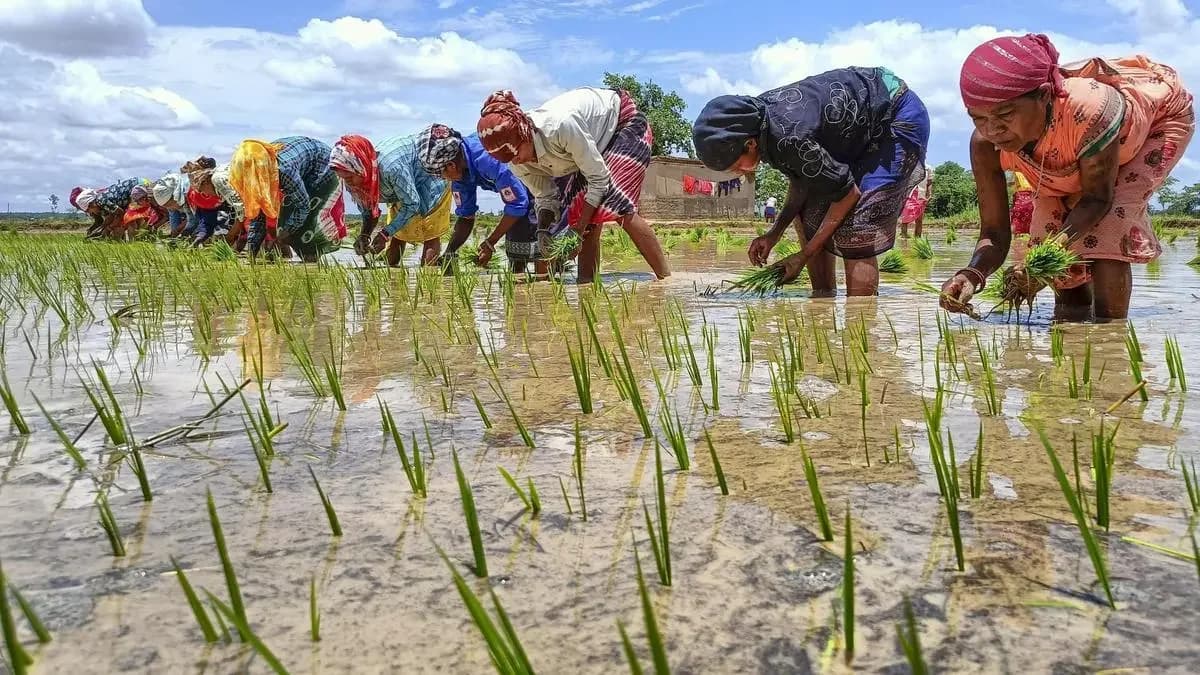
Women in Indian agriculture earn 20 to 30 per cent less than men for identical tasks, taking home just ₹82 for every ₹100 earned by male workers. According to a report titled 'Her Harvest' by Arya.ag, this wage disparity results in significant economic losses for the country. India loses between ₹1.2 trillion and ₹2 trillion in potential agricultural output every year due to systemic disparities in wages, land ownership and resource access. The economic loss stems from a sharp structural imbalance in rural India, where nearly 77 per cent of rural working women now work in agriculture, with their share of the agricultural workforce rising from 57 per cent in 2017-18 to over 64 per cent in 2023-24.
Despite performing more than half of the farm work, women operate just 11.72 per cent of the farmed area, revealing a fivefold disparity between women's labour contribution and their control over land. Women-run farms are 24 per cent less productive, resulting in an estimated 2.5 to 4 per cent output loss to India's ₹48.7 trillion farm economy. As reported by Arya.ag, land title determines who receives credit, extension support and procurement access, with nearly 47.7 per cent of women in agriculture recorded as unpaid helpers on family farms, compared with 20.2 per cent of men. This continuous loop begins with women not being counted as farmers, leading to fewer inputs and no storage options, resulting in distress sales at harvest and lower incomes.
Under the Namo Drone Didi program, about 15,000 women-led self-help groups (SHGs) are being equipped with agricultural drones, enabling trained operators to earn ₹60,000 to ₹80,000 a month. The report emphasizes that providing equal resources would lift yields on women-run farms by 20-30 per cent, while raising women's harvest incomes increases overall household incomes by 20-30 per cent. The UN has declared 2026 as the International Year of the Woman Farmer, with the report outlining four key recommendations including formally recognizing women as farmers, expanding financial access through collateral-light credit, routing drones and advisory services directly through women-run institutions, and building women-led FPOs as permanent market institutions.
The report advocates for the 'Three Rs' approach — Resources, Recognition and Returns — to address gender disparities in agriculture. According to Arya.ag, providing equal resources would lift yields on women-run farms by 20-30 per cent, while raising women's harvest incomes increases overall household incomes by 20-30 per cent. The report emphasizes that 'A rupee earned by a woman farmer does double work. It raises output now and resilience later.' Figures in the report were drawn from public datasets and cited institutional sources including the FAO, PLFS 2023-24, Agriculture Census 2015-16, PIB releases, ILO, USDA, IFC, UNDP, Arya.ag partnership materials and Arya.ag disclosures as of June 2026.