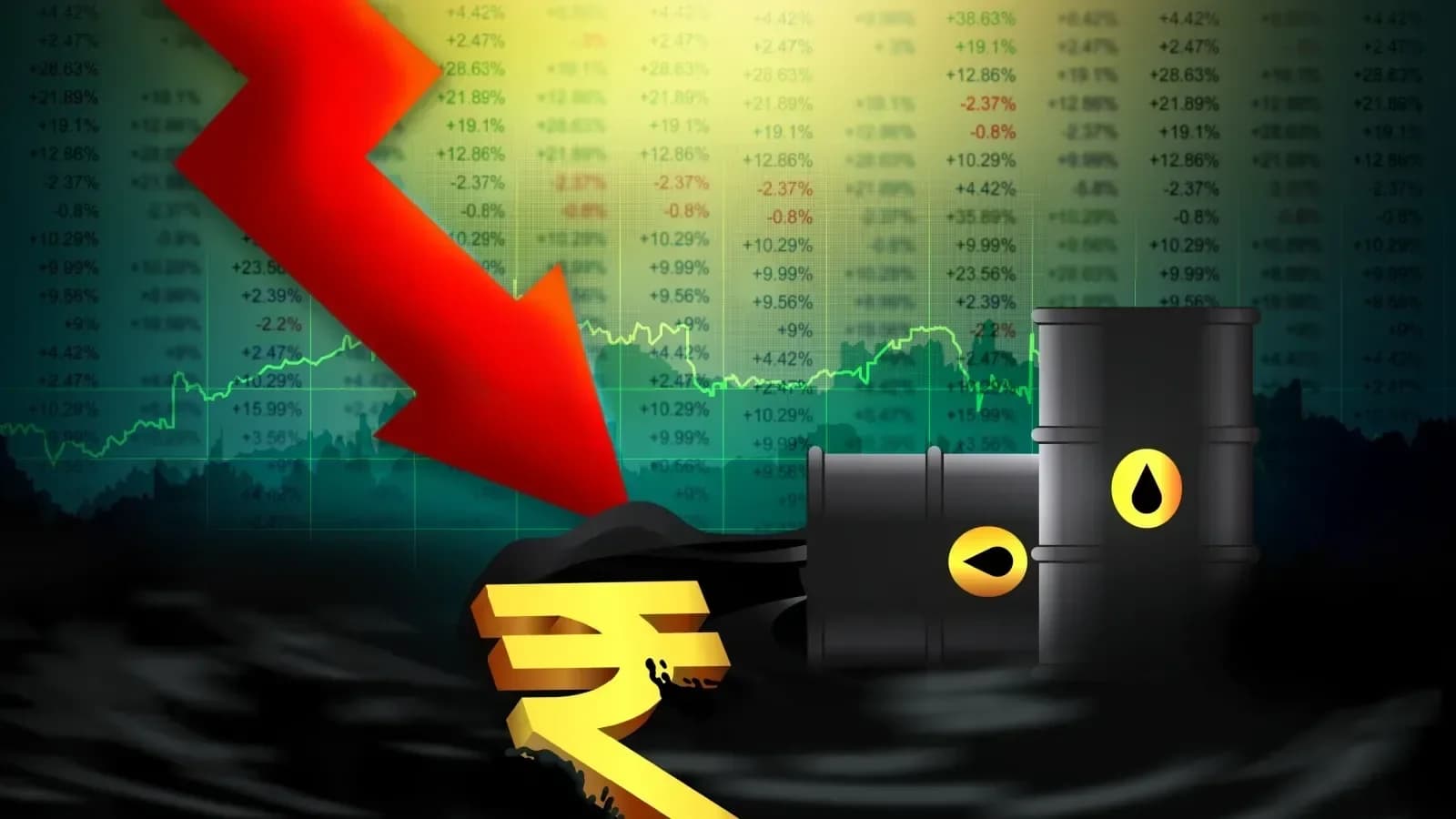
The Indian rupee weakened to a record low of 95.6 against the United States dollar on Tuesday, extending its decline from the previous session's close of 95.31 against the US dollar. According to ET Now, the currency's weakness was primarily attributed to Prime Minister Narendra Modi's austerity remarks, which weighed on market sentiment alongside ongoing Middle East tensions. In the last two consecutive sessions, the Sensex has crashed over 2,000 points, or nearly 2%, reflecting investor concerns about the economic impact of the government's measures. Analysts predict the rupee may continue to weaken, with potential intervention from the RBI only slowing depreciation rather than reversing it.
The government on Friday raised retail prices of petrol and diesel by ₹3 per litre and increased compressed natural gas (CNG) prices by ₹2 per kilogram, marking the first significant fuel price revision in over two years. With the latest revision, petrol and diesel prices in the national capital rose to ₹97.77 and ₹90.67 per litre respectively, while CNG prices increased to ₹79.09 per kilogram. According to government sources, the state-owned oil marketing companies have limited the increase to around 3.5 per cent on a base price of roughly ₹95 per litre in an attempt to cushion consumers from extreme global volatility. Defending the move, officials said a complete pass-through of the global oil shock would have required retail fuel prices to rise by as much as 200-300 per cent of the present increase due to sharp spike in international crude prices and India's heavy dependence on imported oil.
Government officials revealed that oil marketing companies and the Centre have together been absorbing losses of around ₹1,000 crore a day, amounting to more than ₹1 lakh crore per quarter, to keep retail fuel prices largely unchanged despite elevated crude oil prices. Industry analysts warned that the latest increase only partially addresses the severe under-recoveries being borne by OMCs. Prashant Vasisht from ICRA estimates that at crude prices of $105-110 per barrel, OMCs incur a loss of about ₹500 crore daily on the sale of auto fuels and domestic LPG, even after factoring the fuel price hike. As reported by The Hindu BusinessLine, economists expect the impact of the latest fuel price revision to start reflecting in the May CPI print, with the full transmission likely from June onwards, with several analysts indicating that more price hikes may follow if international crude prices remain elevated.
Economists warned that the fuel price increase could rekindle inflationary pressures just as retail inflation had begun easing. Retail inflation, measured by the Consumer Price Index (CPI), stood at 3.5 per cent in April and remained within the Reserve Bank of India's comfort range. However, wholesale inflation, based on the Wholesale Price Index (WPI), surged to a 42-month high of 8.3 per cent in April, driven largely by higher fuel and power prices. Aastha Gudwani from Barclays said the direct impact of the fuel price increase on CPI inflation could be around 15 basis points once fully passed through. At the same CII summit, Kotak Mahindra Bank founder Uday Kotak warned that the economy should be prepared for difficult conditions, stating that businesses should be ready for 'very bad situations' rather than waiting for a shock.
The financial stress on state-run fuel retailers has become severe, with India's three major public sector oil retailers projected to report combined losses of nearly ₹1.2 lakh crore in the first quarter of FY27 alone. According to industry estimates cited during the CII Annual Business Summit 2026, the three major public sector oil retailers -- Indian Oil Corporation, Bharat Petroleum and Hindustan Petroleum -- are staring at the possibility of their entire FY26 profits being wiped out if crude oil prices remain elevated. As reported by Zee News, Petroleum Minister Hardeep Singh Puri stated that the financial stress has become so severe that a single quarter of losses at prevailing crude price levels could potentially erase their entire profit after tax for FY26. The warning comes as global crude oil prices have surged past the psychologically important $100 per barrel mark due to fears of prolonged supply disruptions linked to the US-Iran conflict.