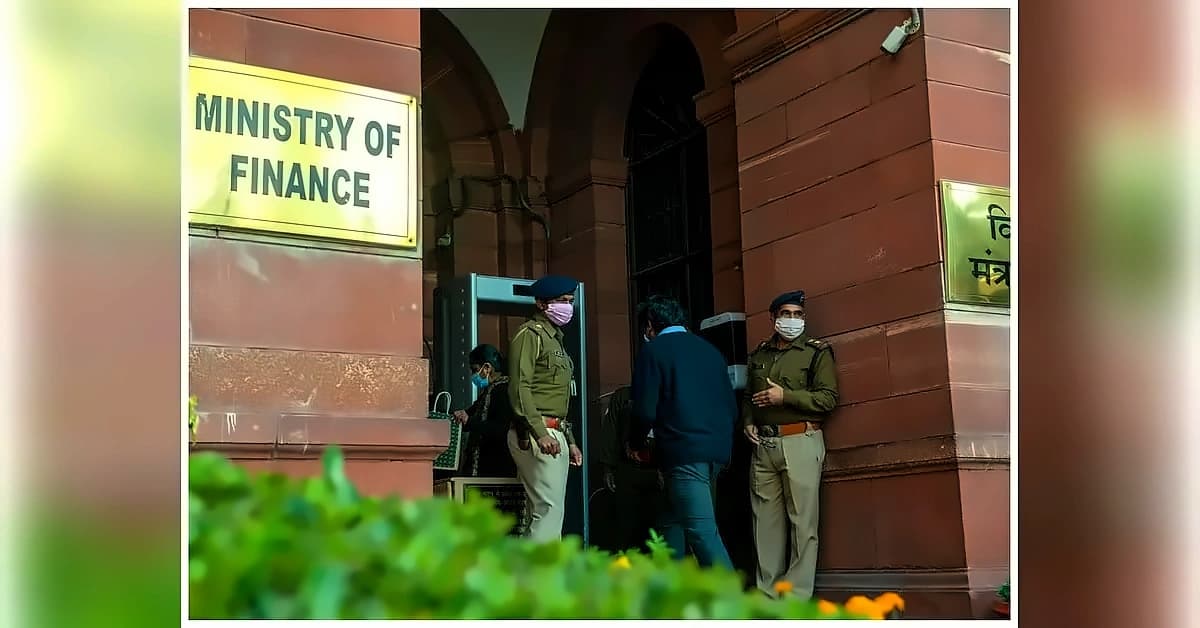
The Finance Ministry has issued a cautionary warning about sustained oil price increases in its July Monthly Economic Review, highlighting significant risks to India's fiscal and external stability. According to the ministry's latest assessment, persistent geopolitical uncertainty and a sustained rise in global crude oil prices could renew pressure on India's fiscal and external balances. The ministry specifically warned that higher energy costs may weigh on both the fiscal deficit and current account, with continued tensions in the Gulf region and potential disruptions to shipping through the Strait of Hormuz already contributing to higher energy prices. As reported by The Times of India, the recent resurgence in global crude oil prices, if sustained, could re-emerge as a source of pressure on financing of both the fiscal deficit and the current account balance. Brent crude futures rose more than 5% to $88.40 a barrel on Wednesday after the United States and Saudi Arabia carried out targeted strikes in Iraq, with crude oil prices having climbed sharply since the West Asia conflict began on February 28, surging from around $73 per barrel before the conflict to a four-year high of $126 per barrel in early May.
India's macroeconomic fundamentals remain strong, supported by robust domestic demand, healthy corporate balance sheets and sustained fiscal discipline amid global challenges, Union Minister Pankaj Chaudhary told Parliament on Tuesday. According to reports from Business Standard, the real GDP has consistently grown at over 7 per cent during the last three years, with economic growth continuing to be supported by these key factors. The Index of Industrial Production (IIP) recorded a growth rate of 4.9 per cent year-on-year in April 2026 and 5.1 per cent YoY in May 2026, indicating continued investment-led industrial growth despite heightened global uncertainty. However, the minister noted that industries reliant on imported inputs may face cost pressures due to global developments, with the latest oil price risks adding another layer of complexity to the economic outlook. As per The Times of India, the Indian economy has remained resilient despite an increasingly difficult global environment, though the ministry cautioned that external uncertainties continue to intensify.
Despite oil price concerns, India's external sector has demonstrated remarkable resilience with significant improvements in key metrics. The ministry highlighted that India's current account recorded a surplus of $2.8 billion during April-May 2026, compared with a deficit of $4.1 billion in the corresponding period last year, aided by resilient services exports and higher remittances. The external sector has been supported by robust merchandise exports, a healthy services trade surplus, strong remittance inflows and comfortable foreign exchange reserves. As of July 10, foreign exchange reserves stood at $675.2 billion, providing an import cover of nearly 10 months and offering a significant buffer against external shocks. As reported by The Times of India, the report also highlighted the resilience of India's external sector, citing robust export performance, a healthy surplus in services trade and steady remittance inflows that have supported the current account. Recent policy measures are expected to encourage capital inflows in the near term, further strengthening India's external position.

The Finance Ministry has called for reinventing India's approach to dealing with evolving global challenges, particularly the challenge of elevated energy prices. According to The Times of India, the ministry stated that India will need to rethink its approach and redesign its policy responses to an increasingly complex global environment, particularly the challenge of elevated energy prices, if it is to strengthen its strategic position. The report emphasized that deeper domestic reforms and quicker policy execution will be essential to alter the country's long-term economic trajectory. The ministry noted that global developments related to AI and weaponisation of supply chains in general are reminders of the distance India needs to travel to achieve long-term resilience and strategic leverage. As per The Times of India, the ministry stressed that India has to reinvent itself and re-imagine its responses to global imperatives if it has to achieve strategic leverage, with the continued interplay of domestic reforms, prudent macroeconomic management and swift policy responses remaining important in shaping India's economic trajectory.
As a major player in global markets, India's economy is linked with international trends, which impact its exchange rate movements. According to the minister's statement reported by Business Standard, the Indian Rupee (INR) has depreciated against the US Dollar (USD) by 5.8 per cent in FY27 from February 27 up to July 22, 2026, following the start of the West Asia conflict. The value of the INR is market-determined, with no target or specific level or band, and the RBI regularly monitors the foreign exchange market and intervenes in situations of excess volatility. The minister also emphasized that the RBI monitors key developments across the globe, which may have an impact on the USD-INR exchange rate. As per The Times of India, the ministry said that while policymakers are closely tracking volatility in global crude oil prices arising from geopolitical developments, as well as the potential impact of El Niño weather conditions, the domestic inflation outlook remains cautious but fundamentally well-supported.