In the summer of 1991, India stood on the edge of an unprecedented economic collapse. The country had foreign exchange reserves barely sufficient to cover two weeks of essential imports, with inflation rising and the government struggling with mounting debt. To avoid default, India took the extraordinary step of pledging its gold reserves overseas. In May 1991, India sent 20 tonnes of gold to the Union Bank of Switzerland in Zurich, followed by an additional 47 tonnes to the Bank of England by July, totaling around 67 tonnes of gold pledged as collateral to secure emergency loans worth approximately $600 million. The crisis was the result of years of high government spending, political instability, weak exports, and an economy that remained heavily regulated. The Gulf War after Iraq invaded Kuwait in August 1990 pushed up global crude oil prices, increased India's import bill, and disrupted remittances from Indian workers in the Middle East.
The 1990-91 crisis revealed the severity of India's economic imbalances through stark statistical data. Trade deficit increased from ₹12,400 crore (1989-90) to ₹16,900 crore (1990-91), while current account deficit rose from ₹11,350 crore to ₹17,350 crore. Inflation increased from 7.5 per cent to 10 per cent, crossing 13 per cent in 1991-92, and GDP growth declined from 6.5 per cent to 5.5 per cent. Forex reserves fell dramatically from ₹5,277 crore (December 1989) to ₹2,152 crore (December 1990). The rupee was devalued in two stages - 9 per cent on July 1, 1991, and 11 per cent on July 3, 1991, losing nearly one-fifth of its value against major international currencies to make Indian exports more competitive.
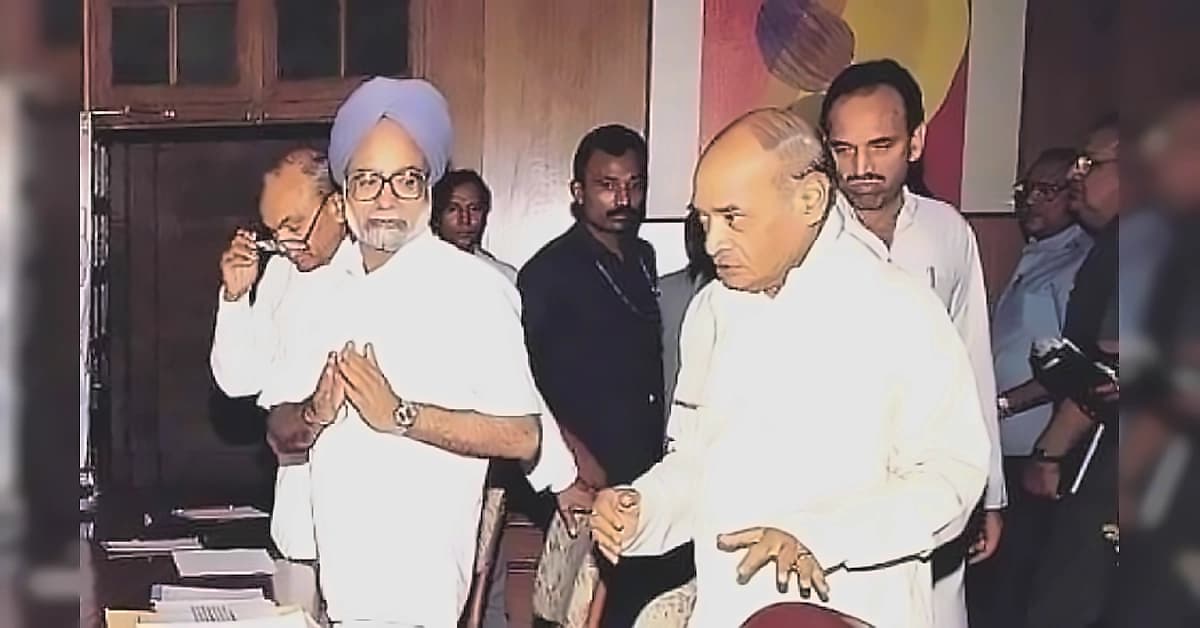
On July 24, 1991, Finance Minister Manmohan Singh presented the Union Budget that charted India's path towards economic recovery. The Budget focused on stabilising the economy while laying the foundation for long-term structural reforms, including reducing fiscal deficit through expenditure rationalisation, reforming tax structure, encouraging foreign investment, and simplifying industrial and trade policies. The same day, the government announced the New Industrial Policy that fundamentally altered India's industrial landscape by abolishing industrial licensing for most sectors, reducing the number of industries reserved for the public sector, allowing greater foreign investment, and reducing government control over private businesses. These reforms marked the beginning of the gradual dismantling of the Licence Raj, which had governed industrial activity for decades. The Narasimham Committee, established in August 1991, recommended wide-ranging banking sector reforms to reduce government interference and strengthen prudential regulations.
Subsequent governments continued the reform process, though these were often slow-paced and faced political setbacks. Tariffs were raised starting in 2018, and industrial policy made a comeback under a different name. If India's growth and development trajectory is to improve, such aberrations should be corrected. The microfinance sector faced particular challenges in FY 2025 with tight liquidity and constrained debt availability, though it showed signs of recovery in the latter half of the year. Despite the reforms, India's performance remains mixed compared to regional peers, with China and Vietnam showing that much more could have been done - Vietnam started with less than half India's per capita income in 1991 and now has an 80 per cent higher income level, while India remains in the lower-middle-income group. As noted, while reforms continued, privatisation did not take off as expected due to unemployment concerns, and factor market reforms of land and labour also remained incomplete.
To revive the reform spirit, it will be important for the government to involve domain experts in driving fresh reforms and ensure the independence of regulatory institutions. Steps should be taken to encourage state governments to embrace reforms through a participative and consultative mechanism. Equally important will be the need to widen the scope of reforms to include hitherto neglected areas such as education, skilling, justice delivery systems and health care. The focus should extend to building deeper engagement, financial resilience, and sustainable empowerment for underserved communities, with technology and digital public infrastructure playing defining roles in accelerating this next phase of inclusion. Recent developments like the Union Government's introduction of a ₹20,000 crore Credit Guarantee Scheme in March 2026 to facilitate bank lending to MFIs, and progress on overseas funding avenues including engagements with international lenders for Non-Convertible Debentures and External Commercial Borrowings, demonstrate continued commitment to supporting financial inclusion. However, challenges remain with the informal sector overshadowing the organized sector, poor productivity improvements, and the middle class no longer growing at previous rates due to quality job shortages.