India's Chief Economic Adviser V Anantha Nageswaran has urged young Indians to rethink conventional education and employment pathways, warning that degrees alone may not guarantee long-term career security in a rapidly changing job market. Speaking on an ANI podcast, Nageswaran stated that 'the era of MBA education is over' and emphasized that the globalising world previously gave advantages to software, computer science and MBA education, but this era is now concluded. He noted that many students continue to follow traditional career routes including graduation, higher studies or preparation for competitive exams such as UPSC without adequately assessing whether these qualifications will translate into future employment opportunities. As reported by Firstpost, Nageswaran warned that students should not assume that a linear educational journey, from a bachelor's degree to a master's degree, followed by a PhD, MPhil or even preparation for the UPSC examination, will automatically lead to employment.
Instead of traditional degrees, Nageswaran stressed the importance of trade skills and human-centric abilities that require physical presence, judgment and interpersonal interaction. As reported by ANI, he argued that rapid advances in AI are forcing workers to reassess which capabilities will remain valuable over the long term. According to the CEA, employability in the future will depend less on credentials and more on skills that technology cannot easily replace. The central message from Nageswaran is that future career security will depend less on the degree a person holds and more on the skills they can continuously build and apply. To illustrate this point, Nageswaran shared the example of a friend's son who trained in catering technology and became a chef, initially feeling discouraged after comparing his career progress with friends. The CEA advised against judging future based on social media posts or short-term comparisons, highlighting that the chef had learnt a skill that technology could not easily replicate and that such expertise would become increasingly valuable in the years ahead.
According to the CEA, India has traditionally undervalued vocational trades such as welding, plumbing, carpentry and electrical work. Countries like Switzerland, Germany, Japan, South Korea and China, on the other hand, give greater respect to such skill-based professions. As reported by ANI, such professions continue to offer strong employment potential and are less vulnerable to automation than many white-collar roles. The CEA emphasized that changing societal attitudes toward such professions will be crucial if India is to build a workforce suited to the demands of the future economy. Nageswaran noted that careers such as counselling, caregiving and hospitality could become increasingly important in the years ahead, as these professions require human judgment and presence that technology cannot easily replicate. He highlighted fields such as counselling, hospitality and culinary arts as examples of occupations where human interaction continues to be critical and where AI may struggle to replace workers completely.
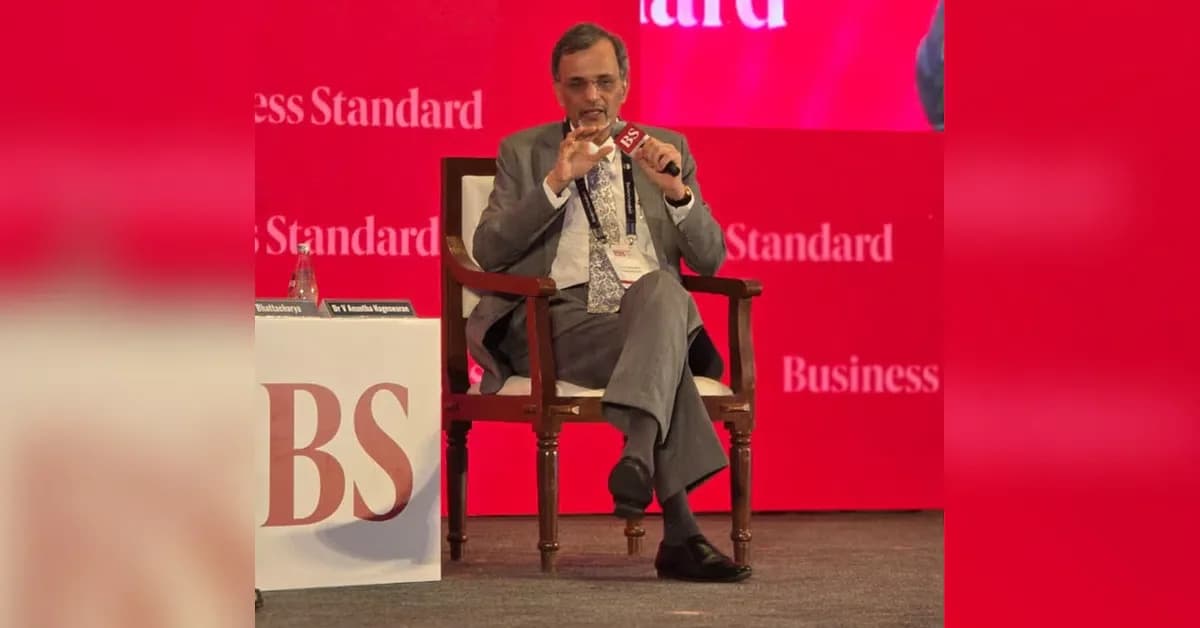
Nageswaran linked employability directly to health outcomes, arguing that economic growth depends not only on technology and infrastructure but also on healthy and productive citizens. Referring to findings from the National Family Health Survey, Nageswaran noted that obesity has increased across income groups despite improvements in several health indicators. He attributed this trend to sedentary lifestyles, limited physical activity and late eating habits. According to the CEA, physical and mental well-being are essential for improving productivity, employability and incomes. His message to young Indians was to focus on acquiring skills that technology cannot easily replace and to invest as much in personal health as in professional qualifications.
Nageswaran emphasized that India's future growth will depend on innovative solutions, entrepreneurship and a willingness to create services that meet changing social needs. As reported by Firstpost, he argued that the key for young people entering the workforce is to develop skills that combine human expertise, practical knowledge and adaptability, qualities that are likely to remain in demand even as AI transforms the job market. The CEA highlighted that technological advances are less likely to replace many trade-based occupations because they require hands-on expertise and human intervention. He noted that India is exploring collaborations to deepen skills training partnerships with countries like Canada, which emphasizes industry-focused, practical education for emerging job markets. The government is promoting sectors like solar and renewable energy, creating new 'green jobs' and collaborating with Canada to deepen skills training partnerships, emphasizing industry-focused, practical education for emerging job markets.