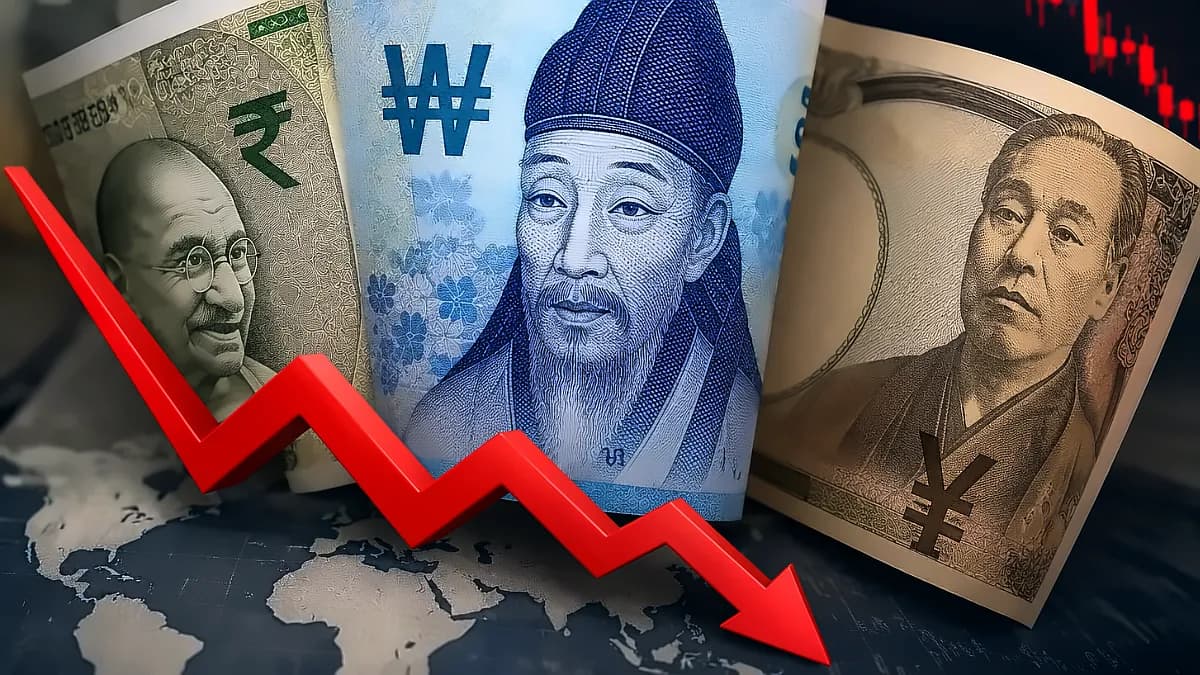
South Korea's won has fallen to around 1,554.9 against the US dollar as of 3:30 p.m., down 5.5 won from the previous session, marking its weakest level since March 2009. The currency weakness comes despite record export performance, with foreign investors selling a net 1.7 trillion won worth of stocks on Wednesday, marking the eighth consecutive day of selling. As noted by economist Moon Dawoon from Korea Investment & Securities Co, the dollar's strength is such that a fresh low for the won would not be surprising, with potential downside to around 1,600 per dollar.
South Korea's exports surged 59.5% in June as AI chip demand pushed the trade surplus to a record $36.1 billion, reinforcing the Bank of Korea's hawkish stance. The expansion was once again led by semiconductor shipments, boosted by substantial investments in AI and data centers, with shipments surging 70.9% year-on-year versus a revised 53.4% increase in May. The surge in AI-related chip demand is being fueled by global tech giants expanding their data center capacity, with both Samsung and SK Hynix announcing massive investment plans to meet this demand. These figures reinforce the Bank of Korea's position, with officials citing robust growth, ongoing inflation, a weak won, and rising housing costs as reasons to consider rate hikes.
South Korean stocks ended by more than 2% lower Wednesday as investors locked in gains following recent artificial intelligence-fueled rallies in semiconductor shares, amid uncertainty over fragile U.S.-Iran peace talks. The benchmark Korea Composite Stock Price Index (KOSPI) lost 173.07 points, or 2.04%, to close at 8,303.41. Market bellwether Samsung Electronics fell 5.84% to 314,500 won, while chip giant SK Hynix declined 3.4% to 1.56 million won. Despite the tech selloff, South Korea's exports reached a record high in June, surpassing the $100 billion mark for the first time on the back of record semiconductor shipments.
Semiconductors have become the backbone of South Korea's export performance, with their share of total exports reaching a historic 43.8% in June, up 18.8 percentage points from the previous year. This marks the first time semiconductors exceeded 40% of Korea's total exports, surpassing the previous record of 42.3% in May. Semiconductor exports hit a record $44.82 billion in June, marking the first time monthly semiconductor exports exceeded $40 billion, surpassing the previous monthly record of $37.2 billion in May. Among Korea's 20 major export categories, 18 posted year-on-year growth in June, with computer exports surging 308.8% to $5.41 billion driven by growing demand for solid-state drives and wireless communication equipment rising 51.9% to $1.55 billion.
South Korean authorities have implemented several measures to address the currency decline, including repeated warnings against excessive currency movements and conducting rare joint inspections of banks' foreign-exchange operations with the Financial Supervisory Service. The government has increased the limit for foreign-exchange stabilization bonds to $5 billion this year and is preparing to expand a 100 trillion won market stabilization programme. Bank of Korea Governor Shin Hyun Song noted that "the chip boom is feeding into consumption, investment, and wages, which could make inflation more persistent," with consumer inflation hitting its highest level in over two years in May. The weaker won has raised import costs, adding complexity for policymakers as they monitor inflationary pressures and the impact on the bond market.