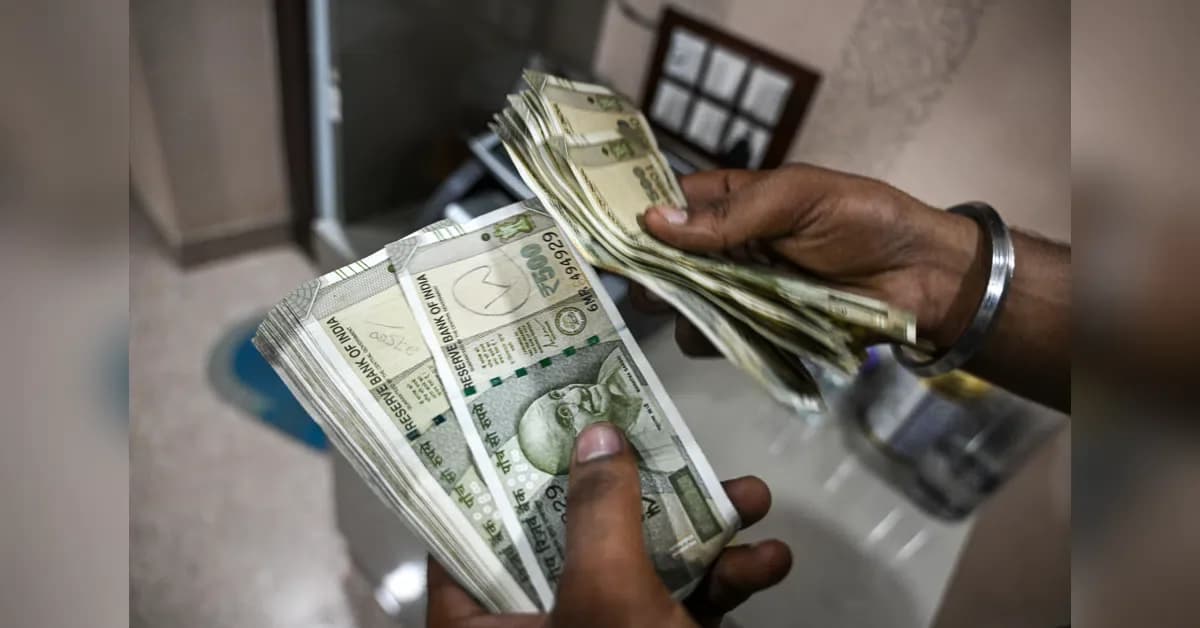
The rupee has reached a concerning milestone, hitting 100 per dollar in 1-year forward markets while closing at 96.82 in spot trade, down 29 paise from the previous close of 96.53. According to Mayur Shetty, the domestic currency slid to a new low of 96.96 during intraday trading before recovering slightly. A one-year outright forward spot rupee transaction represents a foreign-exchange contract where today's exchange rate is agreed for a USD/INR trade settling one year later. The one-year premium on the dollar opened at 321 paise, rose to a high of 322 paise and was last at 302 paise, indicating significant hedging demand and interest-rate differential concerns.
India's strong mutual fund SIP culture may be quietly tightening pressure on the rupee by providing foreign investors with a smooth exit route from the expensive equity market, according to Jefferies analysis. The brokerage argues that capital flows are the culprit for INR pressure, not the current account deficit, with India's CAD averaging just 0.8% of GDP over FY24–26, the lowest ever recorded. Over FY25–26, equity-market-driven foreign outflows reached a massive $78 billion, with foreign institutional investors, private equity funds and foreign promoters all using the deep domestic bid to cash out. As reported by Jefferies, strong domestic flows continue to absorb heavy foreign selling in equity markets, with FPIs alone selling a net $44 billion of Indian equity since April 2024.

The drain from foreign equity outflows has been powerful enough to tip the overall balance of payments into the red for two consecutive years. According to Jefferies, net FDI flows have collapsed from the mid-40 billion dollar range in FY21–22 to just about $5 billion in FY26, with projections showing only slight improvement to $9 billion in FY27. The capital account surplus has shrunk to just around 0.5% of GDP over FY25–26, compared with a 2.6% average surplus over the previous decade – the lowest level on record. The brokerage's FY27 balance-of-payments snapshot projects a trade deficit of $334 billion (8.5% of GDP) and a modest $25 billion capital account surplus, translating into a BoP deficit of $11 billion in FY26.
Market experts highlight additional pressures beyond domestic SIP flows. DBS treasury head Ashish Vaidya noted that the ongoing West Asia conflict and consequent higher oil prices are preventing the rupee from breaching the 97 level, with risks of the current account deficit overshooting. The India-US rate differential is too narrow — an overseas investor can earn about 4.65% in US dollar bonds versus roughly 3.04% in India after hedging, weakening the case for debt inflows. According to Jefferies, REER at c.91 (INR 9% undervalued) provides comfort and historically (barring GFC), INR has rebounded from such levels. However, dealers emphasize that India needs to lower FX forward costs or interest rates to attract foreign capital, which remains critical for growth.
In Jefferies' base case, the rupee is expected to recover somewhat to 93–95 per dollar over the next 12 months, assuming the Strait of Hormuz reopens and the ongoing unwinding of the global AI trade eases FPI outflows. The brokerage warns that the same can happen again if AI as the dominant global investment theme slows down, referring to past episodes where sharp INR slides were followed by strong rebounds in foreign equity flows. However, they caution that a weaker rupee has not consistently translated into meaningful export boosts, especially outside oil and electronics sectors. Market experts suggest that net services exports surged 14–15% in FY26 to ₹217 billion, covering around 65% of the merchandise trade deficit, led by IT and other business services including global capability centres.