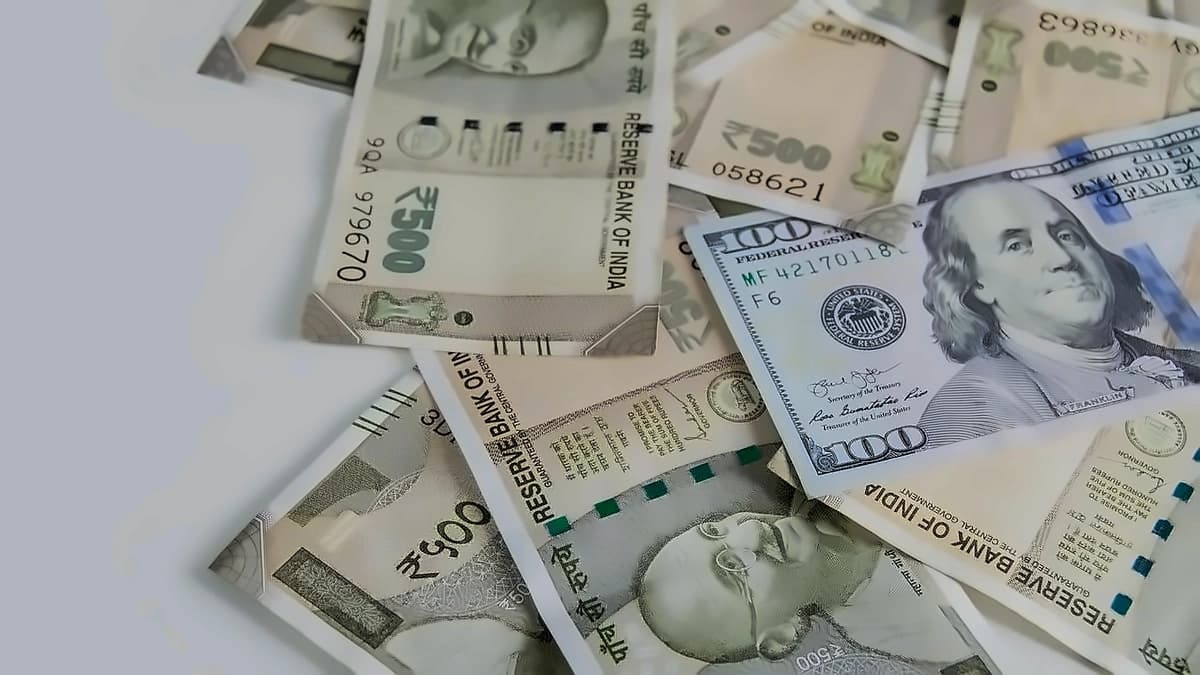
The Indian rupee opened at 94.22 per dollar on Friday (April 24), weakening from Thursday's close of 94.11, as reported by CNBC TV18. The currency has fallen about 1.3% so far this week and is nearly two rupees weaker from its recent high near 92.50, indicating a renewed bout of selling after a brief recovery phase. The rupee traded in a narrow 16 paise range between 94/$ and 94.16/$, with RBI likely selling dollars in the first half of the day, as dealers noted. As compared to last Friday's close of 92.93, the rupee has cumulatively weakened about 118 paise so far this week. At the interbank foreign exchange market, the rupee opened at 94.03 and faced immediate pressure, with some traders expecting the 94-per-dollar level to be breached early in the session. **A currency trader at a private sector bank expects 94 to be "taken out right" at the open", noting that the move from 95 to 92.50 was a relief rally that has now run its course with oil well past $100. Dilip Parmar, Senior Research Analyst at HDFC Securities, said driven by high hedging dollar demand and a broader shift toward safe-haven assets, the rupee has weakened past the 94 level against the greenback. "Central bank interventions failed to arrest the slide as a simultaneous rally in crude oil and the US dollar exerted additional downward pressure," he noted, with dollar-rupee retaining bullish momentum in the near term, with support around 93.80 and resistance at 94.60.
Market participants said the Reserve Bank of India has been intervening intermittently to curb excessive volatility, according to CNBC TV18. Traders noted that the central bank has been supplying dollars at multiple levels rather than defending a specific threshold, signalling an effort to moderate the pace of depreciation. Despite these measures, the dollar/rupee pair has remained elevated, supported by persistent demand for the US currency, suggesting that the impact of intervention has been limited. This represents a shift from the RBI's previous approach of defending specific thresholds, indicating a more nuanced strategy to manage currency stability. According to the RBI Bulletin in April, the central bank was a net buyer of $7.4 billion in the over-the-counter (OTC) market, with gross purchases of $21.4 billion and sales of $14 billion, injecting ₹66,881 crore into the system. In the futures segment, it stayed neutral, with zero net intervention, while trimming its outstanding net sales position to $522 million.
Brent crude oil has risen nearly 18% this week to around $106 per barrel and briefly crossed $107 in the previous session, marking its highest level in two weeks, as reported by CNBC TV18. The surge was triggered by geopolitical tensions in the West Asia, including reports of maritime activity in the Strait of Hormuz and heightened military alerts, which have kept risk premiums elevated and weighed on oil-importing currencies such as the rupee. With both Iran and the U.S. blocking the strait, the standoff appears to "be a case of brinkmanship," ANZ Bank noted in a report. Each day that the waterway remains closed, the risks of energy shortages and inflation intensify, according to the bank. Crude oil prices have continued their upward trajectory, with the latest data showing crude oil at ₹9,110 per barrel, up ₹387 from previous levels. According to Iranian state media, Tehran acknowledged the ceasefire extension but didn't say it was ready to attend a new round of talks to end the war. Analysts note that continued firmness in crude oil prices could add to inflationary pressures and further strain the rupee, given India's reliance on oil imports.
The 30-share Sensex crashed 852.49 points, or 1.09% to settle at 77,664.00, while the Nifty declined 205.05 points, or 0.84% to 24,173.05, according to The Hindu BusinessLine. Foreign Institutional Investors offloaded equities worth about ₹2,078.36 crore on Wednesday, as reported by exchange data. Crude oil prices surged 177 points to ₹9,110 per barrel, while gold prices jumped ₹557 to ₹152,100 per 10 grams and silver prices rose ₹6,264 to ₹242,100 per kg. The dollar index, which gauges the greenback's strength against a basket of six currencies, was 0.12% higher at 98.53, as reported by PTI. Outward remittances softened in February, falling 12.8% month-on-month to $2.3 billion, though they remained 19% higher than a year earlier and 5% below the FY25 monthly average of $2.4 billion, according to The Times of India. Travel continued to dominate at $1.3 billion, accounting for 55.9% of outflows, despite a 21% sequential decline; it still rose 19.8% on year but remained below its FY25 average.