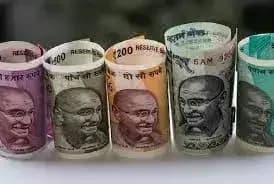
The Indian rupee fell to a fresh record low of 95.85 against the US dollar on Thursday, May 14, marking a 2 paise decline from Wednesday's close of 95.7050, as reported by ET Now. The currency witnessed significant volatility during intraday trading, touching an intra-day high of 95.61 and a record intraday low of 95.96 before settling at the provisional close. According to Finrex Treasury Advisors, the rupee could weaken further and approach the psychologically significant 100 mark against the US dollar within the next six months if external pressures persist. This represents the fifth consecutive session of successive plunges, with the rupee now becoming Asia's worst-performing currency this year, registering a loss of over 6 percent due to elevated crude oil prices, a strong dollar and West Asia crisis concerns.
Brent crude climbed 0.30 per cent to trade at USD 105.96 per barrel on Thursday, while US West Texas Intermediate (WTI) crude rose 0.23 per cent to USD 101.25, as reported by ET Now. Oil prices have remained highly volatile, with Brent climbing near a multi-year high of USD 126 a barrel on April 30, gaining nearly 7 percent intraday, and Brent crude surging over 27 per cent to trade at a multi-year high of USD 119 a barrel on March 9 amid escalating Middle East tensions. The West Asia crisis and blockade of the Strait of Hormuz have disrupted crude petroleum imports into India, with the sharp rise in crude prices making fuel imports costlier. According to Finrex Treasury Advisors, oil prices remaining higher means continuous buying of oil… continuous buying means inflows are lower and you will see rupee approaching 100 quite fast within six months if the Iran impasse continues.
India has significantly raised customs duties on gold, silver, and platinum imports to 15% and 15.4% respectively, as reported by The Economic Times. This move aims to conserve foreign exchange reserves and stabilise the external account amidst the West Asia conflict and global economic uncertainty. The government prioritises essential imports like crude oil and fertilisers while seeking to moderate non-essential imports and support macroeconomic stability. Gold jewellery stocks including Titan, Kalyan Jewellers and Senco Gold fell up to 14% in two sessions after PM Modi urged citizens to reduce gold purchases amid rising oil prices and FX pressures.
The Reserve Bank of India (RBI) likely sold dollars intermittently at 95.75/$ and 95.65/$ on Wednesday to arrest further decline, according to traders cited by The Economic Times. However, traders believe the central bank is not intervening as much in the currency market. The RBI's foreign exchange reserves have fallen to $690 billion as of 1 May, compared with $728 billion as of 27 February, before the US-Iran war started, according to RBI data. Finrex Treasury Advisors noted that policy intervention could slow or even reverse the rupee's slide, with potential measures including tweaking FII tax norms, reducing outward remittance limits under the Liberalised Remittance Scheme, and attracting fresh inflows through instruments like foreign bonds or NRI deposit schemes. Anil Bhansali from Finrex Treasury Advisors expects the rupee to trade with a negative bias amid inflation concerns and a strong dollar, with rising inflation in the US dimming expectations of a rate cut by the Fed.
Foreign Institutional Investors offloaded equities worth ₹4,703.15 crore on Wednesday, according to exchange data, as reported by NDTV Profit. On the domestic equity market front, Sensex jumped 789.74 points to settle at 75,398.72, while the Nifty climbed 277 points to 23,689.60. Analysts warned that persistently high oil prices could significantly expand India's current account deficit due to higher energy import costs. Nomura said additional policy measures may be announced in the coming weeks and months to curb imports and reduce pressure on the external account. The dollar index was trading at 98.51, down 0.01 per cent, while traders anticipate further volatility in the currency market. According to Finrex Treasury Advisors, India's main problem is that we are a capital-deficient country…we always require some sort of inflows, with heavy imports of oil and gold continuing to widen the trade deficit.