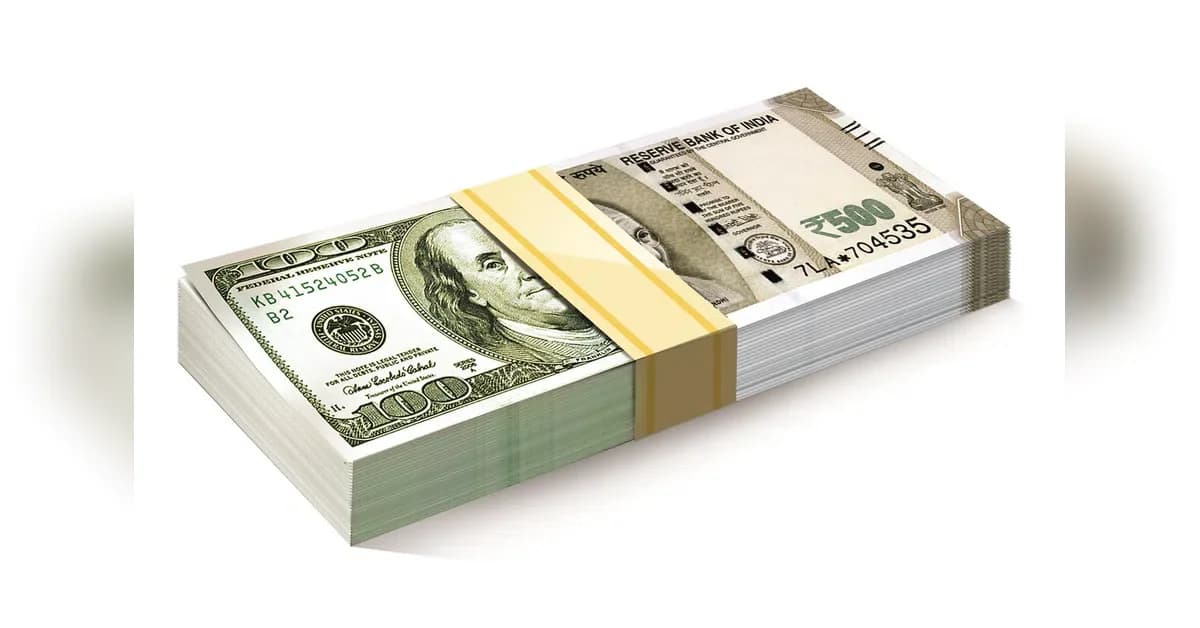
The Indian rupee has emerged as the worst-performing Asian currency in calendar year 2026, falling over 7% year-to-date amid surging crude oil prices and sustained foreign capital outflows. According to Business Standard, the domestic currency slipped to a fresh lifetime low of 96.14 against the US dollar on Friday, extending its losing streak for a fourth straight session as elevated crude oil prices, a stronger dollar, and rising geopolitical tensions in West Asia continued to pressure emerging market currencies. The rupee's decline is driven by a sharp jump in crude oil prices, driven by Middle East conflict, heavy foreign capital outflow, and increased safe-haven demand amid geopolitical uncertainties. A Mint poll of 10 banks, brokerages and economists showed the domestic currency may stay in the 96-98 per dollar range by the end of 2026. The dollar index rose to 99.30 against the previous day's 98.51, measuring the strength of the greenback against a basket of six major currencies, while Brent crude oil prices climbed to around $109 per barrel from the previous day's $105.50 per barrel amid escalating geopolitical tensions and uncertainty surrounding the Iran conflict.
According to a report by Emkay Global Financial Services, even after raising fuel prices and import duty on gold and silver, Indian government may need to consider a combination of monetary tightening, capital flow measures, direct currency intervention and restrictions on outward remittances to support the rupee, if crude oil prices remain elevated at $100-110 per barrel. As reported by Business Standard, markets are still underestimating the macroeconomic risks arising from persistently high oil prices, with the Nifty currently trading at 19.1x FY27 P/E. According to IndusInd Securities, the rupee's recent weakness is closely linked to rising geopolitical uncertainty in the Middle East and the sharp rise in crude oil prices, with Brent crude remaining elevated near $107 per barrel reflecting concerns over global energy supplies. VK Vijayakumar, Chief Investment Strategist at Geojit Investments, noted that if crude oil prices remain elevated for an extended period, the rupee will move to 100, with the other major drag being sustained selling by Foreign Portfolio Investors (FPIs) in the Indian market.
The government has already initiated defensive measures to contain pressure on the rupee and current account deficit. According to Emkay Global, on May 13, 2026, the Central government raised import duties on gold and silver from 6 per cent to 15 per cent, similar to a hike effected in July 2022 which dragged imports by 7-17 per cent in subsequent quarters. The government also announced a ₹3 per litre hike in petrol and diesel prices on May 15, with Emkay Global estimating that current fuel prices are leading to quarterly losses of ₹57,000-58,000 crore for oil marketing companies. Debopam Chaudhuri, Chief Economist at Piramal Group, pointed out that assuming international gold prices remain broadly in line with FY26 levels, the increase in gold import tariffs could potentially reduce India's import bill by nearly $2.5 billion during the year. However, Chaudhuri added that by itself, this may not be sufficient to meaningfully strengthen the USD/INR.
Another key step possible is an interest rate hike by the Reserve Bank of India, with Emkay saying a rate hike in the upcoming Monetary Policy Committee meeting appears "increasingly inevitable," with even a possibility of an inter-meeting action if oil prices remain elevated. However, Emkay Global cautioned that a rate hike would be an "imperfect defence" for the rupee as equity outflows could overwhelm debt inflows. The brokerage also suggested tighter restrictions under the Liberalised Remittance Scheme (LRS), noting that overseas remittances by Indians have grown sharply and now account for 174 per cent of the current account deficit. Madhavi Arora, Chief Economist for Emkay Global Financial Services, believes the import duty hike on gold and silver is one of the measures aimed at strengthening the rupee, but it is unlikely to be the only step, with several options being discussed in Delhi suggesting more measures could be introduced if required to support the currency. Manoranjan Sharma, Chief Economist at Infomerics Ratings, noted that while the government's decision to raise import duties on gold and silver aims to reduce imports and ease pressure on the Indian rupee, the currency's weakness stems more fundamentally from high crude oil prices and foreign capital outflows.
Despite the challenges, Emkay Global maintained that its base case remains a potential US-Iran agreement in the coming weeks, which could cool crude prices and reduce the need for aggressive policy intervention. According to Business Standard, the yield on the benchmark 10-year government bond also inched up by 4 basis points to settle at 7.06 per cent. Market participants said the Reserve Bank of India was likely intervening intermittently through state-run banks to smooth volatility in the currency market, although pressure on the rupee remains elevated due to the sharp rise in oil prices and sustained dollar demand from importers. The treasury head at a private bank noted that "Any intervention measure from the regulator or the government could provide temporary support to the rupee, but in the absence of fresh triggers, the currency may stabilise around the 96-96.25 per dollar levels. The risk of the rupee touching 100 per dollar cannot be ruled out entirely, though assigning a timeline to such a move would be speculative." Bond market participants said that the cut-off yield at the weekly government bond auction was higher than expected, which further pushed the benchmark yield higher, with the cut-off yield on the shorter-tenor bond being higher than expected, which also weighed on sentiment.